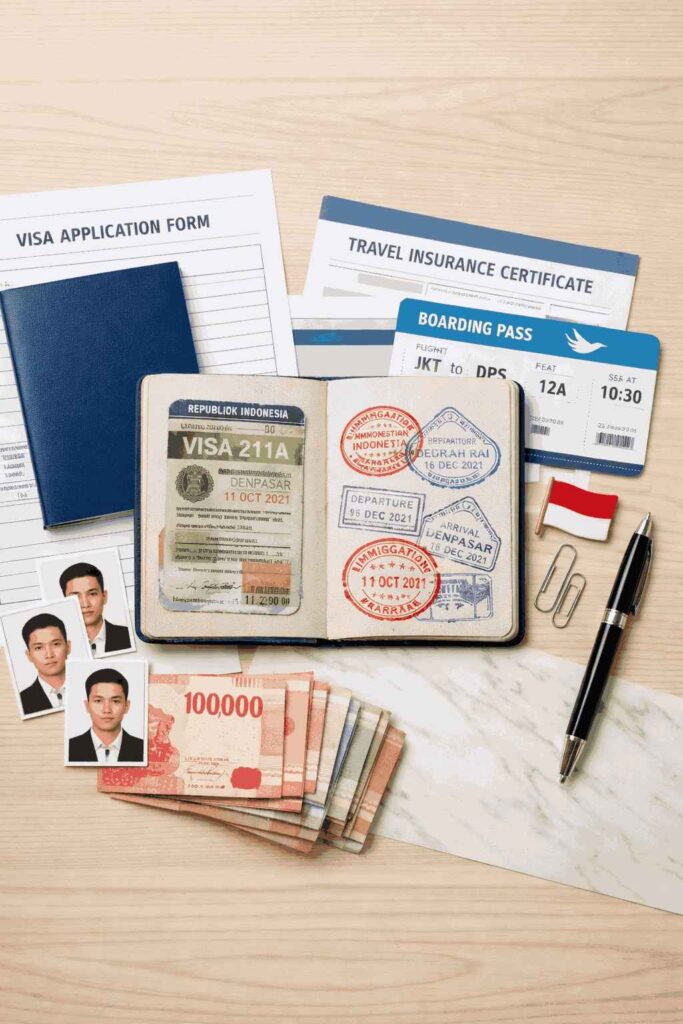
This comprehensive digital nomad visa guide for Indonesia addresses everything remote workers and freelancers need to navigate Indonesian immigration law legally in 2026. With Bali and Jakarta attracting thousands of location-independent professionals annually, understanding visa regulations has become critical. Indonesia offers three primary visa pathways for digital nomads: the 211A Visit Visa with extensions up to 180 days, the E33G Remote Worker KITAS for one-year stays, and the D-Type Multiple Entry Visit Visa for frequent travelers. Each option serves different needs, budgets, and work situations. This guide provides detailed requirements, costs, application processes, and legal restrictions for each visa type. Whether you plan a three-month trial or a multi-year stay working remotely in Indonesia, choosing the correct visa ensures legal compliance and prevents deportation, fines, or future entry bans.
Understanding Indonesia’s Visa Options for Digital Nomads
Indonesia’s immigration system provides several visa categories suitable for remote workers who earn foreign income while residing in the country. Digital nomads working in Bali and other Indonesian locations must select visas designed for non-employment purposes, as Indonesia prohibits foreigners from working for local companies or earning Indonesian income on these visa types.
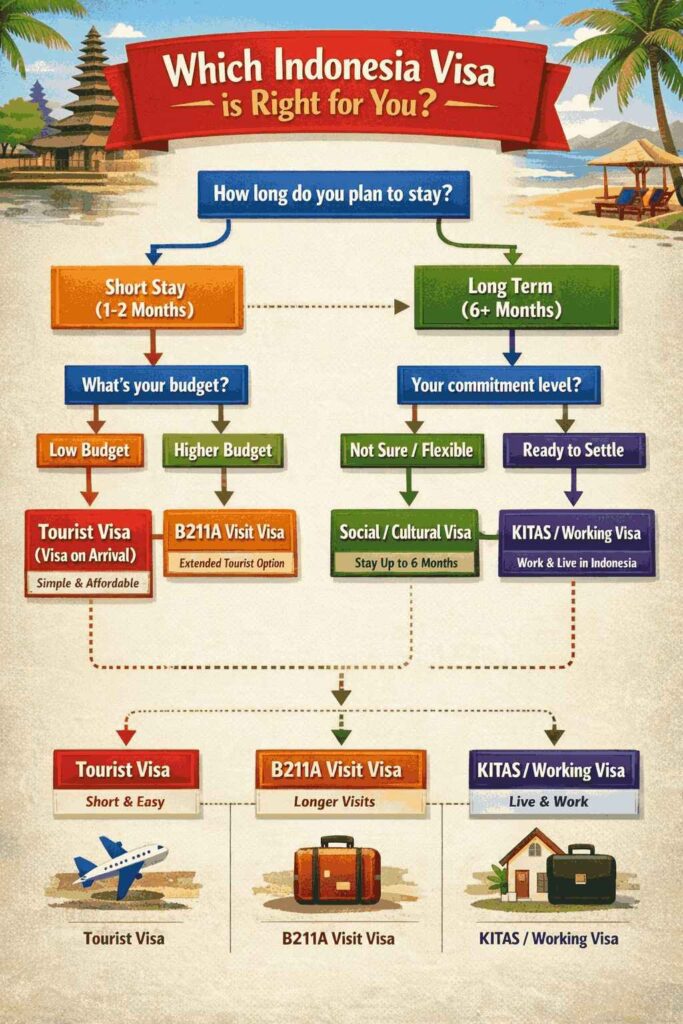
The three viable options are the 211A Visit Visa (C-Type), the E33G Remote Worker KITAS (Temporary Stay Permit), and the D-Type Multiple Entry Visit Visa. Each serves distinct situations based on stay duration, budget, and frequency of travel.
The fundamental legal requirement applies to all options: you cannot work for Indonesian clients, receive payment from Indonesian sources, or earn income in Indonesian rupiah. Your employment must remain with foreign companies or clients, with payments processed through foreign bank accounts. Violations carry serious consequences including deportation, substantial fines, immigration blacklisting, and potential criminal charges.
Working remotely in Indonesia means performing your job duties while physically present in the country but employed by entities outside Indonesia. You maintain foreign employment contracts, invoice international clients, and receive foreign currency payments. This distinction determines legal compliance under Indonesian immigration law.
Who Qualifies as a Digital Nomad in Indonesia?
Indonesian immigration authorities define digital nomads as foreign nationals who perform remote work for non-Indonesian employers or clients while temporarily residing in Indonesia. This includes employees of foreign companies, freelancers with international clients, business owners operating foreign-registered companies, and independent contractors serving overseas markets.
An Indonesia visa for freelancers requires demonstrating consistent foreign income, maintaining contracts or employment letters from foreign entities, and proving financial stability. You must show that your work activities generate no Indonesian-sourced revenue and involve no Indonesian business partnerships.
Eligible employment situations include:
- Employees working remotely for companies registered outside Indonesia
- Freelancers serving exclusively foreign clients
- Business owners managing foreign-registered companies
- Digital service providers (writers, designers, developers, consultants) with international client bases
- Online entrepreneurs earning through foreign platforms or marketplaces
Income and banking requirements:
- All payments must originate from foreign sources
- Funds must transfer through international bank accounts
- No Indonesian rupiah income permitted
- Minimum income thresholds apply for certain visa types (particularly E33G KITAS)
- Financial documentation must prove sustainable foreign income
Tax implications: Indonesia applies tax residency to individuals staying more than 183 days in a calendar year. Below this threshold, you typically maintain tax obligations only in your home country. Beyond 183 days, Indonesian tax residency may trigger, requiring consultation with international tax professionals. Regardless of tax status, you must never receive Indonesian-sourced income on visit visas or remote worker permits.
Option 1: The 211A Visit Visa (C-Type Visa)
What is the 211A Visit Visa Indonesia?
The 211A visit visa Indonesia represents the most popular choice for digital nomads planning stays up to six months. This C-Type Visit Visa provides initial 60-day validity with two possible 60-day extensions, allowing a maximum 180-day continuous stay.
Indonesia’s Directorate General of Immigration designed this visa for tourist, social, and limited business activities. While not explicitly created for remote work, it accommodates digital nomads who perform work for foreign employers while visiting Indonesia.
The 211A serves remote workers seeking flexibility without committing to long-term residency. It requires significantly less documentation than the E33G KITAS and costs considerably less for stays under six months.
Who should choose the 211A: First-time visitors testing Bali’s digital nomad lifestyle, remote workers on extended vacations combining work and leisure, freelancers with project-based timelines under six months, and individuals uncertain about long-term Indonesia plans.
Extension Process and Maximum Stay Duration
The 211A provides a strategic pathway to stay in Bali 6 months visa-compliant through its extension system. You receive an initial 60 days upon arrival, then apply for two consecutive 60-day extensions while remaining in Indonesia.
Extension timeline:
- Days 1-60: Initial visa validity
- Days 61-120: First extension (apply before day 60)
- Days 121-180: Second extension (apply before day 120)
You do not need to leave Indonesia during the extension process. Applications submit through immigration offices or registered visa agents approximately 7-14 days before your current validity expires.
Extension costs:
- Initial 211A visa: $110-$130 USD (varies by application location)
- First 60-day extension: $75-$90 USD
- Second 60-day extension: $75-$90 USD
- Total potential cost: $260-$310 USD for 180 days
Processing typically requires 3-5 business days per extension. You surrender your passport during processing, so plan accordingly for any identification needs.
211A Visa Application Requirements
Required documentation checklist:
- Passport with minimum 18 months validity from arrival date
- Minimum 3 blank visa pages
- Completed visa application form
- Recent passport-sized photographs (4×6 cm, white background, 2 copies)
- Proof of onward travel (return ticket or continuing journey ticket)
- Proof of accommodation (hotel booking or rental agreement for initial period)
- Travel insurance covering minimum $50,000 medical expenses
- Bank statements showing minimum $2,000 USD (some consulates require $2,000 per month of stay)
- Sponsor letter (if applicable, from Indonesian company or individual)
Application process:
- Apply through Indonesian embassy or consulate in your home country or current residence
- Submit complete documentation package
- Pay visa fee
- Processing requires 3-7 business days typically
- Receive visa stamp in passport
- Enter Indonesia within 90 days of visa issue date
- Activate visa upon arrival (60-day validity begins at entry)
Some nationalities can apply online through Indonesia’s e-Visa system, while others must apply in person at Indonesian diplomatic missions.
Pros and Cons of the 211A Visa
Advantages:
- Relatively straightforward application process
- Extendable up to 180 days without leaving Indonesia
- Lower cost compared to KITAS for stays under six months
- Flexible entry timing (90-day validity to enter)
- No employment verification required
- Suitable for testing long-term Indonesia feasibility
Disadvantages:
- Maximum 180-day stay limit (must leave after extensions)
- Extension costs add up
- Must restart entire process after 180 days with exit and re-entry
- Extensions require immigration office visits or agent coordination
- Passport surrender during extension processing
- No path to longer-term residency from this visa
- Some banks and rental contracts prefer KITAS holders
Best suited for: Digital nomads planning 3-6 month stays, first-time Indonesia visitors, remote workers combining extended vacation with work, individuals evaluating long-term relocation, and those with flexible travel schedules allowing departures every six months.
Option 2: The E33G Remote Worker KITAS
Understanding the Remote Worker Visa Indonesia
The remote worker visa Indonesia, officially designated as E33G, represents Indonesia’s purpose-built solution for location-independent professionals. This KITAS (Kartu Izin Tinggal Terbatas, or Temporary Stay Permit) grants one-year validity specifically for foreign nationals working remotely for non-Indonesian entities.
The KITAS remote worker visa acknowledges the growing digital nomad economy while maintaining strict boundaries around local employment. Unlike visit visas, the E33G explicitly recognizes your status as a remote worker, providing clearer legal standing for extended stays.
The E33G targets professionals committed to year-long or multi-year Indonesian residency. It requires substantial documentation proving legitimate remote work arrangements, financial stability, and professional credentials.
Ideal candidates include: Employees of multinational companies working remotely from Indonesia, established freelancers with documented client relationships, digital business owners managing foreign-registered companies, and remote workers planning stays exceeding six months.
E33G Remote Worker Visa Requirements
The digital nomad visa requirements Indonesia imposes for E33G KITAS significantly exceed those for visit visas, reflecting its longer validity and official remote worker recognition.
Required documentation:
- Passport with minimum 18 months validity
- Employment verification: Letter from employer on company letterhead confirming remote work arrangement, employment contract, or business registration documents if self-employed
- Proof of foreign business registration (for business owners)
- Minimum monthly income documentation: Bank statements showing consistent deposits of at least $1,500-$2,000 USD monthly for preceding 6 months
- Tax returns or financial statements demonstrating income stability
- Professional credentials: CV, educational certificates, professional licenses (if applicable)
- Health insurance covering minimum $50,000 medical expenses, valid throughout KITAS period
- Clean criminal background check from home country (apostilled or legalized)
- Proof of accommodation in Indonesia (lease agreement, property ownership, or hotel booking for initial period)
- Sponsor letter from Indonesian sponsor (typically provided by visa agent)
- Recent passport photographs (4×6 cm, red background, 6 copies)
- Copy of birth certificate (apostilled)
- Copy of marriage certificate if married (apostilled)
All foreign documents require Indonesian translation by sworn translator (penerjemah tersumpah). Apostille or embassy legalization applies to background checks, birth certificates, and marriage certificates under Hague Convention protocols.
Application Process for Remote Worker KITAS
The E33G application involves substantially more complexity than visit visas, typically requiring professional visa agent assistance.
Step-by-step procedure:
- Document preparation (4-6 weeks): Gather all required documents, obtain apostilles, arrange Indonesian translations
- Sponsor arrangement: Visa agent provides sponsor letter (required by Indonesian law for KITAS applications)
- Online application submission: Sponsor submits application through Indonesia’s Online Single Submission (OSS) system
- E-KITAS approval: Immigration reviews application, issues electronic approval (typically 7-14 business days)
- Payment of government fees: Pay KITAS issuance fees through designated bank
- Travel to Indonesia: Enter on special visa or convert from existing visa
- Immigration office visit: Complete biometric registration (photos, fingerprints, signature)
- KITAS card issuance: Receive physical KITAS card (typically 2-3 weeks after biometric registration)
- Multiple entry permit: Apply for MERP (Multiple Entry Re-entry Permit) to allow international travel while maintaining KITAS validity
Processing timeline: Complete process typically requires 8-12 weeks from initial application to KITAS receipt. Plan accordingly before current visa expires or intended travel date.
Costs breakdown:
- Government KITAS fee: $350-$400 USD
- Sponsor and agent fees: $800-$1,500 USD (varies significantly by agent)
- Translation services: $100-$300 USD
- Background check and apostille: $100-$200 USD
- Multiple entry permit (MERP): $100-$150 USD
- Health insurance: $500-$1,200 USD annually
- Total estimated cost: $1,950-$3,750 USD for first year
Benefits and Limitations of the E33G KITAS
Advantages:
- One full year of legal Indonesian residence
- Explicit recognition as remote worker (clearer legal status)
- Renewable annually for up to 5 years
- Multiple entry and exit with MERP
- Easier bank account opening
- Landlords and property owners prefer KITAS holders
- Potential pathway to ITAP (Permanent Stay Permit) after qualifying period
- No extension applications required during validity period
Disadvantages:
- Significantly higher cost than visit visas
- Complex application requiring extensive documentation
- Longer processing time
- Sponsor requirement (must use agent typically)
- Income threshold requirements
- Annual renewal process and costs
- Must maintain valid address registration
- Cancellation required when leaving Indonesia permanently
Renewal process: Annual renewal requires updated employment verification, financial statements, health insurance renewal, and sponsor coordination. Renewal costs approximately 60-70% of initial application expenses. You must begin renewal process 30-60 days before expiration.
The E33G can potentially lead to ITAP (permanent residence) after maintaining KITAS status for several years, though digital nomads typically don’t pursue this pathway due to lifestyle preferences for mobility.
Option 3: D-Type Multiple Entry Visit Visa
Multiple Entry Visa Bali Explained
The multiple entry visa Bali option, officially designated as D-Type Multiple Entry Visit Visa, suits digital nomads who prefer frequent international travel while maintaining Indonesian residence as a base.
This visa permits unlimited entries to Indonesia during its validity period, with each entry granting 60 days of stay. Unlike single-entry visas, you can exit and re-enter repeatedly without applying for new visas.
Validity periods offered:
- 6 months validity: Unlimited entries, 60 days per entry
- 1 year validity: Unlimited entries, 60 days per entry
- 2 years validity: Unlimited entries, 60 days per entry (less commonly issued)
Each entry’s 60-day period can be extended twice for additional 60 days each (similar to 211A), allowing 180-day continuous stays. After departing Indonesia, your extension count resets for subsequent entries.
Who Should Choose the Multiple Entry Visa?
The D-Type serves specific digital nomad profiles prioritizing travel flexibility over continuous long-term stays.
Ideal candidates:
- Digital nomads maintaining residences in multiple countries
- Remote workers with frequent business travel requirements
- Individuals who prefer “visa runs” to neighboring countries (Singapore, Malaysia, Thailand)
- Part-time Bali residents spending 2-4 months annually in Indonesia
- Travelers uncertain about continuous stay preferences
- Those who combine Southeast Asian country-hopping with regular Indonesia returns
Cost comparison: For stays totaling less than 4-5 months annually, the D-Type may cost less than repeated 211A applications. For continuous stays, the 211A or E33G provide better value.
Strategic usage: Some digital nomads combine D-Type with regional travel, spending 60-180 days in Indonesia, then exploring neighboring countries before re-entering Indonesia with a fresh 60-day entry.
Application Requirements and Process
Required documentation:
- Passport with minimum 18 months validity
- Minimum 3 blank visa pages
- Completed application form
- Passport photographs (4×6 cm, white background, 4 copies)
- Proof of sufficient funds (bank statements showing $2,000-$3,000 USD minimum)
- Travel itinerary or evidence of travel patterns
- Travel insurance covering medical expenses
- Sponsor letter (sometimes required depending on embassy)
- Proof of accommodation for initial stay
Application procedure:
- Apply at Indonesian embassy or consulate in your home country or country of residence
- Some locations require in-person application and interview
- Submit complete documentation package
- Pay visa fee based on validity period
- Processing requires 5-10 business days typically
- Receive visa stamp in passport showing validity period
Processing and costs:
- 6-month validity: $150-$200 USD
- 1-year validity: $250-$350 USD
- 2-year validity: $450-$600 USD (availability varies by nationality)
- Extension costs per entry: $75-$90 USD per 60-day extension (same as 211A)
Pros:
- Flexibility for frequent travelers
- No need to reapply for multiple trips
- Fresh extension opportunities each entry
- Suitable for non-linear travel plans
- Can combine with regional exploration
Cons:
- Higher upfront cost than single-entry visa
- Requires international travel to reset stays beyond 60-180 days
- Must plan trips to neighboring countries for continuous Indonesia residence
- Travel costs for visa runs add to overall expenses
- Extension requirements same as 211A for stays beyond 60 days per entry
Comparing All Digital Nomad Visa Options for Indonesia
| Feature | 211A Visit Visa | E33G Remote Worker KITAS | D-Type Multiple Entry |
|---|---|---|---|
| Maximum Single Stay | 180 days (with extensions) | 365 days | 180 days per entry (with extensions) |
| Total Validity Period | 60 days + extensions | 1 year (renewable) | 6 months to 2 years |
| Entry Permission | Single entry only | Multiple (with MERP) | Unlimited entries |
| Initial Cost | $110-$130 | $1,950-$3,750 | $150-$600 (validity dependent) |
| Extension Costs | $150-$180 (2 extensions) | None (annual renewal instead) | $150-$180 per entry |
| Total Cost (6 months) | $260-$310 | $1,950-$3,750 | $150-$380 + extensions |
| Application Complexity | Easy | Hard | Medium |
| Documentation Required | Basic | Extensive | Moderate |
| Processing Time | 3-7 days | 8-12 weeks | 5-10 days |
| Renewable | No (must reapply after exit) | Yes (annually) | No (must reapply) |
| Sponsor Required | Sometimes | Yes | Sometimes |
| Income Verification | Minimal | Strict ($1,500-$2,000/month) | Moderate |
| Best For | 3-6 month stays, first timers | 1+ year stays, established remote workers | Frequent travelers, multi-country nomads |
| Legal Recognition | Tourist/visit purposes | Official remote worker status | Tourist/visit purposes |
| Bank Account Opening | Difficult | Easier | Difficult |
When choosing your digital nomad visa Bali option, consider your intended stay duration first. For 3-6 month stays, the 211A provides the most straightforward and cost-effective solution. For full-year commitments, the E33G offers better value and clearer legal status despite higher upfront costs. For flexible, interrupted stays with regional travel, the D-Type delivers maximum flexibility.
Step-by-Step Application Guide for Digital Nomads
Successful visa applications require careful planning and document preparation. Begin your process well before intended travel dates.
Timeline recommendations:
- 3 months before travel: Research visa options, identify best fit for your situation, begin gathering documentation
- 2.5 months before: Obtain background checks, apostilles, and translations if pursuing E33G
- 2 months before: Submit visa application (E33G requires earlier start)
- 6 weeks before: Follow up on processing status, prepare for any additional document requests
- 2-4 weeks before: Receive visa approval or stamp
- Upon arrival: Activate visa at immigration checkpoint, begin planning extensions if applicable
Finding reputable visa agents versus DIY application:
Visit visas (211A and D-Type) can be self-applied through embassies or e-Visa systems, saving agent fees. The E33G KITAS practically requires agent assistance due to sponsor requirements and OSS system complexities.
Evaluating visa agents:
- Verify official business registration and immigration consultant licenses
- Check online reviews from multiple sources
- Confirm transparent pricing with written breakdowns
- Ask about processing timelines and success rates
- Assess communication responsiveness
- Request references from previous clients
- Avoid agents demanding full payment upfront without milestones
Red flags indicating problematic agents: Guaranteeing approval regardless of circumstances, unwillingness to explain processes, significantly below-market pricing, lack of online presence or reviews, pressure tactics for immediate payment, vague responses about requirements.
Document preparation checklist:
- Create digital copies of all documents before submission
- Verify passport validity exceeds visa requirements by 6+ months
- Obtain high-quality passport photographs meeting Indonesian specifications
- Organize financial documents chronologically
- Prepare cover letter explaining your remote work situation and Indonesia plans
- Double-check translation accuracy if using sworn translators
- Keep copies of all submitted materials for your records
Common mistakes to avoid:
- Applying too close to travel dates without buffer time
- Submitting incomplete document packages
- Providing inconsistent information across documents
- Using outdated photograph specifications
- Failing to verify passport blank page requirements
- Not obtaining proper apostilles or legalizations for documents requiring authentication
- Assuming all embassies have identical requirements (policies vary by location)
- Neglecting to confirm visa validity dates and entry deadlines
What to do if your application is rejected:
- Request specific rejection reasons from immigration authorities
- Address deficiencies in documentation or qualifications
- Consider alternative visa types if rejection relates to qualifications
- Reapply after correcting issues (usually possible immediately)
- Consult immigration lawyer for complex situations or repeated rejections
- Explore applying at different embassy locations if possible
Legal Requirements and Restrictions for Digital Nomads
Understanding legal boundaries prevents serious immigration violations. Indonesian law strictly prohibits certain activities on visit visas and remote worker permits.
Prohibited activities (these violations risk deportation, fines, and blacklisting):
- Cannot work for Indonesian companies: You cannot be employed by, contracted to, or provide services to Indonesian-registered businesses
- Cannot receive Indonesian rupiah payments: All income must originate from foreign sources in foreign currencies
- Cannot invoice Indonesian clients: Freelancers cannot serve Indonesian clients, even if paid in foreign currency through foreign entities
- Cannot engage in local employment: No teaching, consulting, freelancing, or service provision to Indonesian individuals or businesses
- Cannot establish Indonesian business operations: You cannot operate as Indonesian business owner on these visas
Tax obligations and considerations:
Indonesia implements a 183-day rule for tax residency. Individuals present in Indonesia for 183 days or more in a 12-month period may trigger Indonesian tax residency status, potentially creating tax obligations.
Below 183 days, you typically remain tax resident only in your home country, subject to your home nation’s laws regarding foreign-earned income. Many countries tax worldwide income regardless of residence location.
Beyond 183 days, consult international tax professionals about potential Indonesian tax filing requirements, double taxation treaties between Indonesia and your home country, and foreign tax credit opportunities.
Maintain detailed records of income sources, payment origins, client locations, and days spent in Indonesia for tax purposes.
Reporting requirements:
KITAS holders must maintain current address registration with local authorities. Address changes require updates through sponsor or immigration offices. Visit visa holders have fewer reporting obligations but must maintain valid addresses on immigration records.
Health insurance mandates:
All visa types increasingly require proof of health insurance covering minimum $50,000 medical expenses. This requirement appears in most embassy applications and KITAS processes. Insurance must provide coverage in Indonesia specifically.
Overstay penalties and consequences:
Overstaying your visa by even one day triggers serious consequences:
- Fines of IDR 1,000,000 (approximately $65 USD) per day
- Deportation at your expense
- Immigration detention pending deportation arrangements
- Blacklist from re-entering Indonesia for periods ranging from 6 months to permanent bans
- Difficulty obtaining visas for other countries due to deportation records
Never overstay your visa. If unable to extend or depart on time due to emergencies, immediately contact immigration authorities to arrange emergency extensions or proper exit procedures.
Costs Breakdown: Digital Nomad Visas in Indonesia
Budget planning requires understanding both direct visa costs and associated expenses.
211A Visit Visa Complete Costs
Initial application:
- Embassy visa fee: $110-$130 USD
- Optional agent fee: $50-$100 USD
- Passport photographs: $5-$10 USD
- Travel insurance (60 days): $50-$100 USD
- Subtotal: $165-$340 USD
First 60-day extension:
- Government extension fee: $75-$90 USD
- Optional agent fee: $30-$60 USD
- Subtotal: $105-$150 USD
Second 60-day extension:
- Government extension fee: $75-$90 USD
- Optional agent fee: $30-$60 USD
- Subtotal: $105-$150 USD
Total 211A cost (180 days): $375-$640 USD including all extensions and services
E33G Remote Worker KITAS Complete Costs
Initial application year:
- Government KITAS fee: $350-$400 USD
- Sponsor and agent fees: $800-$1,500 USD
- Document translation: $100-$300 USD
- Background check: $50-$100 USD
- Apostille services: $50-$100 USD
- Passport photographs: $10-$20 USD
- Travel insurance (12 months): $500-$1,200 USD
- Multiple entry permit (MERP): $100-$150 USD
- Local address registration: $20-$50 USD
- Total first year: $1,980-$3,820 USD
Annual renewal costs:
- Government renewal fee: $300-$350 USD
- Agent renewal fees: $400-$800 USD
- Updated translations: $50-$100 USD
- Insurance renewal: $500-$1,200 USD
- MERP renewal: $100-$150 USD
- Total renewal: $1,350-$2,600 USD annually
D-Type Multiple Entry Visa Complete Costs
6-month validity:
- Visa fee: $150-$200 USD
- Optional agent fee: $50-$100 USD
- Passport photographs: $5-$10 USD
- Travel insurance: $100-$200 USD
- Total: $305-$510 USD
1-year validity:
- Visa fee: $250-$350 USD
- Optional agent fee: $50-$100 USD
- Passport photographs: $5-$10 USD
- Travel insurance: $200-$400 USD
- Total: $505-$860 USD
Per-entry extension costs (if staying beyond 60 days):
- First extension: $75-$120 USD
- Second extension: $75-$120 USD
Additional Budget Considerations
- Emergency extension: $100-$200 USD if extending under special circumstances
- Document courier fees: $20-$50 USD for express processing
- Notary services: $10-$30 USD per document if required
- Visa photographs (Indonesian specs): $5-$15 USD
- Translation services (per page): $10-$25 USD
- Apostille per document: $25-$50 USD
- International background check: $50-$150 USD
Budget planning recommendations: Set aside 20-30% above estimated costs for unexpected fees, exchange rate fluctuations, or requirement changes. Maintain emergency funds for potential overstay fines or departure costs if visa complications arise.
Living in Bali as a Digital Nomad: Practical Considerations
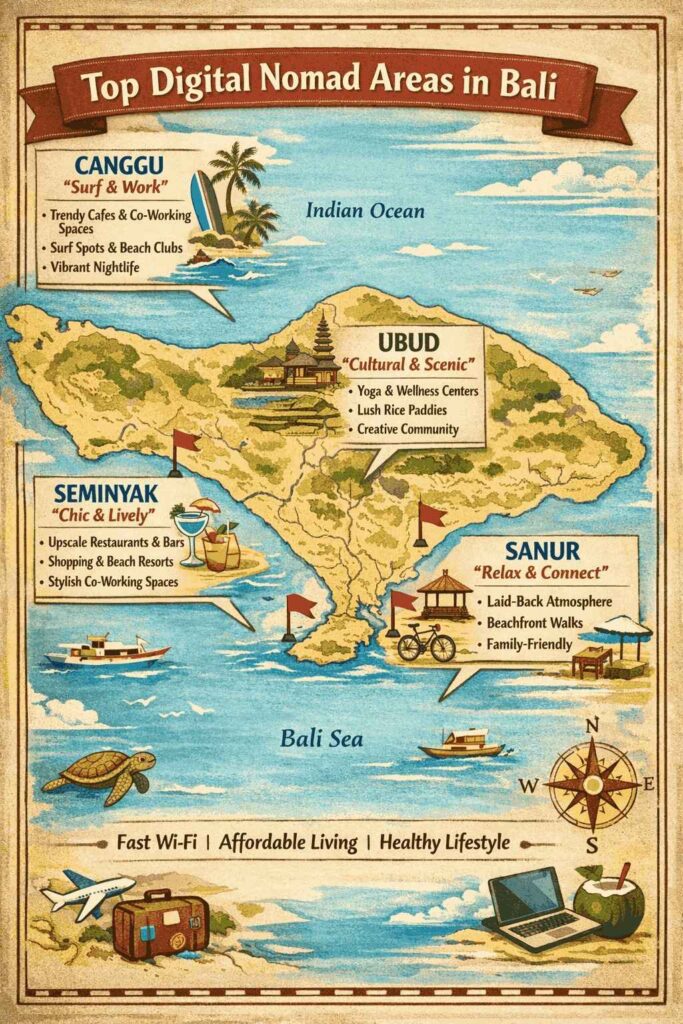
Beyond visa selection, successful digital nomad living requires understanding Bali’s infrastructure, costs, and community dynamics.
Best locations for digital nomads:
- Canggu: Hub for younger digital nomads, abundant coworking spaces, beach lifestyle, vibrant social scene, higher costs ($800-$1,500 monthly rent for good accommodation)
- Ubud: Cultural center, quieter atmosphere, lush surroundings, strong yoga and wellness community, moderate costs ($600-$1,200 monthly rent)
- Sanur: Family-friendly, relaxed beachfront, expat community, reliable infrastructure, moderate to high costs ($700-$1,400 monthly rent)
- Seminyak: Upscale area, sophisticated dining and shopping, professional atmosphere, highest costs ($1,000-$2,000+ monthly rent)
- Denpasar: Local Indonesian city, rare tourist areas, lowest costs, immersive cultural experience, limited coworking infrastructure
Coworking spaces and internet reliability:
Bali offers dozens of coworking spaces with strong WiFi, air conditioning, and professional environments. Popular options include Dojo Bali (Canggu), Outpost (multiple locations), Tropical Nomad (Canggu), and Hubud (Ubud). Memberships range from $5-$15 USD per day to $100-$200 USD monthly.
Internet reliability varies significantly. Canggu, Ubud, and Seminyak generally provide good connectivity (10-50 Mbps typical). Always verify internet speed before committing to accommodation. Many digital nomads maintain mobile data backup connections through Telkomsel or Indosat providers.
Cost of living estimates (monthly):
- Budget lifestyle: $800-$1,200 USD (basic accommodation, local food, minimal activities)
- Comfortable lifestyle: $1,500-$2,500 USD (good accommodation, mixed dining, regular activities)
- Luxury lifestyle: $3,000-$5,000+ USD (premium accommodation, international dining, extensive activities)
Breakdown includes accommodation, food, transportation, coworking, entertainment, and basic expenses but excludes visa costs, travel, and insurance.
Banking and money management:
Opening Indonesian bank accounts on visit visas proves extremely difficult. KITAS holders can open local accounts more easily. Most digital nomads rely on international banks, multi-currency accounts (Wise, Revolut), and ATM withdrawals. Bring multiple cards as backups. ATM withdrawal limits typically cap at IDR 3,000,000 ($190 USD) per transaction with fees of IDR 50,000-70,000 ($3-$4.50 USD).
Healthcare and insurance options:
Bali offers quality private hospitals including BIMC (multiple locations), Siloam Hospitals, and numerous private clinics. Healthcare costs significantly below Western countries. Comprehensive travel insurance or expat health insurance essential. International providers include SafetyWing, World Nomads, Cigna Global, and Allianz.
Community and networking opportunities:
Bali’s digital nomad community hosts regular meetups, networking events, skill-shares, and social gatherings. Facebook groups (Digital Nomads Bali, Canggu Community), coworking events, and Meetup.com provide connection opportunities. The community tends toward collaborative rather than competitive, with experienced nomads helping newcomers navigate visa, accommodation, and lifestyle challenges.
Should I stay in Canggu, Seminyak, or Uluwatu?
Expert Tips for a Smooth Visa Application
After assisting hundreds of digital nomads with Indonesian visa applications, certain strategies consistently produce successful outcomes.
Start early: Begin your visa process 2-3 months before intended travel, particularly for E33G KITAS. Delays occur frequently, and rushing increases error likelihood. Early starts provide buffer time for additional document requests or processing delays.
Use reputable agents for complex applications: While visit visas can be self-applied, E33G KITAS applications benefit enormously from experienced agents who understand current requirements, maintain sponsor relationships, and navigate OSS system complexities. The agent fee often proves worthwhile for time saved and stress reduced.
Organize meticulously: Create both digital and physical organized files with clearly labeled documents. Use folders or binders with tabs separating document categories. Disorganization causes delays when agents or officials request specific documents quickly.
Maintain continuous proof of foreign employment: Keep employment letters updated with recent dates, maintain regular email correspondence with employers or clients showing ongoing relationships, preserve payment receipts showing foreign-source income, and document contracts or client agreements comprehensively.
Keep financial records transparent and consistent: Bank statements should show steady income deposits, avoid large unexplained transactions near application times, maintain minimum balances above stated requirements, and demonstrate financial patterns supporting stated income levels.
Have backup plans: If processing delays, have contingency accommodation arrangements. If rejection occurs, know alternative visa options. If documents need replacing, know how to obtain duplicates. If entry dates shift, understand visa validity implications.
Stay informed on policy changes: Indonesian immigration policies evolve. Follow reputable expat Facebook groups, subscribe to visa agent newsletters, check Indonesian embassy websites periodically, and consult immigration forums for current experiences. Policies can shift between application planning and submission.
Photograph everything: Before submitting passport or documents, photograph or scan every page. If issues arise, you possess records proving what you submitted. This proves invaluable if documents are lost or questions emerge about submission contents.
Confirm specifications precisely: Passport photo requirements (size, background color, quantity) vary between visa types and embassies. Verify current specs before obtaining photos. Using incorrect specifications causes rejections even when all other documents are perfect.
Build relationships with agents: If using visa agents, establish good communication patterns, respond promptly to requests, show appreciation for their efforts, and maintain the relationship for renewals. Good agent relationships smooth extensions and renewals significantly.
Common Mistakes Digital Nomads Make with Indonesia Visas

Learning from others’ errors prevents repeating expensive mistakes.
Arriving on tourist visa and overstaying: The Visa on Arrival (VOA) provides only 30 days with one 30-day extension possibility (60 days maximum). Many digital nomads arrive on VOA thinking they’ll “figure it out,” then face overstay penalties when they cannot obtain longer visas without leaving Indonesia. Apply for proper visas before arrival.
Working for Indonesian clients: The clearest violation involves serving Indonesian customers, clients, or companies. Even if paid in foreign currency through foreign payment platforms, working for Indonesian entities violates visa restrictions. This includes freelance projects for Indonesian businesses, consulting for Indonesian companies, teaching English to Indonesian students (without proper work permits), and providing any services to Indonesian end-users or businesses.
Receiving payment in Indonesia: Accepting cash payments in Indonesia, having Indonesian clients transfer rupiah to your account, or receiving any Indonesian-sourced payments violates visa terms. All compensation must originate from foreign accounts in foreign currencies.
Not maintaining proper documentation: Failing to keep employment letters updated, letting bank statements lapse, not renewing insurance before expiration, and losing track of visa validity dates create problems during extensions or renewals. Maintain organized, current documentation continuously.
Assuming Visa on Arrival is sufficient: The 30-day VOA serves only short tourist visits. Digital nomads planning extended stays need pre-arranged visit visas or KITAS. VOA cannot convert to longer visa types without exiting Indonesia first.
Failing to extend on time: Extensions must apply before current validity expires. Missing deadlines by even one day triggers overstay status with associated penalties. Set reminders for 14 days before expiration to begin extension processes.
Not understanding tax implications: Exceeding 183 days in Indonesia during a calendar year may trigger tax residency. Many digital nomads inadvertently create tax obligations by not tracking days accurately. Maintain careful records of entry and exit dates.
Teaching English or consulting locally: Many digital nomads assume casual English teaching or business consulting is acceptable. These activities require work permits (KITAS with specific work authorization) separate from remote worker permits. Teaching or consulting for Indonesian clients or students violates visit visa and remote worker KITAS restrictions.
Misrepresenting purpose at immigration: Stating you’re “working” when entering Indonesia on visit visa causes problems. State you’re visiting for tourism or social purposes. Your remote work for foreign employers is not Indonesian employment, but immigration officers may not distinguish this clearly if you mention “work.”
Future of Digital Nomad Visas in Indonesia
Indonesia’s approach to digital nomad visas continues evolving as authorities balance economic benefits against regulatory concerns.
Recent policy developments (2024-2026): Indonesia introduced the E33G Remote Worker KITAS in 2024, representing the government’s first explicit recognition of remote workers as a distinct visa category. This signals growing acceptance of digital nomad economics and Indonesia’s desire to compete with Thailand, Portugal, and other popular nomad destinations.
The implementation has progressed slowly with varying interpretations across immigration offices. Some regions process E33G applications smoothly while others remain unfamiliar with requirements. This inconsistency should improve as the program matures.
Potential new visa categories: Discussion exists around creating intermediate visa options between the 180-day maximum visit visa and one-year KITAS. Proposals include a dedicated “Digital Nomad Visa” similar to Thailand’s model, with simplified application requirements and 6-9 month validity. Extended stay visas (270-365 days) with simpler documentation requirements may also emerge.
Government stance on digital nomads: Indonesian officials increasingly view digital nomads positively as contributors to local economies without displacing Indonesian workers. Bali’s provincial government particularly welcomes remote workers who bring foreign income while respecting local culture and regulations. The national government continues developing policies attracting high-quality remote workers while preventing visa abuse.
Expected changes and updates: Anticipate streamlined application processes as immigration offices gain E33G experience, potentially reduced income requirements making visas accessible to more remote workers, clearer tax guidance for remote workers, possible expansion of visa validity periods, and enhanced online application systems.
How to stay informed: Follow official Directorate General of Immigration announcements at www.imigrasi.go.id, join active expat Facebook groups like “Digital Nomads Bali” and “Bali Expats,” subscribe to established visa agent newsletters, consult Indonesian embassies for current policies, and follow reputable expat news sources covering Indonesia.
Policy changes can occur with limited notice. Always verify current requirements with official sources or licensed agents when planning applications.

The best visa for digital nomads in Bali depends on stay duration. The 211A Visit Visa suits 3-6 month stays with extensions to 180 days ($260-$310 total). The E33G Remote Worker KITAS provides one-year validity for serious commitments ($1,950-$3,750 first year). The D-Type Multiple Entry Visa serves frequent travelers with unlimited entries during 6-month to 2-year validity periods.
Real Scenario Examples
Case Study 1: Sarah – Freelance Graphic Designer
Sarah, a 28-year-old freelance graphic designer from Canada, chose the 211A Visit Visa for her first Bali experience. She wanted to test whether the digital nomad lifestyle suited her before committing to long-term stays. With clients in the US and UK paying through PayPal and Wise, she met remote work requirements easily. Sarah applied through the Indonesian embassy in Vancouver, received approval in 5 days, and paid $120 USD. After 60 days in Canggu, she extended twice through a local agent (total extensions: $180 USD), completing six months legally. The 211A’s flexibility allowed her to evaluate Bali without major financial commitment before deciding whether to pursue E33G KITAS for year two.
Case Study 2: Tom – Software Developer for US Company
Tom, a 35-year-old software developer employed by a San Francisco tech company, applied for the E33G Remote Worker KITAS for his planned multi-year Bali relocation. His company provided an employment letter confirming remote work authorization, and his $6,000 monthly salary far exceeded income requirements. Tom engaged a reputable Bali visa agent who handled the complex application process including sponsor arrangements, OSS system submission, and document translations. Total first-year cost reached $2,800 USD, but the one-year validity and official remote worker status justified the investment. Tom successfully opened an Indonesian bank account with his KITAS, signed a year-long villa lease in Ubud, and renewed annually for three consecutive years while working remotely for his US employer.
Case Study 3: Lisa – Part-Time Bali Resident
Lisa, a 42-year-old online business owner from Australia, uses the D-Type Multiple Entry Visa with one-year validity ($280 USD). She splits her time between Australia and Bali, making 4-5 trips annually spending 2-3 months per visit. The Multiple Entry Visa eliminates repeated visa applications for each trip. Lisa enters Bali, stays 60-120 days (extending when needed), returns to Australia for several weeks, then re-enters with fresh 60-day validity. This pattern suits her lifestyle better than continuous stay options. Over three years, Lisa has renewed her Multiple Entry Visa twice, maintaining her flexible bi-continental lifestyle while managing her e-commerce business serving Australian customers from wherever she’s located.
Visa Agent Evaluation Criteria
Choosing the right visa agent significantly impacts application success and experience quality. Use these evaluation criteria when selecting assistance.
Licensing and Registration:
- Verify agent maintains official Indonesian business registration
- Confirm immigration consultant licensing if claimed
- Check agent operates legally in their jurisdiction
- Request proof of credentials and authorizations
- Avoid agents unwilling to provide business registration details
Reviews and Reputation:
- Search multiple review platforms (Google, Facebook, TripAdvisor)
- Look for consistent positive feedback over time
- Read both positive and negative reviews for balanced perspective
- Check expat forums and Facebook groups for agent recommendations
- Ask for client references you can contact directly
- Be wary of only having 5-star reviews (may be fake)
Cost Transparency:
- Request itemized cost breakdown before engaging
- Understand which fees go to government versus agent
- Confirm whether quotes are all-inclusive or have hidden charges
- Compare pricing across multiple agents
- Be cautious of significantly below-market pricing (may indicate inexperience or fraud)
- Get pricing commitments in writing
Communication Quality:
- Assess responsiveness to initial inquiries
- Evaluate clarity of explanations about processes and requirements
- Determine availability during your timezone
- Confirm preferred communication channels (email, WhatsApp, phone)
- Test knowledge by asking specific immigration questions
- Red flag: Vague responses or inability to explain processes clearly
Success Rates:
- Ask about approval percentages for your visa type
- Inquire about experience with your nationality
- Request information about similar cases handled
- Be skeptical of 100% success guarantees (no agent can guarantee approval)
- Ask how they handle rejections or complications
Process Transparency:
- Agent should explain each application step clearly
- You should receive copies of all documents submitted
- Agent should provide realistic timelines
- Red flag: Reluctance to share process details or document copies
- Good agents keep you informed throughout processing
Warning Signs to Avoid:
- Requesting full payment before beginning work
- Guaranteeing approval regardless of circumstances
- Providing conflicting information about requirements
- Lacking physical office or official business presence
- Pressuring immediate decisions without time to consider
- Unwillingness to answer questions about their service
- No written contracts or service agreements
- Asking you to provide false information on applications
- Significantly cheaper than all competitors without explanation
Questions to Ask Potential Agents:
- How long have you been processing Indonesian visas?
- How many [specific visa type] applications have you completed?
- What is your approval rate for my nationality?
- What is your fee structure, and what does it include?
- What documents will you need from me?
- What is the realistic processing timeline?
- How will you communicate updates during processing?
- What happens if my application is rejected?
- Can you provide references from recent clients?
- Are you licensed as an immigration consultant?
Recommended Agent Relationship Practices:
- Maintain copies of all documents you provide
- Keep records of all communications and payments
- Request regular status updates
- Ask questions when processes seem unclear
- Provide accurate information, never falsify documents
- Respond promptly to agent requests for additional information
- Maintain professional courtesy throughout the process
Professional visa agents provide valuable services navigating complex immigration systems, but careful agent selection protects you from fraud, delays, and poor outcomes.
Extension Process Details (211A)
Understanding the extension process helps you plan and execute 211A extensions successfully while remaining in Indonesia.
When to Apply:
- Submit extension applications 7-14 days before current validity expires
- Earlier applications (14 days before) provide buffer for complications
- Late applications risk processing delays causing overstay
- Immigration offices may refuse extensions submitted too early (more than 14 days before expiration)
- Never wait until expiration day, processing requires several days
Required Documents for First Extension:
- Original passport (surrendered during processing)
- Copy of passport bio page
- Copy of current visa stamp or sticker
- Copy of entry stamp
- Copy of sponsor letter (if used for initial visa)
- Recent passport photograph (4×6 cm, white background, 2 copies)
- Extension application form (provided by immigration office or agent)
- Extension fee payment receipt
Required Documents for Second Extension:
- Same documents as first extension
- Copy of first extension approval
- Updated passport photographs
- Updated sponsor letter if required
Processing Timeline:
- Day 1: Submit extension application and documents
- Day 1: Surrender passport to immigration
- Days 2-4: Processing and approval
- Day 3-5: Collect extended passport
Actual timeline varies by immigration office workload and location. Denpasar immigration offices typically process faster than smaller regional offices. Use agents to expedite if needed.
Extension Costs:
- Government extension fee: IDR 1,100,000-1,400,000 (approximately $70-$90 USD)
- Agent fee (if using): IDR 500,000-900,000 (approximately $30-$60 USD)
- Photos: IDR 50,000-100,000 (approximately $3-$6 USD)
- Transportation to immigration office: IDR 50,000-200,000 if self-applying
Whether You Can Travel During Extension Processing:
No, you cannot travel domestically or internationally during extension processing because immigration retains your passport. Plan accordingly:
- Schedule extensions during periods when you don’t need passport identification
- Avoid booking flights during processing periods
- Keep digital passport copies for accommodation check-ins
- Some hotels accept expired passport copies plus receipt showing extension in process
Self-Application vs. Agent Use:
Self-application advantages:
- Saves agent fees ($30-$60 per extension)
- Direct interaction with immigration officers
- Learn process for future extensions
Self-application disadvantages:
- Requires transportation to immigration office
- Potential language barriers
- Longer wait times
- Must navigate bureaucracy yourself
- Time commitment (typically 1-2 hours at office)
Agent advantages:
- Convenience, no immigration office visit
- Faster processing possible
- Language assistance
- Handles paperwork correctly
- Picks up and returns passport
Agent disadvantages:
- Additional cost ($30-$60)
- Requires trusting agent with passport
- Less direct process understanding
Common Extension Problems:
- Insufficient photos: Bring extras meeting exact specifications
- Incorrect photo specifications: Verify current requirements (background color changes occasionally)
- Missing document copies: Bring extra copies of all passport pages
- Application too early: Immigration may refuse and tell you to return later
- Application too late: Risks overstay if processing extends beyond expiration
- Address changes: Inform immigration if you moved since initial entry
- Lost immigration card: Report loss and obtain replacement before extension application
Extension Rejection:
Extensions are rarely rejected if documents are complete and submitted on time. Possible rejection reasons include:
- Incomplete documentation
- Suspicious financial activity or insufficient funds
- Previous immigration violations
- Invalid passport (insufficient validity or blank pages)
- Suspected work for Indonesian clients
- Security concerns or criminal background
If rejected, you must immediately arrange departure from Indonesia before visa expiration to avoid overstay penalties. Rejections usually allow time to exit legally.
Tips for Smooth Extensions:
- Apply exactly 10-14 days before expiration for optimal timing
- Triple-check photo specifications with immigration office or agent
- Bring extra document copies beyond requirements
- Keep all original documents organized in folder
- Verify current extension fees before applying
- Save immigration office receipt showing application submission
- Keep immigration officer contact information for follow-up
- Maintain proof of accommodation throughout stay
- Have return flight booking ready if asked (refundable ticket acceptable)
Bali Immigration Office Locations:
- Denpasar Immigration Office: Jl. Raya Tuban, Kuta, handles most extensions
- Singaraja Immigration Office: North Bali, for those staying northern regions
- Ngurah Rai Airport Immigration: Arrival processing only, not extensions
Most digital nomads use Denpasar office or agents who interface with this office.
Tax Implications Section
Understanding Indonesian tax obligations prevents unexpected liabilities and ensures home country compliance.
Indonesian Tax Residency Rules:
Indonesia determines tax residency using the 183-day rule. You become an Indonesian tax resident if you spend 183 days or more in Indonesia during a 12-month period, OR if you are present in Indonesia with the intention of residing permanently.
Tax Residency Triggers:
- Physical presence for 183+ days in any 12-month period
- Establishing permanent residence in Indonesia
- Maintaining primary dwelling in Indonesia
- Having center of economic interests in Indonesia
Most digital nomads on visit visas staying under 183 days avoid Indonesian tax residency. Those on E33G KITAS exceeding 183 days typically become Indonesian tax residents for that year.
Tax Obligations for Non-Residents (Under 183 Days):
If you remain below 183 days in Indonesia during any 12-month period:
- Generally no Indonesian tax filing requirements
- No Indonesian income tax on foreign-sourced income
- Home country tax obligations continue normally
- Must pay taxes in country of citizenship/residence as required
- US citizens must file US tax returns regardless of residence location
- Other nationalities should verify home country requirements
Tax Obligations for Residents (183+ Days):
If you exceed 183 days in Indonesia:
- May become Indonesian tax resident
- Potentially subject to Indonesian income tax on worldwide income
- Required to obtain Indonesian Tax Number (NPWP)
- May need to file annual Indonesian tax returns
- Tax rates range from 5% to 35% on progressive income brackets
- Double taxation treaties may prevent paying taxes in both countries
Double Taxation Treaties:
Indonesia maintains tax treaties with over 70 countries preventing double taxation. These treaties typically allow tax credits for foreign taxes paid, ensuring you don’t pay full tax in both countries on the same income.
Countries with Indonesian tax treaties include United States, United Kingdom, Australia, Canada, Germany, France, Netherlands, Singapore, and many others. Verify whether your country has a treaty and understand its provisions.
Practical Tax Guidance for Digital Nomads:
- Track your days meticulously: Maintain spreadsheet with entry/exit dates and daily location records
- Stay under 183 days to avoid complexity: Plan departures ensuring you don’t exceed threshold
- Consult international tax professionals: If approaching or exceeding 183 days, get professional tax advice before year-end
- Maintain separate financial records: Keep clear records distinguishing foreign income from any Indonesian expenses
- Never receive Indonesian income: This creates immediate Indonesian tax obligations regardless of residency status
- File home country taxes properly: Remote work abroad doesn’t exempt you from home country obligations
- Understand foreign earned income exclusions: US citizens can exclude up to $120,000 (2024) of foreign earned income if qualifying
- Keep evidence of non-residence: Maintain home country address, bank accounts, and ties demonstrating primary residence elsewhere
When to Consult Tax Professionals:
- Planning to exceed 183 days in Indonesia
- Earning substantial income (over $100,000 annually)
- Operating business with complex international structure
- Receiving income from multiple countries
- Uncertain about treaty provisions
- Facing tax audits in any jurisdiction
- Considering permanent Indonesian residence
Record-Keeping Recommendations:
- Passport copies showing all entry and exit stamps
- Flight and accommodation bookings proving location
- Bank statements showing income sources and amounts
- Contracts or employment letters showing foreign employer relationships
- Calendar tracking daily location (simple spreadsheet sufficient)
- Receipts for major expenses by country
- Tax returns filed in all relevant jurisdictions
Indonesian Tax Authority Resources:
- Directorate General of Taxes: www.pajak.go.id
- Tax treaties: Available on DGT website
- NPWP application: Through local tax office if required
Common Tax Mistakes:
- Assuming no tax obligations exist because you’re “traveling”
- Not filing home country taxes while abroad
- Exceeding 183 days without realizing tax implications
- Failing to track days accurately
- Not consulting professionals when situations become complex
- Mixing business and personal finances without clear records
Tax compliance protects you from penalties, audits, and legal complications in multiple jurisdictions. When in doubt, consult qualified international tax accountants familiar with both Indonesian and your home country tax law.
Advanced Visa Strategies for Long-Term Digital Nomads
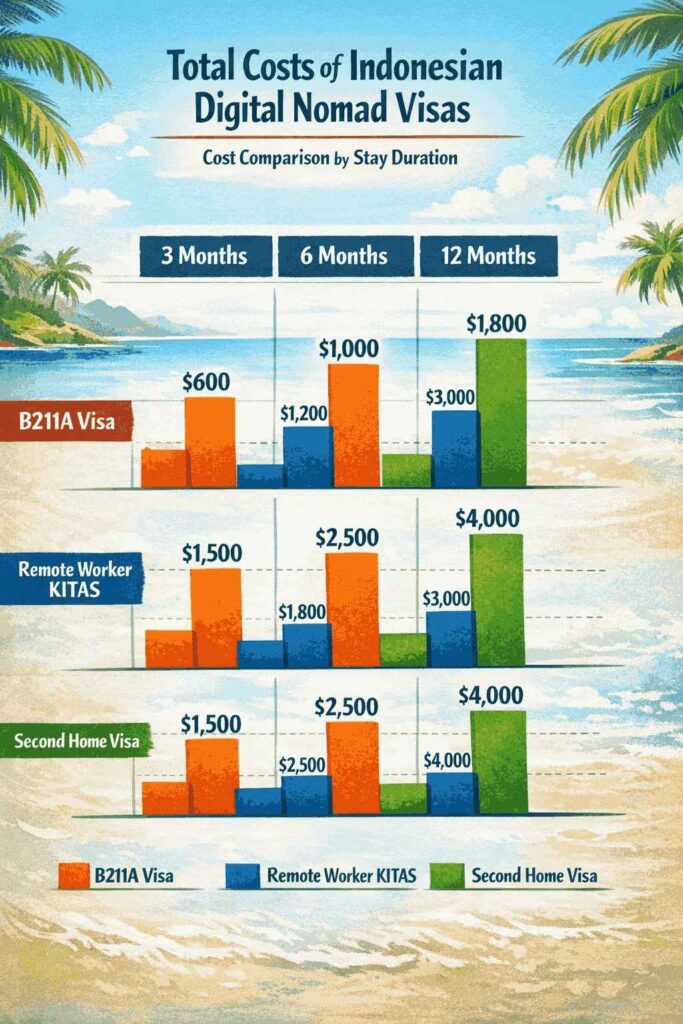
Experienced digital nomads develop sophisticated visa strategies optimizing cost, legal compliance, and lifestyle flexibility over multi-year periods.
Strategy 1: The 211A Rotation System
Use consecutive 211A visas with brief exits between six-month periods. Many digital nomads follow this pattern:
- Months 1-6: Enter on 211A, extend twice, stay 180 days
- Exit to Singapore, Malaysia, or Thailand for 1-2 weeks
- Months 7-12: Re-enter on new 211A, extend twice, stay 180 days
- Repeat cycle indefinitely
Advantages: Lower annual cost than E33G ($520-$640 vs. $1,950+), simpler applications, built-in travel breaks, stays under 183-day tax threshold per calendar year with timing.
Disadvantages: Requires planning exits every six months, cannot maintain uninterrupted Indonesia residence, risks policy changes, some uncertainty with repeated visa applications.
Strategy 2: E33G for Stability
Commit to E33G KITAS for serious long-term Indonesia presence:
- Year 1: Apply for E33G, settle into community
- Years 2-5: Renew annually at lower cost
- Develop deeper Indonesia connections and infrastructure
Advantages: Legal certainty, easier banking and contracts, no six-month departures required, clear remote worker status, potential permanent residence pathway.
Disadvantages: Higher cost, complex application, annual renewal requirements, less flexibility for spontaneous departures.
Strategy 3: The Hybrid Approach
Test with 211A, transition to E33G if committing long-term:
- Year 1: Use 211A to test Bali lifestyle (can do two cycles with exits)
- Year 2+: Apply for E33G if staying, or continue 211A rotation if preferring flexibility
This minimizes upfront commitment while allowing smooth transition to stability.
Strategy 4: Multiple Entry for Flexible Nomads
For digital nomads maintaining bases in multiple countries:
- Obtain 1-year D-Type Multiple Entry
- Make 3-5 trips to Indonesia annually
- Stay 60-120 days per trip
- Maintain residences elsewhere between visits
Perfect for those splitting time between Indonesia and home country or exploring multiple Southeast Asian locations.
Geographic Diversification:
Advanced nomads maintain visa options across multiple countries, never depending solely on one location:
- Indonesia: Primary base (E33G or 211A)
- Thailand: Elite Visa or DTV for backup
- Malaysia: MM2H visa for regional alternative
- Portugal: D7 visa for European access
- Mexico: Temporary residence for Americas option
This diversification protects against policy changes, personal circumstances, or Indonesia-specific complications.
Timing Considerations:
- Calendar year tax planning: Structure stays avoiding 183 days in any calendar year in any single country
- Visa application timing: Apply for renewals during low-season (May-August) when immigration offices less crowded
- Extension timing: Schedule extensions avoiding high season (July-August, December-January) for faster processing
- Exit planning: Book departures during low-cost flight periods
Financial Optimization:
- Pay visa fees using credit cards with travel benefits when possible
- Time applications to consolidate agent fees across multiple people if traveling with partners
- Compare agent pricing across multiple providers for renewals
- Build relationships with agents for potential discounts on repeat business
- Factor visa costs into location-independent budgeting from the beginning
Relationship Building:
- Establish relationships with reliable visa agents for seamless renewals
- Connect with local expat communities for visa intelligence and updates
- Maintain good standing with immigration through proper compliance
- Keep detailed records of all applications for reference in future submissions
- Develop backup agent contacts in case primary agent becomes unavailable
Monitoring Policy Changes:
- Join active expat Facebook groups for real-time policy updates
- Subscribe to multiple visa agent newsletters
- Follow immigration law blogs and news sources
- Set Google Alerts for “Indonesia visa” and “Indonesia immigration”
- Maintain embassy newsletter subscriptions
- Check official immigration website quarterly for policy announcements
Exit Strategy Planning:
Always maintain exit strategies if Indonesian visa options become untenable:
- Backup country visas in application-ready state
- Sufficient funds for rapid relocation
- Digital business infrastructure allowing work from anywhere
- International health insurance covering multiple countries
- Stored belongings in minimal volume for easy movement
- No long-term financial commitments (avoid multi-year leases)
Multi-Year Cost Comparison:
211A Rotation (3 years):
- Year 1: $520-$640 (2 cycles)
- Year 2: $520-$640 (2 cycles)
- Year 3: $520-$640 (2 cycles)
- Total: $1,560-$1,920
E33G KITAS (3 years):
- Year 1: $1,950-$3,750 (initial application)
- Year 2: $1,350-$2,600 (renewal)
- Year 3: $1,350-$2,600 (renewal)
- Total: $4,650-$8,950
The E33G costs 2-4x more over three years but provides uninterrupted residence, official status, and simplified living arrangements worth the premium for many long-term nomads.
Health Insurance Deep Dive
Comprehensive health insurance represents a critical but often underestimated component of legal Indonesian visa compliance and personal risk management.
Minimum Coverage Requirements:
Indonesian immigration increasingly requires proof of health insurance for visa applications:
- Minimum coverage: $50,000 USD medical expenses
- Geographic coverage: Must include Indonesia specifically
- Validity period: Must cover entire visa duration
- Medical evacuation: Recommended but not always required
- Repatriation: Recommended for serious medical situations
Types of Insurance Suitable for Digital Nomads:
1. Travel Insurance:
- Best for: Short-term visits (211A visa users)
- Coverage: Basic medical, emergency treatment, evacuation
- Cost: $50-$150 per month
- Providers: World Nomads, SafetyWing, Allianz Travel
- Limitations: Usually caps at 6-12 months continuous coverage
2. International Health Insurance:
- Best for: Long-term residents (E33G KITAS holders)
- Coverage: Comprehensive medical, specialist care, hospitalization
- Cost: $150-$500+ per month (age and coverage dependent)
- Providers: Cigna Global, Allianz Worldwide Care, Aetna International
- Advantages: Better coverage, higher limits, worldwide portability
3. Expat-Specific Insurance:
- Best for: Committed long-term Indonesia residents
- Coverage: Comprehensive local and international care
- Cost: $100-$300 per month
- Providers: Pacific Prime, Aetna International, IMG Global
- Advantages: Local network relationships, claims assistance in Indonesia
Recommended Providers for Digital Nomads:
SafetyWing Nomad Insurance:
- Popular among digital nomads globally
- $45.08 per month (under age 40)
- Covers 185+ countries including Indonesia
- Can purchase while traveling
- Automatic monthly renewal
- $250,000 overall coverage limit
- Limited coverage in home country (important consideration)
World Nomads:
- Flexible plans for travelers
- $75-$150 per month depending on age and coverage level
- Good emergency coverage
- Adventure activity coverage available
- Easy online purchase and management
- Strong claims reputation
Cigna Global:
- Comprehensive international coverage
- $200-$600+ per month
- Full hospitalization coverage
- Specialist access
- Dental and vision optional modules
- Best for those wanting premium coverage
IMG Global:
- Good middle-ground option
- $100-$300 per month
- Solid international coverage
- Reasonable pricing
- Good customer service reputation
What to Look for in Insurance Policies:
- Indonesia specific coverage: Explicitly lists Indonesia in covered countries
- Minimum $50,000 medical coverage: Meets visa requirements
- Emergency evacuation: Critical for serious medical situations
- Hospitalization coverage: Private hospitals in Bali expensive without insurance
- Outpatient care: Covers doctor visits, not just emergencies
- Prescription medication: Covers necessary medications
- Pre-existing conditions: Understand what’s excluded
- Claims process: Easy submission and reasonable processing times
- Direct billing: Some policies pay hospitals directly rather than requiring upfront payment
- 24/7 assistance: Emergency support line for medical guidance
Indonesian Healthcare System:
Indonesia offers two-tier healthcare: public and private.
Public Hospitals:
- Lower cost but variable quality
- Language barriers common
- Longer wait times
- Basic facilities in smaller cities
- Most insurance doesn’t cover public hospitals
- Generally avoided by expats except emergencies
Private Hospitals (Bali):
- BIMC Hospital (Nusa Dua, Kuta, Ubud): Most popular with expats
- Siloam Hospitals (Denpasar): International standards
- Kasih Ibu Hospital: Good local option
- International standard care
- English-speaking staff
- Modern equipment
- Costs significantly below Western countries but substantial without insurance
Typical Costs Without Insurance:
- Doctor consultation: $25-$50 USD
- Emergency room visit: $100-$300 USD
- Hospital stay (per day): $200-$800 USD depending on room class
- Surgery: $2,000-$15,000 USD depending on procedure
- Medical evacuation to Singapore: $15,000-$50,000 USD
Insurance Claims Tips:
- Keep all receipts and medical documentation
- Photograph prescriptions and medications
- Get official hospital invoices with detailed breakdowns
- Submit claims promptly (many policies have time limits)
- Maintain digital copies of all medical records
- Understand your policy’s claims process before needing it
- Keep insurance contact numbers saved in phone
- Have policy number memorized or easily accessible
Pre-Existing Conditions:
Most travel and expat insurance excludes pre-existing conditions or imposes waiting periods. If you have chronic conditions:
- Declare them honestly on applications (non-disclosure voids coverage)
- Look for policies offering pre-existing coverage after waiting periods
- Budget for out-of-pocket costs for condition-related care
- Bring sufficient medication supplies from home
- Research local specialist availability before relocating
Insurance for Visa Applications:
When submitting visa applications:
- Purchase insurance covering your entire requested visa period
- Ensure policy documents clearly show your name, coverage amounts, validity dates, and Indonesia coverage
- Get English-language policy documents or translations
- Keep printed copies for immigration officers
- Digital copies acceptable for most embassies but have backup prints
- Purchase before applying, not after approval
Combining Insurance Types:
Some digital nomads use layered insurance:
- Basic travel insurance for visa compliance ($50/month)
- Separate accident insurance for additional protection ($20/month)
- Credit card travel insurance for flights and trip interruptions
- Home country insurance if maintaining residency
This creates redundancy but can be cost-effective for specific risk profiles.
Banking and Financial Management
Managing finances as a digital nomad in Indonesia requires understanding banking limitations, currency exchange strategies, and payment systems.
Opening Indonesian Bank Accounts:
With KITAS (E33G holders):
Opening accounts becomes feasible with proper documentation:
- Required: Valid KITAS, passport, proof of address (rental contract or ownership), Indonesian tax number (NPWP)
- Major banks: BCA, Mandiri, BNI, CIMB Niaga
- Process: Visit branch in person, complete paperwork, receive ATM card
- Timeline: Same day for account opening, 1-2 weeks for card delivery
- Minimum deposit: Usually IDR 500,000-1,000,000 ($30-$65 USD)
With Visit Visa (211A or D-Type):
Extremely difficult to impossible for most banks. Indonesian banking regulations require long-term permits (KITAS or KITAP) for foreign nationals. A few exceptions exist but involve complex requirements and special circumstances.
Alternative Financial Solutions:
Wise (formerly TransferWise):
- Multi-currency account with debit card
- Hold IDR, USD, EUR, and 50+ currencies
- Convert currencies at real exchange rates
- Low fees for currency conversion
- ATM withdrawals (fees apply after monthly limit)
- No Indonesian bank account needed
- Accept international transfers easily
Revolut:
- Similar to Wise
- Multi-currency capabilities
- Crypto trading available
- Metal card with airport lounge access (premium tiers)
- Good exchange rates
- International ATM withdrawals
Traditional International Banks:
- HSBC Premier or Expat accounts
- Citibank International
- Require higher minimum balances
- Premium service levels
- Can access in multiple countries
- Often more expensive than modern alternatives
ATM Strategy in Indonesia:
Indonesian ATMs have limitations affecting cash access:
- Withdrawal limits: Typically IDR 3,000,000 ($190 USD) per transaction
- ATM fees: IDR 50,000-70,000 ($3-$4.50 USD) per withdrawal
- Daily limits: May be capped at 2-3 withdrawals daily
- Network availability: Not all ATMs accept international cards
Best practices:
- Use ATMs at major banks (BCA, Mandiri, BNI) for better reliability
- Withdraw maximum amounts to minimize fee frequency
- Avoid standalone ATMs in tourist areas (higher fees, skimming risk)
- Use ATMs inside bank branches during business hours when possible
- Have multiple cards from different networks as backup
Credit Card Usage:
Credit cards increasingly accepted in Bali’s tourist areas but limitations remain:
- Acceptance: Good in restaurants, hotels, larger stores in Canggu/Seminyak/Ubud
- Limited in: Local warungs, markets, small shops, rural areas
- Fees: Many merchants add 3% surcharge for credit cards
- Fraud risk: Card skimming exists, monitor transactions closely
Currency Exchange:
If bringing cash, exchange strategically:
- Airport rates: Worst rates, avoid except small amounts for immediate needs
- Central Ubud Money Changers: Competitive rates, established businesses
- Kuta/Seminyak: Central Money Exchange is reputable
- Avoid: Street-side small changers (scams common)
- Verify: Count money before leaving counter, check for counterfeit notes
Payment Platforms:
Receiving International Payments:
- PayPal: Works but high fees (3-5% per transaction)
- Wise: Lower fees, better exchange rates
- Payoneer: Good for marketplace payments (Upwork, Fiverr)
- Direct bank transfers: SWIFT transfers to international accounts
- Cryptocurrency: Some nomads use for borderless payments (verify legal status)
Local Digital Payments:
- GoPay: Popular local e-wallet, requires Indonesian bank or special setup
- OVO: Similar to GoPay
- Dana: Another e-wallet option
- Most require Indonesian phone numbers and bank accounts, limiting access for visa holders
Financial Record Keeping:
Maintain detailed financial records for visa renewals, tax compliance, and personal budgeting:
- Monthly bank statements showing foreign income deposits
- Invoices and payment records from clients/employers
- Currency conversion tracking for accurate income reporting
- Expense receipts organized by category
- Separate business and personal expenses clearly
- Digital backup of all financial documents
- Spreadsheet tracking income sources, amounts, dates, and currencies
Sending Money Home:
If maintaining financial obligations in home country:
- Wise offers low-cost international transfers
- Traditional wire transfers expensive ($25-$50 per transfer)
- Set up automatic payments before traveling if possible
- Maintain home country bank accounts with online access
- Use credit cards with no foreign transaction fees
Tax-Advantaged Accounts:
Depending on citizenship, maintain contributions to:
- US: Roth IRA, 401(k) contributions if eligible
- UK: ISAs, pension contributions
- Australia: Superannuation
- Canada: RRSP, TFSA
Remote work doesn’t always prevent contributions, but rules vary. Consult financial advisors familiar with expat situations.
Emergency Financial Planning:
- Maintain emergency fund of 3-6 months expenses in accessible accounts
- Keep funds in stable currencies (USD, EUR, home currency)
- Have multiple cards on different networks
- Emergency credit line available if needed
- Know how to receive emergency money transfers quickly
- Inform family/friends of emergency financial contact procedures
Budgeting for Visa Costs:
Factor visa expenses into monthly budgeting:
- 211A users: Set aside $45-55 monthly for visa costs
- E33G users: Year 1 save $165-315 monthly; renewals $115-220 monthly
- Insurance: Budget $50-300 monthly depending on coverage
- Agent fees: Plan for annual agent relationship expenses
- Extension costs: Reserve funds for 2-3 months before needing them
Financial preparedness removes stress from visa processes and allows focus on work and lifestyle rather than money management complications.
Conclusion

This comprehensive digital nomad visa guide for Indonesia has covered the three primary pathways for legal remote work stays: the 211A Visit Visa for flexible 3-6 month periods, the E33G Remote Worker KITAS for serious year-long commitments, and the D-Type Multiple Entry Visa for frequent travelers. Each option serves distinct needs based on stay duration, budget, and lifestyle preferences.
The critical takeaway remains choosing visa types that align with your actual situation and maintaining strict compliance with Indonesian immigration law. Never work for Indonesian clients, receive Indonesian payments, or overstay visa validity. These violations carry serious consequences including deportation, substantial fines, and future entry bans.
While this guide provides detailed information current as of 2026, immigration policies evolve continuously. Consult licensed immigration professionals or experienced visa agents for personalized advice matching your specific circumstances. Invest time in proper documentation, maintain financial transparency, and respect Indonesian regulations throughout your stay.
Indonesia, particularly Bali, offers extraordinary opportunities for remote workers seeking tropical environments, affordable living, and vibrant international communities. With proper visa selection and legal compliance, you can enjoy extended stays working remotely in Indonesia while building meaningful connections in one of Southeast Asia’s most welcoming destinations for digital nomads.
Frequently Asked Questions
What is the best visa for digital nomads in Bali?
The best visa depends on your stay duration and commitment level. For 3-6 month stays, the 211A Visit Visa offers the simplest and most affordable option with extension capabilities to 180 days. For full-year commitments, the E33G Remote Worker KITAS provides clearer legal status and better value despite higher upfront costs. Frequent travelers who split time between countries should consider the D-Type Multiple Entry Visa. All three permit remote work for foreign employers while prohibiting local Indonesian employment.
Can I work remotely in Indonesia on a tourist visa?
Working remotely for foreign employers while on Indonesia visit visas (including 211A) exists in a gray area. Indonesian law prohibits “working” on tourist visas, but remote work for foreign companies serving foreign clients differs from local employment. Immigration authorities generally tolerate remote workers on visit visas provided they don’t work for Indonesian clients or receive Indonesian income. The E33G Remote Worker KITAS provides the clearest legal recognition for remote work activities. Never represent yourself as “working” to immigration officers, state tourism or visit purposes instead.
How long can digital nomads stay in Indonesia?
Maximum stay duration depends on visa type. The 211A Visit Visa allows 180 days maximum with two extensions. The E33G Remote Worker KITAS grants one year with annual renewal options up to five years. The D-Type Multiple Entry Visa permits 180 days per entry with unlimited entries during its validity period (6 months to 2 years). You can combine visa types strategically, such as using a 211A for your first six months, exiting briefly, then returning on another 211A or transitioning to E33G KITAS.
What is the 211A visa and who can apply?
The 211A visa is a C-Type Visit Visa providing 60-day initial validity with two possible 60-day extensions (180 days total). Any nationality eligible for Indonesian visas can apply, though specific requirements vary by nationality and application location. You need a valid passport (18+ months validity), proof of sufficient funds (typically $2,000+ USD), travel insurance, onward travel tickets, and accommodation proof. The 211A suits digital nomads planning medium-term stays who perform remote work for foreign employers while temporarily visiting Indonesia.
What is the E33G Remote Worker KITAS?
The E33G Remote Worker KITAS is Indonesia’s official temporary stay permit specifically designed for foreign nationals working remotely for non-Indonesian employers or clients. This KITAS category provides one-year validity with annual renewal options. It requires substantial documentation including employment verification, income proof (minimum $1,500-$2,000 monthly), background checks, health insurance, and sponsor arrangements. The E33G costs $1,950-$3,750 for the first year but provides clearer legal status than visit visas and facilitates banking, rentals, and long-term residence.
Can I work for Indonesian clients as a digital nomad?
No. All Indonesian visa categories for digital nomads strictly prohibit working for Indonesian clients, companies, or individuals. You cannot provide services to Indonesian end-users, receive payment from Indonesian sources, or earn income in Indonesian rupiah. Your employment must remain with foreign-registered companies, and your clients must be located outside Indonesia. Violating this restriction risks deportation, fines, immigration blacklisting, and potential criminal charges. If you wish to work for Indonesian clients, you need a proper work permit (KITAS with work authorization), which requires Indonesian employer sponsorship.
How much does a digital nomad visa cost in Indonesia?
Costs vary significantly by visa type. The 211A Visit Visa costs approximately $260-$310 USD total for 180 days including extensions. The E33G Remote Worker KITAS costs $1,950-$3,750 USD for the first year including all fees, with annual renewals around $1,350-$2,600 USD. The D-Type Multiple Entry Visa costs $150-$600 USD depending on validity period (6 months to 2 years), plus extension costs of $150-$180 per entry if staying beyond 60 days. Budget additional costs for insurance ($50-$100 monthly), visa agents ($50-$1,500 depending on complexity), and document preparation ($100-$400 for translations and apostilles).
Do I need a visa agent to apply for an Indonesia remote worker visa?
Visit visas (211A and D-Type) can be self-applied through Indonesian embassies, e-Visa systems, or consulates without agent assistance, though agents can simplify the process for $50-$100 USD. The E33G Remote Worker KITAS practically requires agent assistance due to Indonesian sponsor requirements, complex OSS system navigation, and extensive documentation coordination. Agents charge $800-$1,500 USD for E33G applications but provide necessary sponsor letters, handle government submissions, and manage the multi-step process. Choose licensed agents with transparent pricing, positive reviews, and clear communication.
What happens if I overstay my visa in Indonesia?
Overstaying triggers immediate penalties and serious long-term consequences. Indonesia charges fines of IDR 1,000,000 (approximately $65 USD) per day of overstay. You face detention at immigration facilities pending deportation arrangements, deportation at your expense, and immigration blacklisting preventing re-entry for periods ranging from 6 months to permanent bans depending on overstay duration. Deportation records also complicate obtaining visas for other countries. If you cannot extend or depart on time due to emergencies, contact immigration authorities immediately to arrange emergency extensions or proper departure procedures rather than overstaying.
Can I extend my digital nomad visa while in Indonesia?
Yes, both the 211A Visit Visa and D-Type Multiple Entry Visa permit extensions while remaining in Indonesia. The 211A allows two 60-day extensions (total 180 days) applied through immigration offices or visa agents. Each extension costs $75-$120 USD and processes in 3-5 business days. You must apply 7-14 days before current validity expires. The E33G KITAS doesn’t extend mid-year but renews annually for additional one-year periods. Begin extension applications well before expiration dates, as late applications risk overstay status even if by one day. You surrender your passport during extension processing, so plan accordingly.
Official Resources
Indonesian Immigration Authorities:
- Directorate General of Immigration: www.imigrasi.go.id
- Online Single Submission (OSS) System: oss.go.id
- E-Visa Application Portal: molina.imigrasi.go.id
Embassy Resources:
- Indonesian Embassy in United States: www.embassyofindonesia.org
- Indonesian Embassy in United Kingdom: www.indonesianembassy.org.uk
- Indonesian Embassy in Australia: www.indonesia.embassy.gov.au
Visa Application Assistance: Contact Indonesian embassies or consulates in your country of residence for current visa requirements, application procedures, and fee schedules. Requirements vary by nationality and location.
Reputable Visa Agents: Research licensed immigration consultants through expat community recommendations, online reviews, and verification of official business registration. Exercise due diligence before engaging any agent services.
Legal Disclaimer
Information Currency and Limitations:
This guide provides information current as of January 2026 based on Indonesian immigration regulations at the time of publication. Immigration policies, visa requirements, fees, and procedures may change without notice. Visa regulations often vary by nationality, application location, and individual circumstances.
Not Legal Advice:
This content serves informational and educational purposes only and does not constitute legal advice. Immigration law is complex and situation-specific. Do not rely solely on this guide for visa decisions without consulting qualified immigration professionals or official Indonesian immigration authorities.
Verification Recommended:
Always verify current visa requirements, costs, and procedures with official sources including Indonesian embassies, consulates, the Directorate General of Immigration, or licensed immigration consultants before making application decisions or travel plans.
Individual Circumstances:
Visa eligibility depends on numerous factors including nationality, employment status, financial situation, criminal history, and previous immigration history. Approval is never guaranteed. Requirements described here represent general guidelines but may not apply to all situations.
Professional Consultation:
For personalized immigration advice matching your specific circumstances, consult licensed immigration lawyers, registered visa agents, or Indonesian embassy officials. Complex cases particularly benefit from professional guidance.
No Liability:
The author and publisher assume no liability for visa application outcomes, policy changes, financial losses, travel disruptions, or legal consequences resulting from reliance on this information. Users accept full responsibility for their immigration decisions and compliance with Indonesian law.
Policy Changes:
Indonesian immigration authorities may modify visa policies, requirements, or procedures at any time. Users bear responsibility for confirming current regulations before applying or traveling.