
Sustainable travel and tourism has evolved from a niche concern into an urgent imperative as the sector confronts its environmental footprint and social responsibilities. Tourism accounts for approximately 8-11% of global greenhouse gas emissions, with aviation alone contributing roughly 2-3% of carbon dioxide emissions worldwide. As climate impacts intensify and travelers increasingly demand responsible options, understanding and implementing sustainability principles has become essential for survival in this industry. This comprehensive guide explores the environmental realities, practical frameworks, and actionable strategies that travelers, hospitality businesses, and destination managers need to transform tourism into a force for positive change while addressing the complex challenges of balancing economic growth with planetary health.
Understanding Sustainable Travel and Tourism
What is sustainability in travel and tourism? Sustainable travel and tourism represents a holistic approach to managing tourism’s environmental, social, and economic impacts while preserving destinations for future generations. This framework ensures that tourism development meets present needs without compromising the ability of future generations to meet their own needs.
The concept rests on the triple bottom line: environmental stewardship, social equity, and economic viability. Environmental sustainability minimizes ecological damage, conserves biodiversity, and reduces carbon emissions. Social sustainability respects local cultures, empowers communities, and distributes tourism benefits equitably. Economic sustainability creates lasting prosperity for destinations and businesses while avoiding exploitative practices.
This movement emerged in the 1980s alongside broader environmental awareness, gaining momentum after the 1992 Rio Earth Summit. The UN World Tourism Organization formalized sustainable tourism principles in the 1990s, establishing guidelines that recognize tourism’s potential to either harm or heal destinations. Today, frameworks like the UN Sustainable Development Goals provide measurable targets, with SDG 12 specifically addressing sustainable consumption and production patterns in tourism.
Sustainability in travel and tourism is a comprehensive approach that balances environmental protection, social equity, and economic viability. It ensures tourism development meets current needs while preserving natural resources, respecting local cultures, and creating lasting economic benefits for communities without compromising future generations’ ability to enjoy these destinations.
“According to the World Travel & Tourism Council’s 2023 Environmental and Social Research, tourism businesses implementing comprehensive sustainability programs achieve 25-30% reductions in operating costs while improving guest satisfaction scores by an average of 15%. The data demonstrates that sustainability and profitability are not competing priorities but mutually reinforcing objectives.”
The Environmental Impact of Tourism on Our Planet
Carbon Footprint and Climate Crisis
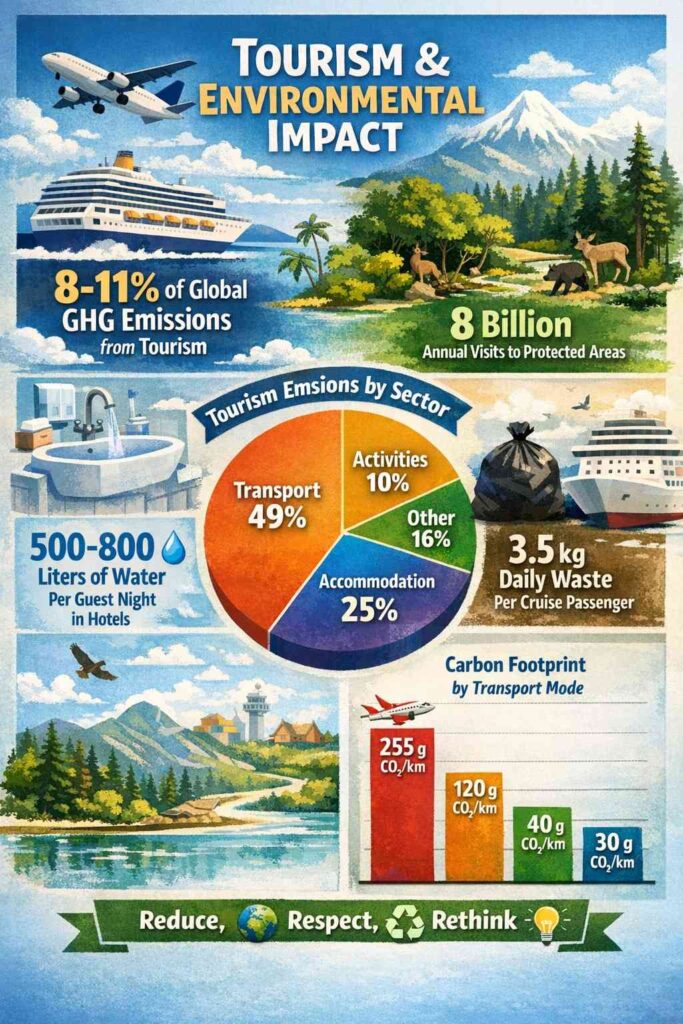
Travel and tourism carbon emissions present one of the sector’s most pressing challenges. According to comprehensive analyses, tourism’s emissions breakdown reveals critical intervention points: aviation contributes 40% of tourism’s total carbon footprint despite representing only 17% of tourist trips, accommodation accounts for 21%, ground transportation 32%, and activities and services 7%.
The environmental impact of tourism extends beyond direct emissions. A single long-haul flight generates approximately 1.6 tons of CO2 per passenger, equivalent to the carbon stored by 80 trees over one year. Cruise ships produce roughly 0.82 pounds of CO2 per passenger mile, while the average hotel room generates 20-30 kg of CO2 daily through energy consumption, laundry services, and food waste.
Climate action in tourism requires understanding scope emissions. Scope 1 covers direct emissions from owned vehicles and facilities. Scope 2 includes purchased electricity and heating. Scope 3, the largest category, encompasses the entire value chain from supplier emissions to guest travel. Most tourism businesses find that 80-95% of their carbon footprint falls under Scope 3, making supply chain transformation essential.
Effects on Biodiversity and Natural Ecosystems
The biodiversity in tourism industry faces a troubling paradox. Nature-based tourism, while funding conservation, simultaneously threatens the ecosystems it celebrates. Wildlife tourism generates an estimated $120 billion annually, yet inappropriate visitor behavior, habitat fragmentation, and infrastructure development degrade the very attractions tourists seek.
Protected areas receive over 8 billion visits yearly, creating pressure on sensitive ecosystems. Coral reefs suffer physical damage from snorkelers and divers, with studies showing reefs near tourist areas experience 80% greater decline than remote reefs. Mountain regions face trail erosion, vegetation loss, and wildlife displacement. The Galápagos Islands, despite strict regulations, struggle with invasive species introduced through tourism and resident population growth supporting the industry.
Water consumption presents another critical concern. Hotels in water-stressed destinations consume 500-800 liters per guest night, compared to local residents using 150-200 liters daily. Tourism in the Mediterranean region accounts for significant water stress during peak summer months when natural availability reaches its lowest. Waste generation compounds these impacts, with cruise ship passengers producing 3.5 kg of waste daily, much of which lacks proper disposal infrastructure at ports.
Types and Forms of Sustainable Tourism
The Three Pillars of Sustainable Travel
What are the three types of sustainable travel? The three types address distinct but interconnected dimensions: environmental sustainability, social sustainability, and economic sustainability.
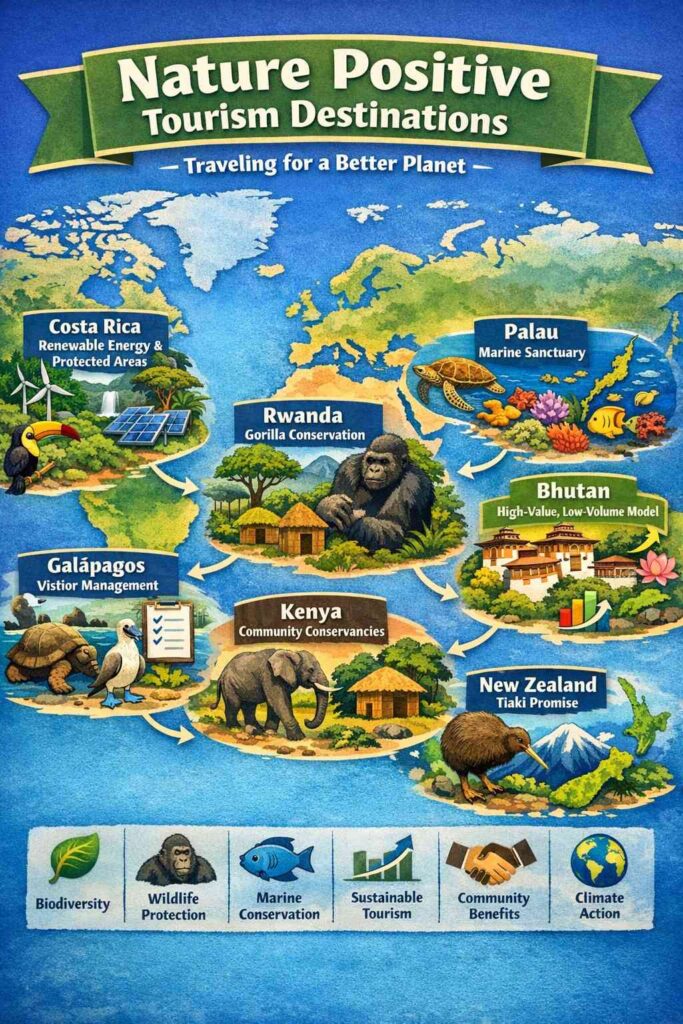
Environmental sustainability focuses on minimizing ecological harm. Costa Rica exemplifies this approach, deriving 99% of electricity from renewable sources and maintaining 25% of its territory as protected areas. Tourism businesses adopt practices like renewable energy systems, water recycling, zero-waste operations, and biodiversity protection programs. The Grootbos Private Nature Reserve in South Africa demonstrates comprehensive environmental sustainability through indigenous plant propagation, marine conservation, and habitat restoration alongside luxury accommodations.
Social sustainability ensures tourism benefits local communities and respects cultural heritage. This includes fair wages exceeding minimum standards, employment opportunities for local residents, cultural preservation initiatives, and community consultation in tourism development. The Indigenous Tourism Association of Canada showcases social sustainability through Indigenous-owned and operated experiences that share authentic cultural knowledge while generating community income.
Economic sustainability creates lasting prosperity without exploitation. Fair trade tourism principles ensure local communities receive equitable compensation. The SEED Madagascar initiative demonstrates this through community-managed tourism enterprises where profits fund healthcare, education, and conservation. Economic sustainability requires transparent revenue sharing, local business development, and investment in infrastructure that serves residents beyond tourism needs.
Seven Forms of Sustainable Tourism
What are the 7 forms of sustainable tourism? These specialized approaches address different sustainability goals while operating within the triple bottom line framework.
Ecotourism focuses on experiencing natural areas while minimizing impact and funding conservation. The Mountain Gorilla conservation program in Rwanda charges $1,500 per permit, with revenue supporting anti-poaching efforts and community development. Visitor numbers remain strictly limited to 96 daily permits across the country, demonstrating how ecotourism balances access with protection.
Agritourism connects visitors with agricultural heritage and sustainable farming. Working farm stays in Tuscany allow guests to participate in olive harvesting and winemaking while supporting small-scale agriculture. This model preserves rural livelihoods and traditional landscapes threatened by industrial farming.
Community-based tourism places control and benefits directly with local communities. The Chalalan Ecolodge in Bolivia, owned and operated by the Indigenous Quechua-Tacana community, returns all profits to community development. Visitors experience authentic cultural exchange while communities retain autonomy over how tourism develops.
Voluntourism combines travel with volunteer work, though this form requires careful implementation to ensure genuine community benefit rather than superficial engagement. Habitat for Humanity’s Global Village programs provide substantive construction assistance with proper skill matching and community-directed projects.
Slow travel emphasizes longer stays, deeper cultural immersion, and reduced transportation emissions. Rather than visiting ten countries in two weeks, slow travelers might spend two weeks in one region, using trains and buses, staying in locally-owned guesthouses, and building relationships with residents.
Regenerative tourism goes beyond minimizing harm to actively improving destinations. The Regenerative Travel Movement encourages tourism that leaves places better than found. Finca Luna Nueva Lodge in Costa Rica practices regenerative agriculture, reforestation, and wildlife corridor restoration, demonstrating how tourism can enhance ecosystem health.
Responsible wildlife tourism prioritizes animal welfare and conservation over entertainment. This means choosing sanctuaries over attractions featuring animal performances, maintaining appropriate observation distances, and supporting facilities where animals live in natural social groups with adequate space and enrichment.
Four Dimensions of Sustainability
What are the 4 types of sustainability? The four dimensions, environmental, economic, social, and cultural, create a comprehensive framework for tourism management.
Environmental sustainability encompasses resource conservation, pollution prevention, and ecosystem protection. Economic sustainability ensures financial viability for businesses and prosperity for communities. Social sustainability addresses human rights, labor conditions, and community wellbeing. Cultural sustainability preserves heritage, traditions, and authentic experiences.
These dimensions interconnect inseparably. Cultural sustainability fails without economic support for traditional practitioners. Environmental conservation requires economic alternatives to destructive practices. Social equity demands cultural respect alongside fair wages. The Rapa Nui (Easter Island) community demonstrates this integration through tourism management that balances archaeological preservation, Indigenous rights, economic development, and environmental carrying capacity.
Key Sustainable Tourism Initiatives Driving Change
Sustainable tourism initiatives at global, national, and industry levels provide frameworks and accountability mechanisms for transformation. The UN Sustainable Development Goals establish measurable targets, with tourism specifically contributing to Goals 8 (decent work and economic growth), 12 (responsible consumption), 13 (climate action), 14 (life below water), and 15 (life on land).
The Glasgow Declaration on Climate Action in Tourism, launched at COP26 in 2021, commits signatories to halving emissions by 2030 and reaching net zero by 2050. Over 700 organizations have signed, including major hotel chains, airlines, destinations, and tourism associations. Signatories must develop climate action plans within 12 months and report progress annually.
Industry-led certification programs provide verification of sustainable practices. The Global Sustainable Tourism Council establishes baseline standards through destination and industry criteria. Certifications like Green Key, EarthCheck, and Travelife assess accommodations across energy efficiency, water conservation, waste management, community engagement, and biodiversity protection.
CASE STUDY: Palau Pledge The island nation of Palau requires all visitors to sign an eco-pledge stamped into passports, promising to act responsibly and preserve the country for future generations. This initiative combines legal requirements with visitor education. Palau banned reef-toxic sunscreens, restricted fishing in 80% of its territorial waters, and limits visitor numbers to match infrastructure capacity. Tourism revenue funds marine conservation while maintaining pristine ecosystems that attract high-value, low-impact visitors.
Government policies increasingly mandate sustainability reporting and operational standards. The European Union’s Corporate Sustainability Reporting Directive requires large companies to disclose environmental and social impacts beginning in 2025. New Zealand’s Tourism Sustainability Commitment requires businesses to demonstrate environmental management, community support, and visitor experience quality.
The Path to Net Zero Tourism
Understanding the Net Zero Commitment
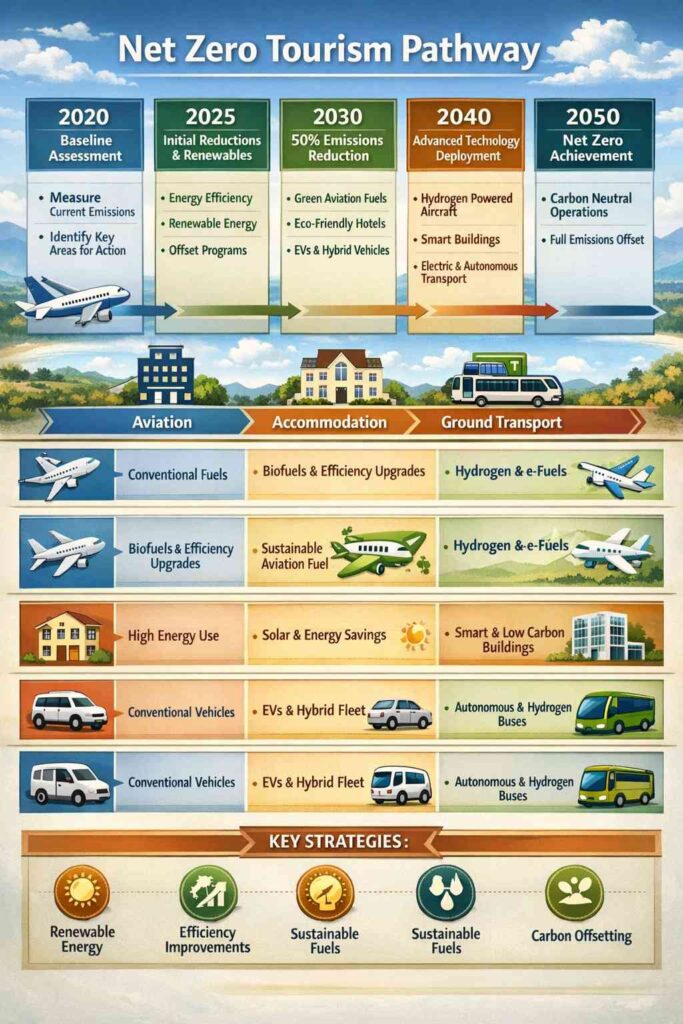
The net zero tourism roadmap establishes clear pathways for the sector to align with the Paris Agreement’s 1.5°C warming limit. Net zero means balancing carbon emissions produced with carbon removed from the atmosphere, achieving equilibrium where tourism adds no additional greenhouse gases.
According to WTTC research, tourism must reduce emissions by 50% by 2030 and achieve net zero by 2050 to meet climate targets. However, business-as-usual projections show tourism emissions increasing 25% by 2030 due to growth in international travel. This gap requires aggressive intervention across all subsectors.
The 2030 milestones include achieving 100% renewable energy in accommodations, electrifying ground transportation, introducing sustainable aviation fuels at scale, and eliminating single-use plastics. The 2040 targets require zero-emission short-haul flights, carbon-neutral cruise ships, and regenerative practices becoming standard across the industry.
“WTTC research indicates that achieving net zero tourism by 2050 requires annual investment of $410 billion in sustainable aviation fuels, renewable energy infrastructure, and low-carbon transportation technologies. While substantial, this represents less than 5% of tourism’s annual global revenue and delivers positive ROI through operational savings and enhanced market positioning.”
Decarbonisation Strategies Across the Value Chain
Travel and tourism decarbonisation demands targeted strategies for each emission source. Aviation presents the most significant challenge, with technological solutions developing slowly relative to climate urgency. Sustainable aviation fuels derived from waste oils, algae, or synthetic processes can reduce lifecycle emissions by 80% but currently cost 3-5 times conventional jet fuel and supply remains limited. Electric aircraft show promise for short regional flights under 500 miles but face battery weight and charging infrastructure challenges.
Ground transportation offers more immediate solutions. Electric vehicle adoption for rental fleets and airport transfers eliminates direct emissions while grid decarbonization addresses upstream impacts. High-speed rail networks in Europe and Asia demonstrate low-carbon alternatives to short-haul flights. The shift from Paris to Lyon by train generates 96% less CO2 than flying while offering competitive travel times.
Accommodations can achieve significant reductions through energy efficiency retrofits, renewable energy installation, and operational changes. LED lighting reduces energy consumption by 75% compared to incandescent bulbs. Heat pump technology cuts heating emissions by 50-80% versus fossil fuel systems. Solar panels and wind power provide clean energy, with some hotels achieving 100% renewable supply. The Proximity Hotel in Greensboro, North Carolina, uses 39% less energy than conventional hotels through geothermal heating, solar hot water, and advanced building design.
Carbon offsetting and removal technologies address residual emissions that cannot yet be eliminated. High-quality offsets fund reforestation, renewable energy projects, or methane capture. However, offsetting must supplement rather than replace emissions reduction. Carbon removal through direct air capture or enhanced weathering offers long-term solutions but currently costs $600-1,000 per ton, requiring technology advancement and scale to become viable.
Hotel Sustainability Practices That Make a Difference
Hotel sustainability practices span energy management, water conservation, waste reduction, and supply chain transformation. Leading properties demonstrate that sustainability and luxury coexist successfully, with guests increasingly expecting environmental responsibility.
Energy and Water Conservation: Automated lighting and climate control systems adjust based on occupancy, reducing energy waste by 20-30%. Low-flow showerheads and faucet aerators cut water consumption by 50% without compromising guest experience. Towel and linen reuse programs save water, energy, and chemicals, with typical hotels reducing laundry emissions by 30% through voluntary daily linen changes. The 1 Hotel brand achieves LEED certification across its portfolio through comprehensive energy monitoring, renewable energy procurement, and water recycling systems.
Waste Reduction and Circular Economy: Zero-waste initiatives divert materials from landfills through composting, recycling, and waste-to-energy conversion. Single-use plastics are replaced with refillable dispensers, bamboo amenities, and compostable packaging. Food waste represents 30-40% of hotel waste, making food donation programs and composting essential. The Scandic Hotels chain eliminated single-use plastics across 280 properties, preventing 20 million plastic items from entering waste streams annually.
Sustainable Sourcing: Local procurement reduces transportation emissions while supporting regional economies. Organic and seasonal menus minimize agricultural impacts. The Six Senses resorts source 25-30% of ingredients from on-site gardens, with remaining food sourced within 50 kilometers when possible. Fair trade certification ensures coffee, tea, and chocolate purchases support ethical labor practices.
Green Building Certifications: LEED (Leadership in Energy and Environmental Design), Green Key, and EarthCheck provide third-party verification of sustainability performance. LEED certification requires meeting standards across location efficiency, water efficiency, energy performance, materials selection, and indoor environmental quality. Buildings achieving LEED certification demonstrate 25% less energy consumption and 11% lower water use than conventional construction.
Sustainability Certification Comparison Table
| Certification | Key Requirements | Recognition Level | Best For | Implementation Difficulty | Approximate Cost |
|---|---|---|---|---|---|
| Green Key | Energy/water efficiency, waste management, education | Global (65+ countries) | Hotels, hostels, attractions | Moderate | $500-2,000 annually |
| EarthCheck | Comprehensive benchmarking, continuous improvement | Global, science-based | Resorts, destinations | High | $2,000-10,000+ |
| Travelife | Labor rights, environmental management, supply chain | Europe-focused | Tour operators, accommodations | Moderate-High | $1,500-5,000 |
| Green Globe | 44 core criteria across sustainability pillars | Global | All tourism sectors | Moderate | $1,000-5,000 |
| LEED | Green building design and construction | Global, highly recognized | New construction, renovations | High | $15,000-100,000+ |
Nature Positive Travel: Becoming Guardians of the Environment
Nature positive travel represents the evolution beyond sustainability toward regeneration. This approach requires tourism to deliver net gains for biodiversity, leaving ecosystems healthier than before human interaction. Where sustainable tourism aims to minimize harm, nature positive tourism actively restores and enhances natural systems.
This framework aligns with the Kunming-Montreal Global Biodiversity Framework adopted at COP15, which calls for protecting 30% of land and sea by 2030. Tourism can contribute through conservation funding, habitat restoration, invasive species removal, and wildlife population support.
Conservation funding through tourism provides critical resources for protected area management. Entrance fees, permits, and tourism taxes generate revenue that governments often cannot provide through general budgets. Mountain gorilla conservation in Rwanda generates $400 million annually, funding ranger salaries, anti-poaching technology, and community programs. This economic value creates powerful incentives for conservation over conversion to agriculture or resource extraction.
Community-led conservation initiatives prove most effective for long-term protection. The Northern Rangelands Trust in Kenya supports Indigenous and community conservancies covering 44,000 square kilometers. Tourism revenue provides income that reduces poaching pressure while communities retain land rights and management authority. Wildlife populations including elephants, lions, and endangered Grevy’s zebras have increased significantly under this model.
CASE STUDY: Grootbos Foundation The Grootbos Private Nature Reserve in South Africa combines luxury tourism with intensive conservation and community development. The foundation has identified six new plant species, propagates endangered indigenous plants, operates a marine research unit studying whale populations, and runs education programs training local youth in conservation careers. Tourism revenue funds these initiatives while guest experiences include guided nature walks led by community members trained as field guides. Over 20 years, the project has restored 1,400 hectares of fynbos vegetation and created employment for over 1,000 people.
“Analysis of 200 protected areas across five continents shows that tourism-funded conservation generates 60% more effective biodiversity outcomes than government funding alone, according to research published in Nature Sustainability. The study found that community-managed tourism programs combining visitor revenue with local decision-making authority achieved the highest conservation success rates while delivering equitable economic benefits.”
How Travelers Can Practice Sustainable Tourism
Individual travelers collectively wield enormous influence through spending decisions and behavioral choices. Each journey presents opportunities to minimize harm and support positive practices.
Transportation Choices: Aviation dominates travel emissions, making flight decisions critical. Direct flights reduce emissions by 20-30% compared to routes with connections due to the high energy consumption of takeoffs and landings. Economy class generates half the emissions per passenger of business class due to higher density. When feasible, trains and buses offer low-carbon alternatives, with trains producing 80-90% less CO2 than equivalent flights.
Carbon calculators like those from atmosfair, myclimate, or Gold Standard help travelers understand trip emissions and purchase high-quality offsets. However, reduction remains the priority, with offsetting addressing unavoidable emissions.
Accommodation Selection: Certified green properties provide verified sustainability performance. Search for Green Key, EarthCheck, or LEED certifications. Locally-owned guesthouses and boutique hotels circulate money within communities more effectively than international chains. Longer stays reduce per-night impact by distributing cleaning resources across multiple days.
Supporting Local Economies: Direct spending with local businesses maximizes community benefit. Hiring local guides, eating at independent restaurants, purchasing crafts directly from artisans, and using local transportation services ensures money stays in the destination. Studies show locally-owned businesses recirculate 3-4 times more revenue within their communities than chain establishments.
Responsible Wildlife Tourism: Ethical wildlife encounters prioritize animal welfare over entertainment. Avoid facilities offering elephant riding, tiger selfies, or marine mammal performances. Choose sanctuaries and rehabilitation centers where animals live in social groups with adequate space and natural behaviors. Maintain observation distances recommended by guides, never feed wild animals, and report exploitation to conservation authorities.
10-Step Sustainable Traveler Checklist: ✓ Research destination sustainability initiatives and challenges before visiting ✓ Pack reusable water bottles, shopping bags, and utensils to avoid single-use plastics ✓ Choose direct flights in economy class when flying is necessary ✓ Stay in certified green accommodations or locally-owned properties ✓ Use public transportation, walk, or cycle rather than renting vehicles ✓ Eat at local restaurants serving regional cuisine and seasonal ingredients ✓ Purchase souvenirs directly from artisans and craftspeople ✓ Respect cultural norms, dress codes, and photography restrictions ✓ Minimize water and energy consumption through conscious behavior ✓ Leave destinations cleaner than found through responsible waste disposal
Digital Tools and Resources: Several platforms facilitate sustainable travel planning. Bookdifferent.com and Ecobnb.com specialize in verified sustainable accommodations. The UN Environment Programme’s Global Cleaner Production and Sustainable Tourism Network provides resources and case studies. Carbon calculators from Conservation International and WWF assess trip impacts. The Responsible Travel platform curates tours and experiences meeting sustainability criteria.
How Businesses Can Implement Sustainable Practices
Tourism businesses face both challenge and opportunity in sustainability transformation. Frameworks and measurement systems provide structured pathways for implementation.
Measurement and Reporting: Baseline measurement establishes current performance across energy consumption, water use, waste generation, carbon emissions, and social indicators. The Hotel Carbon Measurement Initiative provides standardized methodologies for accommodations. The Global Reporting Initiative offers comprehensive sustainability reporting frameworks applicable across tourism sectors.
Data collection systems track monthly consumption and identify improvement opportunities. Smart meters provide real-time energy monitoring. Water submeters reveal usage patterns. Waste audits categorize disposal streams and identify diversion opportunities. Employee engagement programs encourage staff to identify efficiency improvements from their operational perspectives.
Frameworks and Roadmaps: The Science Based Targets initiative provides methodologies for setting emissions reduction goals aligned with climate science. Companies commit to reducing emissions consistent with limiting warming to 1.5°C. Targets must cover Scope 1, 2, and significant Scope 3 sources, with independent validation ensuring rigor.
The Tourism Declares a Climate Emergency initiative offers resources for businesses developing climate action plans. Members commit to transparent reporting, annual emissions reduction, and advocacy for stronger climate policy. Over 800 organizations participate, creating peer learning networks and collaborative problem-solving.
Employee Training and Culture: Sustainability succeeds only with employee buy-in and empowerment. Training programs educate staff on environmental impacts, company goals, and individual responsibilities. Green teams provide cross-departmental forums for sharing ideas and implementing initiatives. Recognition programs celebrate sustainability achievements, reinforcing cultural values.
The Fairmont Hotels’ Green Partnership Fund exemplifies employee engagement. Staff submit project proposals addressing sustainability challenges, with winning ideas receiving implementation funding. This bottom-up approach has generated innovations in waste reduction, energy efficiency, and guest engagement across the portfolio.
Technology Solutions: Building management systems integrate lighting, heating, and cooling control to optimize efficiency. Occupancy sensors adjust conditions based on real-time usage. Predictive maintenance prevents equipment failures that cause energy waste. Cloud-based platforms aggregate data across multiple properties, enabling portfolio-wide performance tracking and benchmarking.
Business Case and ROI: Sustainability investments deliver financial returns beyond environmental benefits. Energy efficiency retrofits typically achieve 3-7 year payback periods through reduced utility costs. Water conservation measures save both water fees and energy for heating. Waste reduction decreases disposal costs while potentially generating revenue from recyclable materials.
Revenue benefits increasingly accompany cost savings. Research shows 73% of global travelers intend to stay in sustainable accommodations, with 43% willing to pay more for certified green properties. Sustainability credentials attract corporate clients with ESG procurement requirements. Destination marketing organizations increasingly promote sustainable businesses, providing marketing exposure.
Key Business ROI Statistics:
- Hotels implementing comprehensive sustainability programs reduce operating costs by 20-30%
- Energy efficiency improvements deliver average ROI of 30-40% annually
- Sustainable properties command 10-15% premium pricing in competitive markets
- Employee retention improves 25% in companies with strong sustainability programs
- Millennial and Gen Z travelers, representing growing market share, prioritize sustainable options by 87%
The Benefits and Challenges of Sustainable Tourism
Key Benefits
Environmental preservation represents the most visible benefit of sustainable tourism practices. Protected areas funded by tourism revenue safeguard biodiversity, ecosystem services, and natural heritage for future generations. Climate action reduces tourism’s contribution to global warming while building resilience against climate impacts.
Enhanced visitor experiences emerge from sustainable practices. Travelers increasingly seek authentic connections with destinations, local cultures, and natural environments. Sustainable tourism delivers these experiences while preserving the assets that attracted visitors initially. Destinations that balance access with protection maintain long-term appeal, while overtourism degrades experiences and damages the environment.
Economic benefits for local communities multiply when tourism development follows sustainable principles. Employment creation, entrepreneurship opportunities, and infrastructure improvements enhance quality of life for residents. Revenue sharing mechanisms ensure communities receive direct benefits from tourism on their lands and resources.
Competitive advantage and brand differentiation reward businesses demonstrating genuine sustainability commitment. As consumer preferences shift toward responsible options, certified sustainable businesses capture growing market segments. Corporate reputation strengthens, attracting investors, partners, and employees who prioritize ESG performance.
Long-term industry resilience depends on sustainable practices. Tourism requires healthy ecosystems, stable communities, and cultural authenticity. Extractive approaches that prioritize short-term profits over long-term stewardship ultimately destroy the foundations tourism depends upon.
Challenges and Barriers
Higher initial costs present significant barriers, particularly for small businesses operating on thin margins. Solar panel installations, building retrofits, and certification processes require upfront capital that many enterprises lack. Access to green financing and grant programs remains limited in many destinations.
Greenwashing concerns undermine consumer trust and market differentiation. Companies making unsubstantiated environmental claims without meaningful action damage credibility across the sector. Lack of standardization allows superficial gestures to masquerade as substantive sustainability, making it difficult for travelers to identify genuine commitment.
Measurement and verification difficulties complicate progress tracking and accountability. Carbon accounting across complex tourism supply chains requires sophisticated methodologies and data collection systems. Small businesses often lack technical expertise for accurate measurement, while third-party verification adds costs.
Balancing growth with sustainability creates fundamental tensions. Tourism growth projections contradict emissions reduction requirements under current technology constraints. Destinations struggle to limit visitor numbers while maintaining economic viability. The industry must confront whether sustainable tourism requires degrowth or radical technological transformation.
Consumer awareness and behavior change lag behind stated preferences. While surveys show travelers value sustainability, booking decisions often prioritize price and convenience. Converting intentions into behaviors requires education, accessible sustainable options, and sometimes acceptance of higher costs or reduced convenience.
The Future of Sustainable Travel and Tourism
Emerging trends and innovations point toward accelerated transformation across the tourism sector. Technological advancement, policy evolution, and shifting consumer expectations converge to reshape industry practices.
Technology and AI Applications: Artificial intelligence optimizes energy management in hotels through predictive algorithms that anticipate demand and adjust systems accordingly. Machine learning analyzes guest preferences to personalize sustainable options without compromising experience. Blockchain technology enables transparent supply chain tracking, verifying sustainable sourcing claims and carbon offset legitimacy.
Virtual and augmented reality reduce travel necessity for certain experiences, enabling destination preview without physical travel. Digital twins allow destinations to model tourism impacts and test management strategies before implementation. Smart destination platforms integrate real-time data on congestion, environmental conditions, and infrastructure capacity to guide visitors toward less impacted areas.
Regenerative Tourism Evolution: The shift from sustainable to regenerative tourism represents the next paradigm. Rather than merely sustaining current conditions, regenerative approaches actively heal degraded ecosystems, revitalize cultures, and enhance community wellbeing. This framework recognizes that many destinations already suffer significant damage requiring restoration, not just preservation.
New Zealand’s Tiaki Promise exemplifies regenerative principles by asking visitors to care for the land, sea, and culture. Palau’s Pristine Paradise Environmental Fee funds conservation and infrastructure improvements. These models demonstrate destinations taking proactive stances on tourism’s role in enhancement rather than extraction.
Policy and Regulatory Developments: Government intervention accelerates through tourism taxes, visitor caps, and mandatory sustainability reporting. Amsterdam limits visitor numbers and bans new hotel construction in the city center. Venice implements entrance fees and restricts cruise ships. Bhutan’s high-value, low-volume model charges $200 daily sustainable development fees, demonstrating alternatives to mass tourism.
The EU’s Carbon Border Adjustment Mechanism and potential aviation fuel taxation will reshape travel economics. Stricter emissions regulations for shipping affect cruise operations. These policies create market conditions favoring sustainable operators while penalizing high-carbon practices.
Industry Predictions for 2030: Based on analysis of hundreds of sustainable tourism programs and current trajectories, several developments appear likely by 2030. Sustainable aviation fuels will power 10-15% of commercial flights, reducing aviation’s carbon intensity while costs remain elevated. Electric vehicles will dominate short-distance tourism transportation, with charging infrastructure widespread across developed destinations. Regenerative tourism will transition from fringe concept to mainstream expectation, with travelers seeking net-positive impact experiences.
Certification and verification systems will consolidate around globally recognized standards, reducing confusion and greenwashing. Carbon pricing mechanisms will incorporate tourism activities into broader climate policy frameworks, making high-carbon options more expensive. Destinations will implement more sophisticated carrying capacity management, using dynamic pricing and permit systems to balance access with protection.
Consumer behavior will increasingly align with stated values as sustainable options become more accessible and affordable. However, tensions between tourism growth and climate commitments will intensify, potentially forcing industry reckoning with growth models incompatible with planetary boundaries.
Carbon Emissions Breakdown: Tourism Sector Analysis
Tourism’s Carbon Footprint by Subsector:
- Aviation: 40% (539 Mt CO2)
- Despite representing only 17% of tourist trips
- Long-haul international flights contribute disproportionately
- Business class generates double emissions per passenger vs. economy
- Reduction strategies: Sustainable aviation fuels, flight consolidation, route optimization, modal shift to rail
- Accommodation: 21% (283 Mt CO2)
- Hotel energy consumption for heating, cooling, lighting
- Laundry and food service operations
- Embedded emissions in construction and furnishings
- Reduction strategies: Renewable energy, efficiency retrofits, green building design, operational improvements
- Ground Transportation: 32% (431 Mt CO2)
- Rental vehicles, taxis, and tour buses
- Private vehicle travel to/from destinations
- Airport transfers and local transportation
- Reduction strategies: Electric vehicle adoption, public transit, walking/cycling infrastructure, car-sharing
- Activities and Services: 7% (94 Mt CO2)
- Tours, attractions, and recreational activities
- Restaurants, shopping, and entertainment
- Waste generation and disposal
- Reduction strategies: Local sourcing, waste reduction, sustainable operations, low-impact activity design
Comparative Emissions by Travel Type (per passenger per 1,000 km):
- Long-haul flight (economy): 150 kg CO2
- Long-haul flight (business): 434 kg CO2
- Short-haul flight: 255 kg CO2
- Train (electric): 14 kg CO2
- Train (diesel): 41 kg CO2
- Bus (coach): 27 kg CO2
- Car (petrol, one passenger): 171 kg CO2
- Car (shared with four passengers): 43 kg CO2 per person
- Cruise ship: 285 kg CO2
Conclusion
Sustainable travel and tourism represents not merely an ethical choice but a fundamental requirement for the sector’s long-term viability. With tourism contributing 8-11% of global emissions and significant biodiversity impacts, transformation from extractive to regenerative models becomes urgent. The frameworks, certifications, and technologies for this transition exist today, requiring commitment and investment to implement at scale. Travelers can immediately adopt practices that minimize harm while supporting communities and conservation. Businesses face both imperative and opportunity in sustainability leadership, with demonstrated returns through cost savings, revenue growth, and competitive positioning. The path to net zero tourism by 2050 demands aggressive action across aviation, accommodations, and all tourism subsectors. Success requires honest confrontation of growth tensions, rejection of greenwashing, and commitment to measurable progress. The choice before us remains clear: transform tourism into a regenerative force that enhances destinations, or watch degradation destroy the very assets that make travel meaningful.
Frequently Asked Questions
What is sustainability in travel and tourism?
Sustainability in travel and tourism is a comprehensive approach balancing environmental protection, social equity, and economic viability. It ensures tourism development meets current needs while preserving natural resources, respecting local cultures, and creating lasting economic benefits for communities without compromising future generations’ ability to enjoy destinations. This framework minimizes ecological impacts, supports local communities, and maintains economic prosperity across the entire value chain from transportation to accommodations and activities.
What are the three types of sustainable travel?
The three types of sustainable travel are environmental sustainability, social sustainability, and economic sustainability. Environmental sustainability minimizes ecological harm through carbon reduction, resource conservation, and biodiversity protection. Social sustainability ensures fair treatment of workers, respect for local cultures, and equitable distribution of tourism benefits to communities. Economic sustainability creates lasting prosperity for destinations and businesses through fair wages, local procurement, and revenue sharing that supports long-term development rather than extractive short-term gain.
What are the 7 forms of sustainable tourism?
The seven forms of sustainable tourism are ecotourism, agritourism, community-based tourism, voluntourism, slow travel, regenerative tourism, and responsible wildlife tourism. Ecotourism focuses on nature-based experiences funding conservation. Agritourism connects visitors with sustainable farming and rural heritage. Community-based tourism places control with local communities. Voluntourism combines travel with service projects. Slow travel emphasizes deeper immersion and reduced transportation. Regenerative tourism actively restores destinations. Responsible wildlife tourism prioritizes animal welfare and conservation over entertainment. Each form addresses specific sustainability goals while operating within environmental, social, and economic principles.
What are the 4 types of sustainability?
The four types of sustainability are environmental, economic, social, and cultural. Environmental sustainability conserves natural resources, reduces pollution, and protects ecosystems. Economic sustainability ensures financial viability for businesses and prosperity for communities without exploitation. Social sustainability addresses human rights, labor conditions, and equitable benefit distribution. Cultural sustainability preserves heritage, traditions, and authentic experiences while respecting local values. These dimensions interconnect inseparably, requiring integrated approaches where success in one area supports rather than undermines the others.
How does tourism contribute to climate change?
Tourism contributes approximately 8-11% of global greenhouse gas emissions through transportation, accommodation, and activities. Aviation accounts for 40% of tourism’s carbon footprint despite representing only 17% of trips, with a single long-haul flight generating 1.6 tons of CO2 per passenger. Accommodations contribute 21% through energy consumption, while ground transportation adds 32%. Activities and services account for 7%. The sector’s emissions continue rising with increased international travel, requiring aggressive decarbonization across all subsectors to align with Paris Agreement targets limiting warming to 1.5°C.
What is net zero tourism and how can we achieve it?
Net zero tourism means balancing carbon emissions produced with carbon removed from the atmosphere, achieving equilibrium where tourism adds no additional greenhouse gases. The net zero tourism roadmap requires 50% emissions reduction by 2030 and complete neutralization by 2050 through renewable energy adoption, sustainable aviation fuels, electrified transportation, operational efficiency, and carbon removal. Achieving these targets demands immediate action including 100% renewable energy in accommodations, elimination of single-use plastics, technology investment in low-carbon aviation and shipping, and supply chain transformation addressing Scope 3 emissions that represent 80-95% of most tourism businesses’ footprints.
How can hotels become more sustainable?
Hotels become more sustainable through comprehensive programs addressing energy, water, waste, and supply chains. Energy efficiency measures include LED lighting, occupancy sensors, heat pumps, and renewable energy installation, reducing consumption by 25-75%. Water conservation uses low-flow fixtures, towel reuse programs, and recycling systems, cutting usage by 30-50%. Waste reduction implements composting, recycling, and eliminates single-use plastics. Sustainable sourcing prioritizes local procurement, organic food, and fair trade products. Green building certifications like LEED verify performance. These practices reduce operating costs by 20-30% while attracting environmentally conscious guests willing to pay 10-15% premiums for certified sustainable properties.
What is nature positive travel?
Nature positive travel goes beyond minimizing harm to actively improving ecosystems and biodiversity. This approach requires tourism to deliver net gains for nature, leaving destinations healthier than before human interaction. Nature positive tourism funds conservation through entrance fees and permits, supports habitat restoration projects, removes invasive species, and contributes to wildlife population recovery. It aligns with global biodiversity targets protecting 30% of land and sea by 2030. Examples include mountain gorilla conservation in Rwanda generating $400 million annually for protection, and community conservancies in Kenya where tourism revenue enables wildlife population increases while communities retain land rights and management authority.
How can I travel more sustainably as an individual?
Travel more sustainably by making conscious choices across transportation, accommodation, spending, and behavior. Choose direct flights in economy class, or substitute trains and buses when feasible, reducing emissions by 80-90%. Stay in certified green accommodations or locally-owned properties. Use public transportation, walk, or cycle rather than renting vehicles. Eat at local restaurants serving regional cuisine. Purchase crafts directly from artisans. Pack reusable bottles, bags, and utensils to avoid single-use plastics. Respect cultural norms and wildlife viewing distances. Support conservation through responsible wildlife tourism that prioritizes animal welfare. Calculate trip emissions and purchase high-quality carbon offsets for unavoidable impacts.
What is the difference between sustainable tourism and ecotourism?
Sustainable tourism is a comprehensive framework addressing environmental, social, and economic impacts across all tourism types, from beach resorts to urban hotels to adventure travel. Ecotourism is a specific form of sustainable tourism focusing on nature-based experiences in relatively undisturbed areas that fund conservation and benefit local communities. All ecotourism should be sustainable, but not all sustainable tourism is ecotourism. A sustainably-operated city hotel practicing energy efficiency and fair labor exemplifies sustainable tourism without being ecotourism. Mountain gorilla tracking in Rwanda represents both ecotourism and sustainable tourism through conservation funding, strict visitor limits, and community benefit sharing.
Tools and Resources Section
Carbon Calculators:
- atmosfair Flight Emissions Calculator – Calculates aviation emissions and offers Gold Standard offsets
- myclimate Travel Footprint Calculator – Comprehensive tool covering flights, ground transport, and accommodation
- Conservation International Carbon Footprint Calculator – Calculates emissions from travel, home energy, and lifestyle
- ICAO Carbon Emissions Calculator – Official aviation industry calculator using standardized methodologies
Sustainable Accommodation Platforms:
- Bookdifferent.com – Search engine showing sustainability scores for accommodations worldwide
- Ecobnb.com – Curated collection of verified sustainable hotels, B&Bs, and vacation rentals
- Green Pearls – Portfolio of sustainable luxury hotels meeting stringent environmental criteria
- Kind Traveler – Platform combining hotel booking with charitable giving to local communities
Certification Databases:
- Global Sustainable Tourism Council Recognition Program – Directory of certified sustainable tourism programs
- Green Key Eco-label – Searchable database of certified properties in 65+ countries
- EarthCheck Certified Properties – Directory of accommodations, destinations, and attractions meeting benchmarks
- Travelife Certified Partners – Database of tour operators and hotels meeting sustainability standards
ESG Reporting Frameworks:
- Global Reporting Initiative (GRI) Standards – Comprehensive sustainability reporting guidelines applicable to tourism
- Hotel Carbon Measurement Initiative (HCMI) – Standardized carbon accounting methodology for hotels
- Science Based Targets Initiative (SBTi) – Framework for setting and validating emissions reduction targets
- CDP (formerly Carbon Disclosure Project) – Platform for environmental disclosure and scoring
Planning and Education Resources:
- UN Environment Programme Sustainable Tourism – Research, case studies, and implementation guides
- Tourism Declares Climate Emergency – Resources and network for tourism businesses committing to climate action
- Responsible Travel Platform – Curated sustainable tours and experiences with verified operators
- The International Ecotourism Society – Education, resources, and certification information
Hotel Sustainability Audit Checklist
Energy Management: ☐ Conduct comprehensive energy audit identifying consumption patterns ☐ Install LED lighting throughout property (75% energy reduction vs. incandescent) ☐ Implement occupancy sensors for lighting and HVAC in guest rooms and common areas ☐ Upgrade to high-efficiency HVAC systems or heat pumps ☐ Install smart thermostats with automated temperature control ☐ Procure renewable energy through direct installation or green power purchasing ☐ Implement building management system for real-time monitoring and optimization ☐ Establish energy reduction targets with annual 3-5% improvement goals
Water Conservation: ☐ Install low-flow showerheads (2.0 GPM or less) and faucet aerators ☐ Replace toilets with high-efficiency models (1.28 GPF or less) ☐ Implement towel and linen reuse program with clear guest communication ☐ Install water meters to track consumption by department ☐ Repair leaks within 24 hours of identification ☐ Landscape with native, drought-resistant plants requiring minimal irrigation ☐ Install rainwater harvesting or greywater recycling systems where feasible ☐ Set water reduction targets with 15-20% improvement over three years
Waste Management: ☐ Conduct waste audit categorizing materials and identifying diversion opportunities ☐ Eliminate single-use plastics (water bottles, toiletries, straws, takeaway containers) ☐ Implement comprehensive recycling program for paper, glass, metal, plastic ☐ Establish food waste composting or donation programs ☐ Source bulk amenities with refillable dispensers ☐ Partner with organizations accepting donations of used linens, furniture, appliances ☐ Track waste generation per guest night and set reduction targets ☐ Achieve minimum 50% waste diversion from landfills
Sustainable Sourcing: ☐ Establish procurement policy prioritizing local, organic, fair trade products ☐ Source 30%+ food and beverage from suppliers within 50 kilometers ☐ Purchase sustainable seafood certified by MSC or equivalent standards ☐ Source coffee, tea, chocolate from fair trade certified suppliers ☐ Select cleaning products with eco-label certifications (Green Seal, EcoLogo) ☐ Purchase FSC-certified paper products and wood furnishings ☐ Request environmental disclosures from major suppliers ☐ Establish supplier code of conduct addressing labor and environmental practices
Certification and Reporting: ☐ Pursue third-party sustainability certification (Green Key, EarthCheck, LEED) ☐ Establish baseline emissions using Hotel Carbon Measurement Initiative methodology ☐ Set science-based emissions reduction targets aligned with 1.5°C pathway ☐ Publish annual sustainability report disclosing performance and progress ☐ Participate in industry benchmarking programs to compare performance ☐ Communicate sustainability achievements to guests through in-room materials and website ☐ Train all employees on sustainability policies, targets, and their role in achievement ☐ Establish sustainability committee with executive sponsorship and cross-departmental representation