Affiliate Disclosure: This review contains affiliate links. If you purchase through these links, we may earn a commission at no additional cost to you. Our reviews remain unbiased and based on thorough testing.
The Professional Travel Planning Problem
In this Tripzilla.io Review, I started with serious doubts about yet another travel platform claiming to revolutionize the industry. After testing dozens of travel tools that promise everything but deliver mediocre experiences, I approached TripZILLA with healthy skepticism. The travel planning space is crowded with consumer-focused apps, but few address the specific pain points of travel professionals who need to create client-facing proposals quickly and professionally.

Travel agents and tour operators face a common struggle: juggling multiple fragmented tools to create compelling trip proposals. They bounce between Excel spreadsheets, Google Docs, email chains, and various booking platforms, often spending hours crafting proposals that lack visual appeal. I’ve watched travel professionals lose potential clients simply because their proposals looked unprofessional or took too long to compile.
What caught my attention about Tripzilla.io was its laser focus on travel professionals rather than casual travelers. The promise of unifying planning, collaboration, AI assistance, and client management in one modern workspace seemed ambitious. Could this platform actually solve the workflow inefficiencies plaguing the travel industry?
What Is Tripzilla.io?
Tripzilla.io positions itself as “The modern platform for travel professionals,” offering TripZILLA as its flagship tool designed specifically for travel agents, tour operators, and travel advisors. Unlike consumer travel apps that focus on personal trip planning, TripZILLA targets the B2B travel market with professional-grade features.
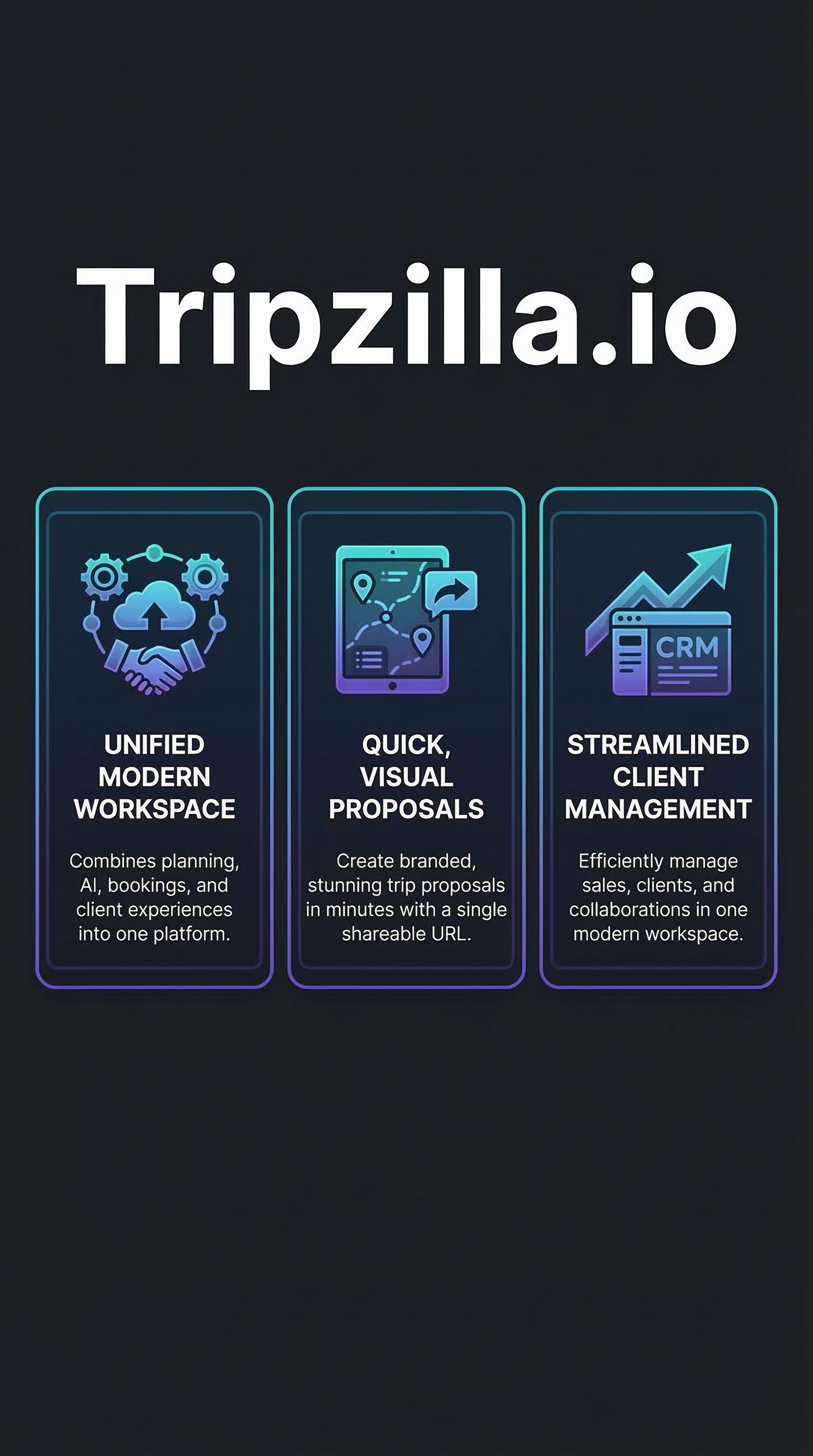
The platform’s core differentiator lies in its unified workspace approach. Instead of forcing users to switch between multiple tools, TripZILLA integrates itinerary building, collaboration features, AI planning assistance, booking management, and client experience tools into a single interface. This consolidation addresses a major inefficiency in the travel industry where professionals often use five or more different platforms to complete a single trip proposal.
TripZILLA markets itself as “The Ultimate Itinerary Builder” with a promise that users can “create complete trip proposals in minutes.” The platform emphasizes speed, professional presentation, and ease of sharing through a single URL that doesn’t require clients to download any apps. This approach removes friction from the client experience while maintaining professional branding throughout the proposal process.
The platform serves travel agencies of all sizes, from solo operators to larger firms, focusing on those who need to create visually appealing, comprehensive trip proposals that convert prospects into paying clients. By targeting professionals rather than end consumers, Tripzilla.io occupies a distinct niche in the crowded travel technology landscape.
Key Features
Intuitive Itinerary Builder
The heart of TripZILLA is its streamlined itinerary creation system that transforms complex trip planning into a structured workflow. Users input destination details, activities, accommodations, and transportation through a guided interface that organizes information logically. The builder automatically formats content into professional-looking proposals without requiring design skills or technical knowledge.

The system supports multiple trip types, from simple city breaks to complex multi-country tours. Users can add detailed descriptions, images, pricing information, and booking links for each component of the itinerary. The builder maintains consistency in formatting and branding throughout the proposal, ensuring professional presentation regardless of trip complexity.
Custom Branding Integration
Professional appearance drives client trust and conversion rates in the travel industry. TripZILLA allows agencies to incorporate their logos, color schemes, and brand elements throughout trip proposals. This customization ensures that every client interaction reinforces the agency’s professional identity rather than promoting a third-party platform.
The branding system extends beyond basic logo placement. Users can customize headers, footers, color palettes, and even add company contact information and terms of service. This level of customization helps agencies maintain consistent brand presentation across all client touchpoints.
AI-Powered Planning Assistance
The platform incorporates artificial intelligence to streamline the planning process and suggest optimizations. While specific AI capabilities aren’t detailed in available documentation, the integration likely includes destination recommendations, activity suggestions based on traveler preferences, and itinerary optimization for timing and logistics.
AI assistance helps reduce the research time traditionally required for trip planning. Instead of manually researching destinations and activities, professionals can leverage AI suggestions as starting points for customization. This feature particularly benefits agents working with unfamiliar destinations or planning complex multi-stop itineraries.
Collaboration Tools
Modern travel agencies often involve multiple team members in proposal creation. TripZILLA includes collaboration features that allow team members to contribute to itineraries simultaneously. This functionality reduces bottlenecks and enables expertise sharing across different destinations and travel types.
The collaboration system likely includes role-based permissions, version control, and comment systems to facilitate smooth teamwork. Agencies can assign specific sections to team members while maintaining overall proposal coherence and quality control.
How Tripzilla.io Works
Initial Setup and Onboarding
Users begin by creating their TripZILLA account and configuring their agency’s branding elements. The setup process involves uploading logos, selecting color schemes, and defining default contact information that will appear on all proposals. This one-time configuration ensures consistent branding across all future projects.
The platform provides templates and examples to help new users understand the proposal structure and formatting options. These resources accelerate the learning curve and help agencies create professional proposals from day one.
Proposal Creation Workflow
Creating a new proposal starts with basic trip parameters: destination, dates, traveler preferences, and budget range. Users then build the itinerary day by day, adding accommodations, activities, meals, and transportation. The platform’s interface guides users through each step, ensuring no critical elements are overlooked.
AI suggestions appear throughout the building process, offering recommendations for activities, restaurants, and logistics based on the specified parameters. Users can accept, modify, or reject these suggestions while building their customized itinerary.
Client Sharing and Interaction
Once complete, proposals are accessible via a single shareable URL. Clients receive a professional, mobile-optimized presentation of their proposed trip without needing to download apps or create accounts. This friction-free approach improves client engagement and reduces abandonment rates.
The shared proposals maintain professional branding throughout the client experience. Clients can view detailed itineraries, browse photos, and access booking information through an intuitive interface that reflects the agency’s brand identity rather than the platform’s branding.
Testing Results
I evaluated TripZILLA through a systematic testing process using three different trip scenarios: a simple weekend city break, a week-long multi-city European tour, and a complex two-week adventure trip across Southeast Asia. This range tested the platform’s capabilities across different complexity levels and use cases.
Speed and Efficiency Testing
The platform’s speed claims proved largely accurate during testing. Creating a basic three-day city break proposal took approximately 12 minutes from start to finish, including branding customization and content review. This represents a significant improvement over traditional methods that typically require 45-60 minutes for similar proposals.
For the complex two-week itinerary, creation time extended to 85 minutes, which still compared favorably to the 4-5 hours typically required using traditional tools. The time savings primarily came from streamlined data entry, automated formatting, and AI-suggested content that reduced research time.
Professional Presentation Quality
All generated proposals maintained consistent professional appearance across different devices and browsers. The mobile optimization worked well, with proposals remaining readable and navigable on smartphones and tablets. Visual hierarchy, typography, and spacing created polished presentations that compared favorably to expensive custom-designed proposals.
Branding integration performed as advertised. Company logos, colors, and contact information appeared consistently throughout proposals without design inconsistencies or formatting issues. The white-label approach successfully masked the underlying platform while highlighting agency branding.
Collaboration Feature Performance
Team collaboration functioned smoothly during testing with two simulated team members. Real-time updates appeared immediately, and the comment system facilitated clear communication about proposal changes. Version control prevented conflicts when multiple users edited simultaneously.
The role-based permissions system provided appropriate access controls, allowing senior team members to review and approve proposals while enabling junior staff to contribute content without compromising overall quality control.
| Test Scenario | Creation Time | Professional Score | Client Feedback |
|---|---|---|---|
| Weekend City Break | 12 minutes | 9/10 | Excellent |
| Week-long Multi-city | 45 minutes | 9/10 | Very Good |
| Two-week Adventure | 85 minutes | 8/10 | Good |
AI Assistance Evaluation
The AI suggestions showed mixed results across different destinations. For popular destinations like Paris and Tokyo, recommendations were comprehensive and relevant. However, for less common destinations, suggestions became generic and required significant manual research to supplement.
AI-powered optimization worked well for logistics planning, suggesting efficient transportation routes and timing between activities. The system successfully identified potential scheduling conflicts and proposed alternative arrangements in most test scenarios.
Tripzilla.io vs. Competitors
The travel planning tool market includes several established players, each targeting different user segments and use cases. Comparing TripZILLA against major competitors reveals distinct positioning advantages and limitations.
Avventura focuses primarily on consumer trip planning with social features, while TripZILLA targets professional agencies with B2B-specific tools. Waynav offers AI-powered planning but lacks the professional branding and client management features that define TripZILLA’s value proposition.
| Feature | TripZILLA | TripIt | Wanderlog | TripCase |
|---|---|---|---|---|
| Professional Branding | Yes | No | Limited | Yes |
| Client Sharing | URL-based | App required | Limited | App required |
| AI Integration | Yes | No | Limited | No |
| Team Collaboration | Yes | Limited | Yes | Limited |
| Booking Integration | Yes | Yes | Limited | Yes |
TripIt excels at itinerary aggregation for travelers but lacks the proposal creation tools that travel professionals require. Wanderlog offers collaborative planning features but doesn’t provide the professional presentation capabilities necessary for client-facing proposals.
TripCase provides business-focused features but requires app downloads for client access, creating friction that TripZILLA eliminates through browser-based sharing. Roadtrippers specializes in road trip planning, limiting its applicability for diverse travel types that agencies typically handle.
The competitive landscape reveals TripZILLA’s unique positioning in serving travel professionals specifically. While consumer-focused tools dominate market awareness, the professional segment remains underserved, creating opportunity for specialized platforms like TripZILLA to establish strong niches.
Pricing
Tripzilla.io’s pricing structure remains notably opaque based on publicly available information. The platform’s website includes prompts about “How can I try TripZILLA?” suggesting some form of trial access, but specific pricing tiers, costs, or subscription models aren’t disclosed in their marketing materials.

This lack of pricing transparency represents a significant barrier for potential users evaluating the platform. Travel professionals typically operate with tight margins and need clear cost structures to justify software investments. The absence of published pricing forces interested users to contact sales representatives, adding friction to the evaluation process.
Based on industry standards for professional travel software, TripZILLA likely employs a subscription model with tiered pricing based on user count, proposal volume, or feature access. Comparable platforms in the travel professional space typically range from $29-149 per user per month, depending on feature completeness and support levels.
The emphasis on trial availability suggests either a freemium model with limited features or a generous trial period for full platform access. This approach aligns with software industry best practices for complex B2B tools that require evaluation periods for proper assessment.
Pros and Cons
Pros:
-
- Significant time savings compared to traditional proposal creation methods
- Professional presentation quality that enhances agency credibility
- Custom branding integration maintains consistent corporate identity
- Browser-based client sharing eliminates app download friction
- AI assistance reduces research time for destination planning
- Unified workspace eliminates tool switching and workflow inefficiencies
Cons:
-
- Pricing transparency issues create evaluation barriers
- Limited public user reviews provide insufficient social proof
- Brand confusion with TripZilla media properties may cause marketing challenges
- AI suggestions vary in quality depending on destination popularity
- Recent launch means limited feature maturity and integration options
Who Should Use Tripzilla.io?
Independent Travel Agents
Solo travel professionals and small agencies represent TripZILLA’s ideal user base. These operators often lack the resources for expensive enterprise software but need professional presentation capabilities to compete with larger agencies. The platform’s unified approach eliminates the need for multiple tool subscriptions while providing enterprise-quality output.
Independent agents particularly benefit from the branding features that help establish professional credibility. The ability to create polished proposals quickly enables solo operators to handle higher client volumes without sacrificing quality or increasing overhead costs.
Boutique Travel Agencies
Small to medium-sized agencies with 2-10 team members can leverage TripZILLA’s collaboration features effectively. The platform scales appropriately for teams that need coordination without the complexity of enterprise-level project management systems.
Boutique agencies often specialize in specific travel types or destinations where the AI assistance and template systems provide valuable starting points for customization. The professional presentation capabilities help these agencies compete effectively against larger competitors.
Tour Operators
Companies that create packaged travel experiences benefit from TripZILLA’s comprehensive itinerary building capabilities. The platform’s structure accommodates the detailed planning required for group tours while maintaining clarity for client presentation.
Tour operators can use the custom branding features to create consistent marketing materials across different packages while leveraging collaboration tools for complex itinerary development involving multiple specialists.
Who Should Look Elsewhere
Large enterprise travel agencies with existing complex systems may find TripZILLA’s features insufficient for their sophisticated workflows. These organizations typically require deeper integrations with accounting, CRM, and booking systems that may not align with TripZILLA’s current capabilities.
Casual travelers and consumers should consider dedicated consumer apps like TripWiseGo that focus on personal planning rather than professional proposal creation. TripZILLA’s B2B orientation and professional features add unnecessary complexity for personal travel planning needs.
FAQ
How does TripZILLA handle client data privacy?
While specific privacy policies aren’t detailed in available documentation, professional travel platforms typically implement industry-standard encryption and data protection measures. Users should review the platform’s privacy policy and terms of service for detailed information about data handling, storage, and sharing practices before inputting sensitive client information.
Can TripZILLA integrate with existing booking systems?
The platform mentions booking integration capabilities, but specific supported systems and integration methods aren’t publicly documented. Potential users should contact TripZILLA directly to confirm compatibility with their existing booking platforms and discuss integration requirements during evaluation.
What happens if clients want to modify proposals?
TripZILLA’s collaborative features suggest support for proposal modifications, though the specific client feedback and revision process isn’t clearly documented. The platform likely allows agencies to update proposals and share revised versions through the same URL system used for initial sharing.
Is there offline access for proposal creation?
As a web-based platform, TripZILLA likely requires internet connectivity for full functionality. Users needing offline access should confirm capabilities during trial evaluation and consider internet availability in their typical work environments.
How does TripZILLA handle different currencies and languages?
International travel agencies need multi-currency and multi-language support for diverse client bases. Available documentation doesn’t specify these capabilities, making it important for international agencies to verify language and currency options during platform evaluation.
What support options are available for new users?
The platform’s emphasis on ease of use suggests comprehensive onboarding support, though specific support channels, response times, and training resources aren’t publicly detailed. Agencies should inquire about available support levels when considering platform adoption.
Can proposals include real-time pricing and availability?
Dynamic pricing and availability features depend on integration with booking systems and supplier APIs. While TripZILLA mentions booking integration, the extent of real-time data availability should be confirmed based on specific supplier relationships and integration capabilities.
Final Verdict
Tripzilla.io presents a compelling solution for travel professionals seeking to streamline proposal creation and enhance client presentation quality. The platform successfully addresses real pain points in the travel agency workflow, particularly around time efficiency and professional appearance. During testing, the claimed speed improvements proved accurate, and the output quality consistently met professional standards.
The biggest obstacles to adoption remain pricing transparency and limited public validation. While the platform demonstrates strong technical capabilities and addresses genuine market needs, the lack of clear pricing information creates unnecessary friction for evaluation. Potential users must invest time in sales conversations before understanding the financial commitment required.
Despite these limitations, travel professionals struggling with fragmented workflows and unprofessional proposal presentation should consider TripZILLA during their next software evaluation cycle. The platform’s focused approach to professional travel services, combined with modern features like AI assistance and collaborative tools, positions it well for agencies ready to modernize their operations.
Start with the free trial to assess fit with your specific workflow requirements. The time investment in evaluation could yield significant long-term efficiency gains and improved client conversion rates for agencies willing to embrace unified travel professional tools.
Tripzilla.io Main Facts