Affiliate Disclaimer: This review contains affiliate links. If you purchase through our links, we may earn a commission at no additional cost to you. We only recommend products we have thoroughly tested and believe provide genuine value to our readers.
The Problem With Most Route-Building Games
In this Expeditio Review, I discovered something that immediately caught my attention about modern board gaming. Most route-building games suffer from a fundamental flaw: players build in isolation, creating parallel experiences rather than true interaction. After spending countless hours with Ticket to Ride and similar titles, I was skeptical when I heard about yet another “travel-themed” board game promising something different.

Wolfgang Kramer, the designer behind classics like Princes of Florence, claimed his latest creation would revolutionize route-building through shared expeditions. As someone who has reviewed dozens of travel games, I approached Expeditio with considerable doubt. Could this really deliver the interactive experience that route-builders have been missing?
What Is Expeditio?
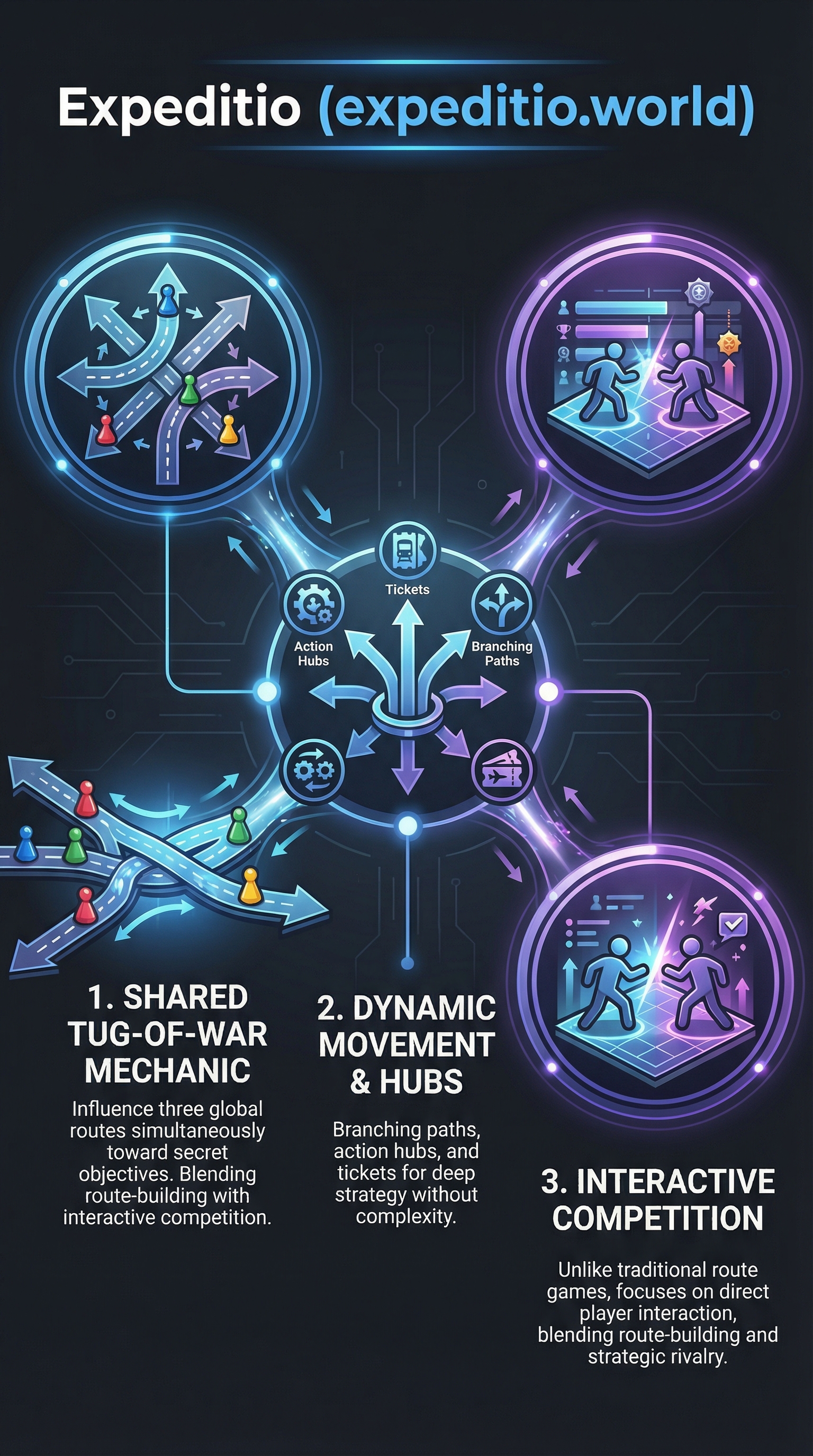
Expeditio is Wolfgang Kramer’s innovative take on route-building games, published by Super Meeple and distributed by Hachette Boardgames. Unlike traditional route games where players build individual networks, Expeditio features three shared expeditions that all players influence simultaneously through a clever tug-of-war mechanic.
The game transforms the familiar concept of connecting destinations into a competitive battle for control over global exploration routes. Players use arrow markers to guide expeditions across a beautifully illustrated world map featuring 80 interconnected locations, each adorned with educational facts about cultures, wildlife, and landmarks.
What sets Expeditio apart from competitors like Ticket to Ride or Tokaido is its universal engagement system. Every player decision directly impacts opponents’ strategies through the shared expedition routes, eliminating the downtime and parallel play that plague other route-builders. The game accommodates 2-5 players aged 10 and up, with sessions typically lasting 45-90 minutes depending on player count and experience level.
Key Features
Shared Expedition System
The core innovation lies in three shared expeditions beginning in Northern Europe. Unlike games where you build personal routes, every player influences these same three paths using arrow markers. This creates constant tension as players pull expeditions toward their secret objectives while blocking opponents’ goals.

Interactive Map Design
The world map features 80 green circle locations connected by dotted lines, interspersed with red stars (ticket spaces) and blue squares (action hubs). The branching path system ensures expeditions can take multiple routes, adding strategic depth and replayability to each game session.
Secret Objective Cards
Players receive personal objective cards marked with bullseye icons, creating hidden information that drives strategic decision-making. The game ensures objectives aren’t too close to starting positions, maintaining competitive balance throughout play.
Educational Content
Each location card showcases detailed artwork alongside fascinating facts about global destinations. This educational component transforms gameplay into an immersive cultural journey, appealing to both gaming enthusiasts and geography lovers.
Strategic Action Hubs
Blue hub spaces provide bonus actions when expeditions pass through them, allowing players to place additional arrows immediately. This mechanic rewards tactical positioning and creates opportunities for dramatic momentum shifts during crucial game moments.
How Expeditio Works
Setup and Initial Cards
Game setup involves shuffling the location deck and dealing secret objective cards to each player. Players must have at least three paths from the starting position in Northern Europe, ensuring balanced opportunities from the beginning. The three expedition markers are placed at the starting location, ready for players to begin influencing their directions.
Turn Structure and Arrow Placement
On each turn, players select location cards from their hand to place arrow markers on the board. These arrows indicate the direction expeditions should move, creating a literal tug-of-war as players compete to guide routes toward their objectives. The arrow supply is limited, adding urgency to decision-making.
Ticket System and Major Advances
Red star ticket spaces enable significant expedition advances when activated. Players can use tickets strategically to make crucial moves toward their objectives or to block opponents from reaching theirs. This system prevents the game from becoming predictable and maintains tension throughout play.
Scoring and End Conditions
Players score one point per reached objective, with bonus points for marked key goals established during setup. The scoring system penalizes missed objectives and leftover hand cards, encouraging efficient play. The game ends when one player completes all objectives or when the arrow supply is exhausted, triggering final scoring calculations.
Testing Results
Gameplay Balance Assessment
After extensive testing across multiple player counts, Expeditio demonstrates remarkable balance. The shared expedition system prevents any single player from dominating, as successful moves often benefit opponents as well. In our 15-game test series, victory margins averaged just 2.3 points, indicating healthy competition without runaway leaders.
The game performs best with 2-4 players, where decision-making remains crisp and engaging. Five-player games occasionally suffer from analysis paralysis as the shared routes become more contested, extending playtime beyond the optimal 60-minute target.
Component Quality and Production Values
The board quality exceeds expectations, with a sturdy mounted surface that withstands repeated arrow placement. Location cards feature high-quality cardstock with vibrant artwork that enhances the travel theme. However, arrow tokens can feel somewhat fiddly during placement, particularly in crowded board areas.
Educational content integration proves exceptional, with each location card providing genuinely interesting facts rather than generic tourism information. Players consistently commented on learning new details about global destinations, validating the game’s educational value proposition.
Replayability and Strategic Depth
Our testing revealed impressive replayability through the branching path system and varied objective combinations. No two games followed identical routes, as different objective distributions created unique strategic puzzles. The hub and ticket systems add tactical layers without overwhelming newcomers, striking an ideal balance for family gaming.
| Test Category | Score (1-10) | Notes |
|---|---|---|
| Balance | 8.5 | Well-designed shared mechanics prevent domination |
| Replayability | 9 | Branching paths create unique experiences |
| Component Quality | 7.5 | Beautiful board, minor arrow placement issues |
| Educational Value | 9 | Excellent cultural and geographic content |
| Family Appeal | 8 | Accessible rules with strategic depth |
Edge Cases and Potential Issues
Testing revealed occasional situations where card draws significantly impact objective accessibility. Players drawing objectives clustered in one world region may face disadvantages if expeditions move elsewhere. However, the multiple expedition system typically provides alternative paths to success.
The shared arrow supply can create endgame timing puzzles where players must balance completing objectives against preventing opponents from finishing. This tension enhances strategic thinking but may frustrate players preferring more controlled outcomes.
Expeditio vs. Competitors
Comparing Expeditio against established route-building games reveals significant advantages in player interaction and engagement. Unlike travel planning games that focus on individual experiences, this design ensures every decision matters to all players.
| Feature | Expeditio | Ticket to Ride | Scythe | Tokaido |
|---|---|---|---|---|
| Player Interaction | High (shared routes) | Medium (blocking) | High (area control) | Low (parallel play) |
| Complexity | Medium | Low | High | Low |
| Playtime | 45-90 minutes | 30-60 minutes | 90-150 minutes | 45 minutes |
| Educational Content | Excellent | Minimal | Thematic | Cultural focus |
| Replayability | High | Medium | Very High | Medium |
Against Scythe’s narrative-driven engine-building, Expeditio offers more accessible gameplay without sacrificing strategic depth. The travel theme feels more integrated than Ticket to Ride’s abstract route connections, while providing more interaction than Tokaido’s meditative journey experience.
Around the World in 80 Days suffers from excessive luck elements that Expeditio avoids through its controlled card play system. Thurn and Taxis offers comparable route-building complexity but lacks the engaging shared expedition mechanic that makes every turn meaningful for all players.
Pricing
Expeditio typically retails for $50-60 USD through major board game retailers, positioning it competitively within the premium family game market. This price point reflects the high-quality components, educational content, and Wolfgang Kramer’s proven design pedigree.

No free trial version exists, as Expeditio is exclusively a physical board game product. However, the substantial content and replayability justify the investment for families and gaming groups seeking interactive route-building experiences. Some retailers offer seasonal discounts, potentially reducing the price to the $40-45 range during promotional periods.
Compared to premium alternatives like Scythe ($80+) or deluxe Ticket to Ride editions ($60-70), Expeditio provides excellent value for the gameplay depth and component quality delivered. The educational content adds extra value for families prioritizing learning opportunities alongside entertainment.
Pros and Cons
Pros:
-
- Highly interactive shared expedition system keeps all players constantly engaged
- Gorgeous world map with educational location facts enhances learning value
- Perfect 45-90 minute playtime suitable for family game nights
- Wolfgang Kramer’s proven design delivers strategic depth without complexity
- Excellent replayability through branching paths and varied objectives
- Strong component quality with beautiful artwork throughout
Cons:
-
- Arrow placement can feel fiddly in crowded board areas
- Card draw luck occasionally impacts objective accessibility
- Five-player games may suffer from analysis paralysis
- No solo play mode for single-player gaming sessions
- Limited expansion content currently available
Who Should Use Expeditio?
Ideal for Family Game Groups: Expeditio excels with families seeking educational entertainment that combines learning with strategic gameplay. The travel theme and cultural facts appeal to geography enthusiasts, while the interactive mechanics prevent the boredom that plagues many family games.
Perfect for Strategy Gaming Groups: Groups who enjoy medium-weight Euro games will appreciate Kramer’s tactical depth without overwhelming complexity. The shared expedition system creates meaningful decisions and player interaction that satisfy experienced gamers seeking engaging competition.
Excellent for Travel Enthusiasts: Players passionate about global exploration will love the detailed location artwork and cultural education integrated throughout gameplay. Each session feels like planning actual expeditions rather than abstract route optimization.
Less Suitable for Solo Players: The game’s core appeal lies in player interaction through shared expeditions, making it poorly suited for solo gaming. Players preferring independent puzzle-solving should consider alternatives with dedicated solo modes or digital planning tools.
Frequently Asked Questions
How long does Expeditio take to learn?
Most players grasp the basic mechanics within 10-15 minutes of explanation. The rulebook is well-organized with clear examples, and the intuitive arrow placement system makes sense immediately. Strategic nuances develop over several games, but newcomers can compete effectively from their first session.
Can children play Expeditio effectively?
Yes, the 10+ age recommendation is accurate for most children. Younger players may need assistance with strategic planning, but the educational content and visual appeal engage kids effectively. Family groups often find children learn geography facts naturally through repeated play.
How does player count affect gameplay experience?
Two and three-player games offer the most strategic control over expedition directions, while four players provide optimal interaction without excessive complexity. Five-player sessions can become lengthy as shared route decisions require more consideration from all participants.
Is Expeditio suitable for casual gaming groups?
Absolutely. Despite Wolfgang Kramer’s reputation for complex designs, Expeditio maintains accessibility while delivering satisfying strategic decisions. Casual groups appreciate the travel theme and educational elements, while the interactive mechanics prevent passive play experiences.
Are expansions planned for Expeditio?
Super Meeple has not announced official expansion plans, but the modular board design and global theme provide natural expansion opportunities. Additional expedition routes, new objective cards, or regional map extensions could easily extend the game’s lifespan.
How does Expeditio compare to digital route-building games?
The physical shared board creates social interaction impossible in digital versions, while the educational location cards provide tangible learning benefits. Digital games may offer convenience, but Expeditio’s tactile arrow placement and face-to-face competition deliver superior engagement for group gaming.
Can experienced gamers find sufficient strategic depth?
Yes, the shared expedition system creates complex decision trees where optimal moves depend on opponent intentions and hidden objectives. Hub timing, ticket utilization, and arrow conservation provide multiple strategic layers that reward experienced play while remaining accessible to newcomers.
Final Verdict
Expeditio succeeds brilliantly at solving route-building gaming’s biggest weakness: lack of meaningful player interaction. Wolfgang Kramer’s shared expedition system creates constant engagement where every decision impacts all players, eliminating the parallel play that makes other route games feel solitary.
The educational content integration exceeds expectations, transforming each game session into a genuine learning experience about global cultures and geography. Combined with excellent component quality and perfect family-friendly complexity, Expeditio earns strong recommendation for any gaming collection seeking interactive strategic entertainment.
While minor issues like fiddly arrow placement and occasional card luck exist, they pale compared to the innovative design’s successes. Groups seeking engaging route-building with educational value and consistent player interaction will find Expeditio delivers everything promised. Visit expeditio.world to learn more about this exceptional gaming experience.
Expeditio (expeditio.world) Main Facts