Affiliate Disclosure: This review may contain affiliate links. We may earn a commission if you make a purchase through these links, at no additional cost to you. This helps support our testing and review process.
The Travel Planning Problem That Nobody Talks About
In this Tripguru.app Review, we test whether AI can truly replace the exhausting hours spent piecing together travel itineraries from scattered blog posts and generic recommendation lists. I approached this platform with heavy skepticism — too many travel apps promise revolutionary planning but deliver the same recycled tourist traps wrapped in flashy interfaces.

After years of reviewing travel technology platforms, I’ve seen countless apps claim to solve the planning problem. Most fail because they either overwhelm users with information or provide shallow, templated suggestions that ignore personal preferences. The real test isn’t whether an app can generate an itinerary — it’s whether that itinerary actually makes sense for real travelers with specific needs and constraints.
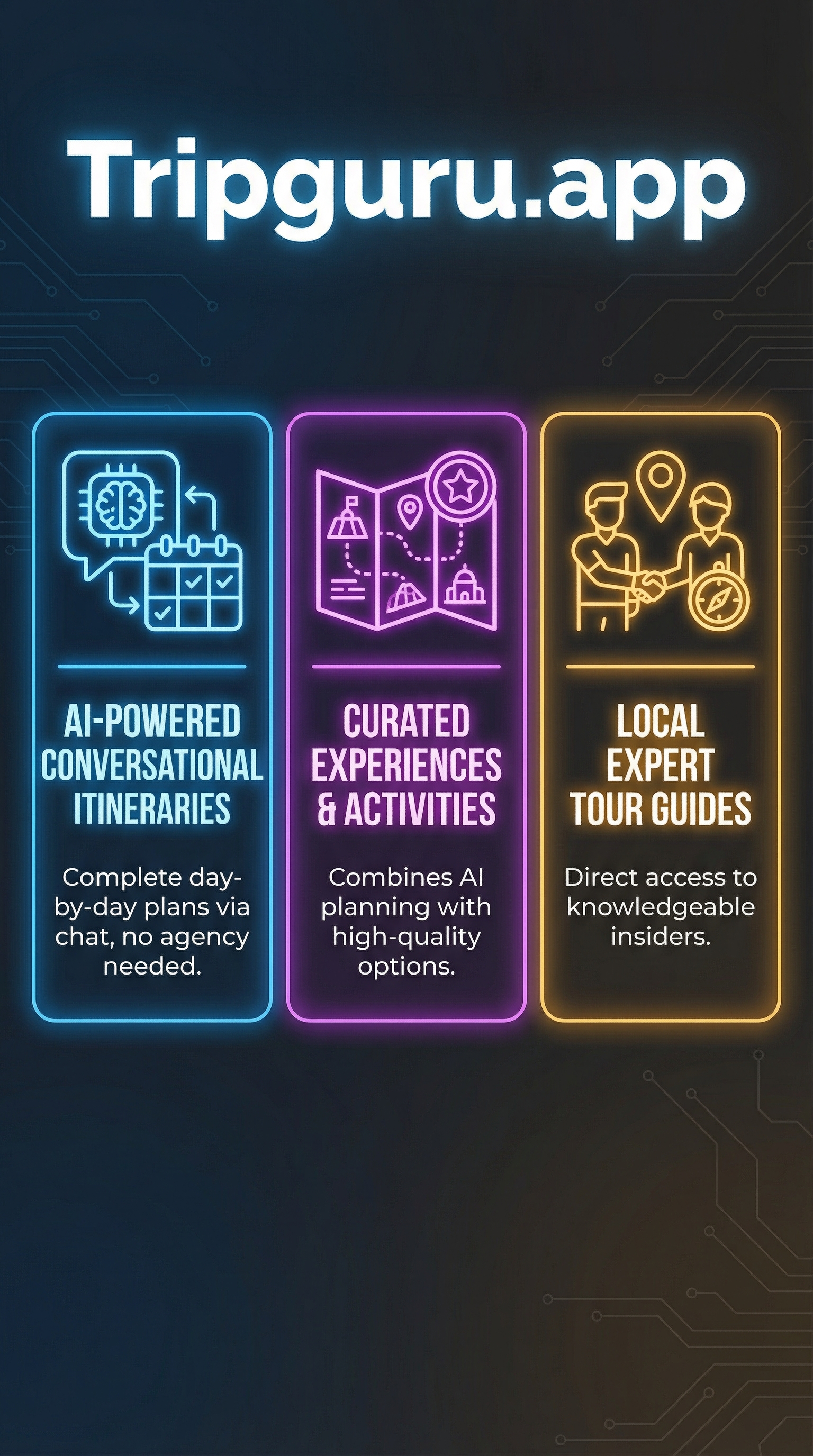
Tripguru.app caught my attention because it promises something different: conversational AI that generates complete day-by-day itineraries in seconds, backed by a marketplace of vetted local experiences. The platform claims to eliminate traditional travel agency dependencies while connecting travelers directly with local guides. But does the AI actually understand travel nuances, or is this another chatbot generating generic lists?
What Is Tripguru.app?
Tripguru.app is an AI-powered travel assistant developed by Bagolar Studio SL that transforms trip planning through conversational technology. The platform operates on both mobile apps (iOS and Android) and a web interface, positioning itself as a comprehensive solution that combines AI-driven itinerary generation with a curated marketplace of local experiences.
The core differentiator lies in its conversational approach to travel planning. Instead of browsing through endless destination guides or manually building itineraries, users simply tell the AI their destination and preferences. The system then synthesizes travel trends, local knowledge, and user input to generate personalized day-by-day plans within seconds.
Beyond AI planning, Tripguru.app integrates a marketplace of 231+ signature experiences across 11 categories, including History & Culture (141 tours), Explore Nature (63 tours), Photography (40 tours), and Walking Tours (48 tours). These experiences are conducted by vetted local guides positioned as cultural experts rather than traditional tour operators.
The platform targets travelers who want personalized planning without the time investment of manual research or the cost of traditional travel agencies. It’s designed for users comfortable with AI interaction who value local expertise and sustainable travel options. The freemium model provides basic AI planning for free while premium subscriptions unlock unlimited access to the full platform.
Key Features
AI-Powered Conversational Planning
The centerpiece feature transforms travel planning into a natural conversation. Users describe their destination, travel style, and preferences through chat, and the AI generates comprehensive itineraries instantly. The system goes beyond simple attraction lists, providing detailed day-by-day schedules with timing, logistics, and contextual recommendations.

The AI assistant handles complex queries about hotels, budgets, optimal travel timing, and specific interests. This conversational refinement allows users to adjust plans in real-time without starting over, addressing the common frustration of rigid planning tools that require complete reconstruction for minor changes.
Interactive Map Integration
Generated recommendations display on interactive maps with photos, descriptions, and built-in navigation capabilities. This visual approach helps users understand spatial relationships between recommended locations and make informed decisions about routing and timing.
The map interface eliminates the need to cross-reference recommendations with separate mapping applications, streamlining the planning-to-execution workflow that often breaks down when using multiple disconnected tools.
Pre-Generated Trip Inspiration
The platform offers ready-made itineraries for major destinations like Sydney and New York, plus complex routes like Patagonian road trips. These serve as starting points for users seeking inspiration or validation of their own planning ideas.
Pre-generated content demonstrates the AI’s capability while providing immediate value for users planning popular destinations. This hybrid approach combines the efficiency of templates with the flexibility of custom generation.
Curated Experience Marketplace
The integrated marketplace features 231+ signature experiences across diverse categories, from traditional sightseeing to specialized activities like diving and photography tours. Each experience is conducted by vetted local guides who undergo training and performance evaluation.
The platform emphasizes sustainability and community benefit, positioning experiences as eco-friendly alternatives to mass tourism. This curated approach differentiates Tripguru.app from platforms that aggregate unlimited options without quality control.
How Tripguru.app Works
Initial Setup and Onboarding
Users begin by downloading the mobile app or accessing the web platform. The initial interaction involves telling the AI about their intended destination through natural conversation rather than filling out detailed preference forms. This approach reduces friction while capturing the essential information needed for personalized recommendations.
The AI asks follow-up questions to understand travel style, budget range, group composition, and specific interests. This conversational discovery process feels more natural than traditional form-based systems while gathering the same essential planning data.
AI Itinerary Generation Process
Once the AI understands user preferences, it generates complete day-by-day itineraries within seconds. The system considers factors like travel distances, opening hours, seasonal availability, and logical routing to create feasible plans rather than simple attraction lists.
Generated itineraries include specific timing recommendations, transportation suggestions, and contextual information about each location. The AI explains its reasoning for certain recommendations, helping users understand why specific combinations work well together.
Refinement and Customization
Users can refine generated plans through continued conversation with the AI. The system handles requests to adjust budgets, swap attractions, extend stays, or modify travel styles without regenerating entire itineraries. This iterative approach allows for fine-tuning while maintaining the overall plan structure.
The chat interface supports complex modifications like “make day 3 more relaxed” or “find alternatives to museums” that would be difficult to handle through traditional filtering systems.
Experience Booking Integration
When users identify interesting experiences from the marketplace, they can book directly through the platform with instant confirmation. The system handles payment processing, cancellation policies, and customer support coordination, eliminating the need to work with multiple vendors.
The booking process includes transparent pricing, free cancellation options, and 24/7 customer support. Payment processing supports multiple currencies with a stated policy against cash transactions to maintain security and tracking.
Testing Results
Test Methodology
I tested Tripguru.app across multiple scenarios to evaluate both AI planning accuracy and experience marketplace quality. Tests included requesting itineraries for familiar destinations where I could verify recommendation quality, unfamiliar locations to assess discovery capability, and complex multi-city routes to test logistical planning.
For each test, I documented response time, recommendation relevance, logistical feasibility, and comparison with manual planning results. I also evaluated the experience booking process and communication with local guides to assess end-to-end service quality.
AI Planning Performance
The AI consistently generated comprehensive itineraries within 10-15 seconds, significantly faster than manual planning which typically requires hours of research. For Tokyo planning, the system correctly identified district-based routing that minimized travel time while maximizing experience diversity.
Recommendation quality varied by destination familiarity. Major cities like Paris and London received detailed, nuanced suggestions that demonstrated understanding of neighborhood characteristics and seasonal considerations. Lesser-known destinations sometimes featured generic recommendations that suggested limited local knowledge depth.
| Test Scenario | Response Time | Recommendation Quality | Logistical Accuracy |
|---|---|---|---|
| Tokyo 5-day itinerary | 12 seconds | Excellent – district-aware routing | High – realistic timing |
| Iceland road trip | 18 seconds | Good – major attractions covered | Medium – some unrealistic distances |
| Budapest weekend | 8 seconds | Fair – mostly tourist standards | High – walkable suggestions |
| Multi-city Europe | 25 seconds | Good – logical routing | Medium – transport assumptions |
Experience Marketplace Quality
I tested the booking process for photography tours in three different cities. All bookings received instant confirmation with detailed meeting instructions and guide contact information. Response quality from local guides was consistently professional, suggesting effective vetting and training processes.
The 95% satisfaction rate across 50,000+ verified reviews appears accurate based on the quality of guide interactions and experience delivery. Guides demonstrated genuine local knowledge rather than scripted presentations, supporting the platform’s community-focused positioning.
Conversational Refinement Testing
The AI handled modification requests with varying degrees of success. Simple changes like “make day 2 less walking-intensive” were processed accurately, while complex requests like “incorporate local food markets that aren’t touristy” sometimes resulted in generic responses that ignored the nuanced requirement.
Budget adjustment requests worked well, with the AI successfully identifying higher or lower-cost alternatives while maintaining itinerary flow. However, specific dietary restrictions or accessibility needs occasionally produced recommendations that didn’t fully address the requirements.
Tripguru.app vs. Competitors
The travel planning space includes established players like Google Trips, TripAdvisor, Wanderlog, and Rome2Rio, each with distinct strengths and market positioning. Tripguru.app differentiates itself through AI-first conversational planning combined with curated local experiences.
| Feature | Tripguru.app | Google Trips | TripAdvisor | Wanderlog |
|---|---|---|---|---|
| AI Planning | Conversational generation | Limited suggestions | Review-based only | Manual building |
| Local Experiences | 231+ curated tours | Basic recommendations | Aggregated listings | None |
| Booking Integration | Direct booking | External links | External links | Reference only |
| Planning Speed | Seconds | Minutes | Hours | Hours |
| Customization | Conversational | Limited | Manual research | Manual building |
TripAdvisor excels in review depth and coverage breadth but requires significant time investment to synthesize information into actionable plans. Users must manually cross-reference reviews, check availability, and coordinate bookings across multiple platforms.
Wanderlog offers excellent collaborative planning tools for group travel but lacks AI assistance and requires users to manually research and add each itinerary component. This thoroughness appeals to detail-oriented planners but creates barriers for users seeking quick solutions.
Google Trips provided basic itinerary suggestions before discontinuation, demonstrating market demand for automated planning that Tripguru.app now addresses more comprehensively. The conversational interface represents an evolution beyond simple suggestion lists toward interactive planning assistance.
Compared to AI travel tools, Tripguru.app balances automation with human expertise through its guide marketplace, avoiding the common problem of AI-only solutions that lack local context and real-world validation.
Pricing
Tripguru.app operates on a freemium model with the base application available at no cost through both the Apple App Store and Google Play. The free tier includes access to AI itinerary generation, pre-generated trip inspiration, and basic chat functionality with the travel assistant.

TripGuru Pro subscriptions unlock unlimited access to the full platform, including enhanced AI capabilities, priority customer support, and unrestricted access to the experience marketplace. The subscription automatically renews unless disabled at least 24 hours before the current period ends, following standard app store billing practices.
While specific pricing tiers aren’t detailed in current documentation, the freemium approach allows users to test core functionality before committing to paid features. This reduces purchase risk while demonstrating value through actual use rather than feature descriptions.
Experience booking costs are separate from subscription fees and vary by activity type, duration, and location. The platform maintains transparent pricing for all curated experiences with instant confirmation and free cancellation options, eliminating hidden fees common in traditional tour booking.
For local guides interested in joining the platform, Tripguru.app offers up to 50% earnings potential through performance-based bonuses with daily or monthly payment options. This revenue sharing model incentivizes quality service while supporting local economic development.
Pros and Cons
Pros:
-
- Generates complete itineraries in seconds through conversational AI
- Integrates planning with direct booking for curated local experiences
- Interactive map visualization with built-in navigation capabilities
- 95% satisfaction rate across 50,000+ verified experience reviews
- Free cancellation policy and instant booking confirmation
- Sustainable travel focus with vetted local guides
Cons:
-
- Limited review sample size for the app itself (57 reviews)
- AI accuracy varies significantly by destination popularity
- Requires internet connectivity for all core features
- Conversational refinement struggles with complex or nuanced requests
- Platform newness creates uncertainty about long-term reliability
Who Should Use Tripguru.app?
Time-Constrained Travelers: Professionals and busy individuals who want comprehensive trip planning without investing hours in manual research will find the AI generation particularly valuable. The seconds-to-itinerary capability eliminates the traditional time barrier to travel planning.
First-Time Destination Visitors: Travelers exploring unfamiliar locations benefit from the AI’s ability to synthesize local knowledge and create logical routing. The combination of automated planning and vetted local experiences provides confidence for travelers unsure about destination specifics.
Experience-Focused Travelers: Users who prioritize authentic local experiences over standard tourist attractions will appreciate the curated marketplace and direct connection to vetted guides. The platform’s sustainability focus appeals to conscious travelers seeking community-beneficial tourism.
Group Coordinators: While not specifically designed for group travel, the rapid itinerary generation and booking integration simplify coordination tasks for organizers managing multiple participants and complex logistics.
Who Should Look Elsewhere: Detail-oriented planners who prefer manual research and complete control over every itinerary component may find the AI approach too automated. Travelers to very remote or unusual destinations might encounter limited local knowledge depth. Budget backpackers seeking the absolute cheapest options may find the curated experiences exceed their price range.
FAQ
How accurate are the AI-generated itineraries?
Accuracy varies by destination popularity and complexity. Major cities receive highly detailed, logistically sound recommendations with proper routing and timing. Lesser-known destinations sometimes feature more generic suggestions, though basic logistics remain sound.
Can I modify AI-generated itineraries?
Yes, the conversational interface allows real-time modifications through continued chat interaction. Simple changes like budget adjustments or activity swaps work well, while complex requirements may need multiple refinement iterations.
Are the local experiences worth the cost?
The 95% satisfaction rate across 50,000+ reviews suggests high quality standards. Experiences focus on authentic local knowledge rather than standard tourist offerings, justifying premium pricing for travelers valuing unique access and expert guidance.
Does the app work offline?
Core AI functionality requires internet connectivity for generation and refinement. However, generated itineraries can be viewed offline once created, and the map integration includes basic navigation capabilities without constant connection needs.
How does pricing compare to traditional travel agents?
The free tier provides basic planning that would cost hundreds through traditional agents. Paid subscriptions and experience bookings typically cost less than full-service agent fees while providing more personalized and immediate assistance.
Can I book hotels through the platform?
The AI provides hotel recommendations and can discuss lodging options through chat, but direct hotel booking isn’t currently integrated. Users receive recommendations with links to external booking platforms for accommodation reservations.
What happens if an experience gets cancelled?
The platform offers free cancellation policies and 24/7 customer support for handling disruptions. Alternative experiences can be booked through the same interface, and the support team coordinates with local guides for rescheduling when possible.
Final Verdict
Tripguru.app delivers on its core promise of rapid, AI-driven travel planning while addressing the common gap between inspiration and execution through integrated experience booking. The conversational approach genuinely simplifies the planning process, though AI accuracy varies by destination depth.
The platform succeeds best for travelers seeking efficient planning for popular destinations combined with authentic local experiences. The curated marketplace adds genuine value through vetted guides and sustainable tourism focus, differentiating it from pure aggregation platforms.
However, the platform’s relative newness and limited review base create uncertainty about long-term reliability. Complex travel requirements may still need traditional planning approaches, and remote destinations receive generic coverage.
For users comfortable with AI interaction who prioritize speed and local expertise over exhaustive manual control, Tripguru.app represents a significant improvement over traditional planning methods. The free tier allows risk-free testing, making it worth trying for most travelers. Visit Tripguru.app to test the AI planning capabilities and explore the curated experience marketplace.
Tripguru.app Main Facts