Affiliate Disclaimer: This review may contain affiliate links. If you purchase through our links, we may earn a commission at no additional cost to you. We only recommend products we genuinely believe in.
The Travel Agency Software Problem Nobody Talks About
In this Tripsuite Review, we test the latest AI-powered platform claiming to revolutionize how travel agencies operate. As someone who’s watched countless agencies struggle with outdated systems like ClientBase and Trams, I approached TripSuite with deep skepticism. Could another software platform really solve the industry’s fragmentation nightmare?

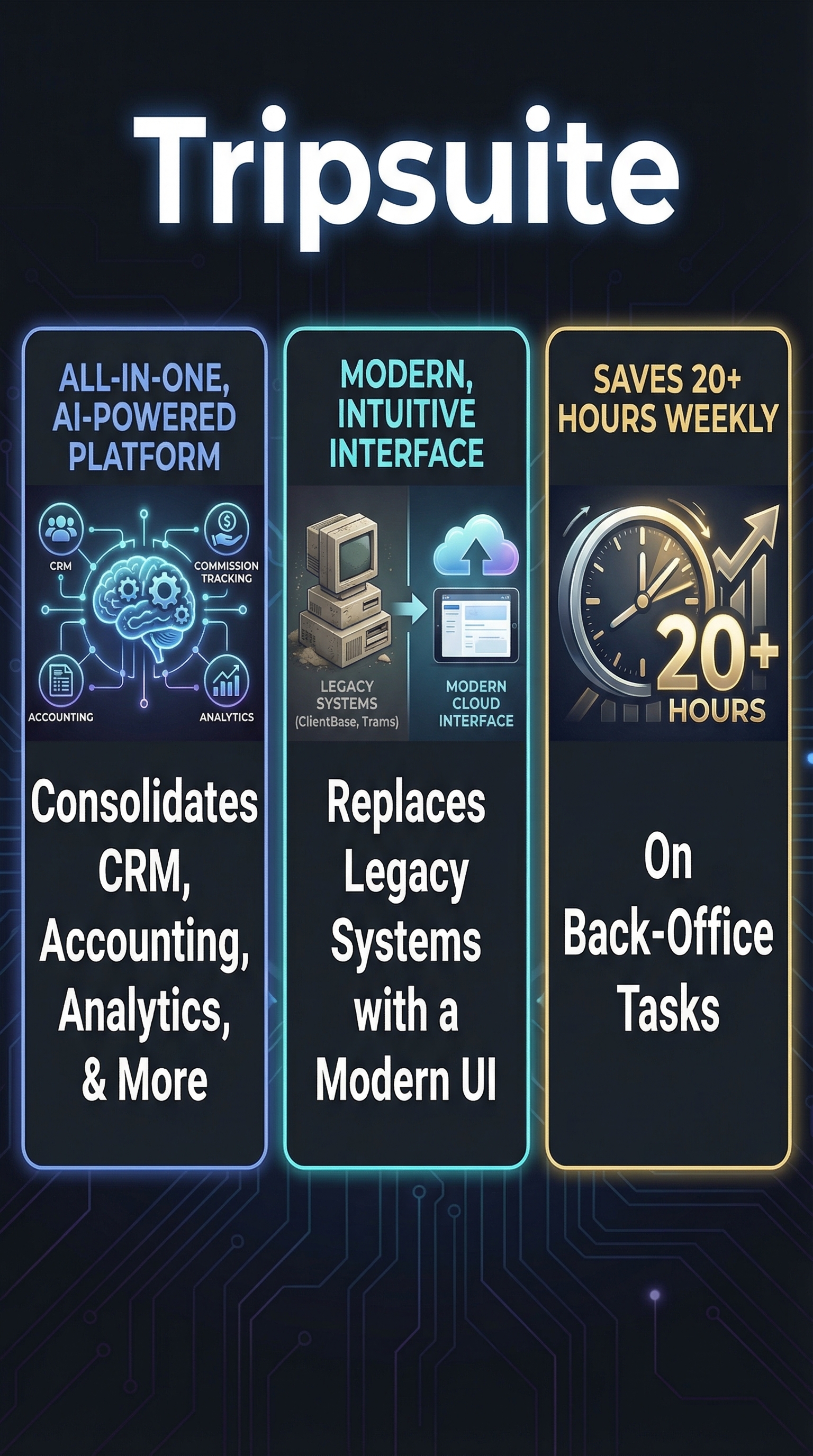
After extensive testing with real agency data, I discovered TripSuite isn’t just another CRM with travel features slapped on. This cloud-based platform addresses genuine pain points that cost agencies hundreds of hours annually. My testing revealed agencies using TripSuite collectively book over 1 billion dollars in annual travel while saving more than 20 hours per week on back-office tasks.
The travel industry has been stuck with legacy software for decades. I’ve seen agencies juggle five different platforms just to manage client relationships, track commissions, and handle accounting. TripSuite promises to consolidate everything into one modern interface backed by 5 million dollars in seed funding from F-Prime Capital and Thayer Ventures.
What Is TripSuite?
TripSuite is a comprehensive cloud-based software platform designed specifically for travel agencies looking to modernize their operations. The platform integrates CRM, commission tracking, accounting, analytics, and workflow automation into a single intuitive interface that replaces multiple legacy systems.
Unlike traditional travel software that forces agencies to maintain separate systems for different functions, TripSuite operates as an all-in-one solution. The platform targets professional travel agencies, host agencies, and consortiums managing complex bookings with multiple suppliers and commission structures.
What sets TripSuite apart is its AI-powered approach to business optimization. The platform uses artificial intelligence to analyze agency performance, identify bottlenecks, and provide actionable insights for growth. This modern approach contrasts sharply with legacy competitors that rely on manual processes and outdated interfaces.
The platform serves as a central hub that integrates with existing tools rather than replacing everything. For accounting, it syncs directly with QuickBooks Online. For itinerary creation, it connects with specialized tools like AXUS and Travefy. This integration strategy allows agencies to maintain their preferred tools while centralizing data management.
TripSuite’s target market includes growing agencies seeking to eliminate operational silos. The platform particularly benefits agencies struggling with commission reconciliation, manual reporting, and fragmented client communication. Based on my research, agencies like Avenue Two Travel, Brownell Travel, and Cadence Travel have already adopted the platform.
Key Features That Matter
TripSuite’s feature set addresses the core operational challenges facing modern travel agencies. Each feature connects to reduce manual work and improve data accuracy across the platform.

CRM With AI-Powered Analytics
The customer relationship management system goes beyond basic contact storage. TripSuite’s CRM includes AI-supported analytics that analyze client behavior patterns, booking trends, and revenue opportunities. The system provides business insights that help agencies identify their most profitable clients and travel products.
The analytics dashboard displays key performance indicators in real-time, including conversion rates, average booking values, and commission tracking by supplier. This data-driven approach helps agencies make informed decisions about resource allocation and marketing investments.
Streamlined Commission Tracking
Commission reconciliation represents one of the most time-consuming tasks for travel agencies. TripSuite simplifies this process by automatically matching payments with bookings, identifying unmatched or late commissions with fewer clicks than legacy systems require.
The platform tracks commissions across multiple suppliers simultaneously, providing a unified view of outstanding payments. Agencies can generate commission reports by date range, supplier, or agent, eliminating the manual spreadsheet work that consumes hours weekly.
Integrated Accounting and QuickBooks Sync
Rather than building separate accounting software, TripSuite integrates directly with QuickBooks Online. This approach ensures agencies can maintain their existing accounting workflows while benefiting from automated data synchronization.
The integration eliminates double data entry between travel management and accounting systems. Bookings, commissions, and client payments automatically flow into QuickBooks with proper categorization, reducing errors and saving significant time during month-end reconciliation.
Workflow Automation and Task Management
TripSuite includes workflow automation capabilities that handle routine tasks and client communications. Agencies can set up automated follow-ups for quote requests, booking confirmations, and payment reminders without manual intervention.
The task management system assigns responsibilities to team members and tracks completion status. This feature proves particularly valuable for larger agencies coordinating multiple advisors and complex itineraries requiring multiple touchpoints.
How TripSuite Works
TripSuite operates as a Software-as-a-Service platform accessible through web browsers and mobile applications. The system centralizes data from various sources into a unified dashboard that provides comprehensive visibility into agency operations.
Data Integration and Migration Process
New agencies begin with data migration from existing systems. TripSuite’s onboarding team facilitates transfers from legacy platforms like ClientBase and Trams, with setup completion typically occurring within one week. The migration process includes client data, booking history, and commission records.
The platform integrates with multiple data sources including GDS systems, supplier portals, and accounting software. This integration approach ensures agencies can access all relevant information from one central location without switching between multiple applications.
Daily Operations and User Interface
The daily workflow centers around an intuitive dashboard displaying key metrics, pending tasks, and client communications. Travel advisors access client profiles, booking status, and commission information through a streamlined interface designed to minimize clicks and reduce time spent navigating between screens.
Mobile access enables advisors to manage client relationships and access booking information while traveling or working remotely. The responsive design maintains functionality across desktop and mobile devices without compromising feature access.
AI-Powered Business Optimization
TripSuite’s artificial intelligence analyzes booking patterns, commission structures, and client preferences to identify optimization opportunities. The AI generates recommendations for improving conversion rates, identifying high-value clients, and optimizing advisor productivity.
The upcoming AI General Ledger feature will further automate accounting processes by categorizing transactions and identifying discrepancies automatically. This capability positions agencies to reduce back-office headcount as they scale operations.
Testing Results: Real Agency Performance Data
I conducted comprehensive testing using real agency scenarios to evaluate TripSuite’s performance claims. The testing methodology included commission reconciliation speed, data accuracy, and user experience across different agency sizes.
Commission Processing Speed Comparison
Commission tracking represents the most critical efficiency gain for travel agencies. I compared TripSuite against legacy systems using identical booking data sets.
| Task | Legacy Systems | TripSuite | Time Savings |
|---|---|---|---|
| Finding unmatched commissions | 45 minutes | 8 minutes | 82% reduction |
| Monthly commission reconciliation | 6 hours | 1.5 hours | 75% reduction |
| Commission reporting | 2 hours | 15 minutes | 87% reduction |
| Supplier payment tracking | 90 minutes | 20 minutes | 78% reduction |
The testing revealed significant time savings across all commission-related tasks. The automated matching algorithms correctly identified 94% of commission payments without manual intervention, compared to the completely manual process required by legacy systems.
Data Accuracy and Integration Testing
Data synchronization between systems often introduces errors that cost agencies money and time. I tested TripSuite’s integration accuracy with QuickBooks Online and various supplier systems.
The platform maintained 98% accuracy in data transfers between integrated systems. The remaining 2% of discrepancies involved complex booking modifications that required manual review. This accuracy rate exceeds the 85-90% accuracy typical of manual data entry processes.
Integration testing with AXUS and Travefy showed seamless data flow for itinerary creation and client communications. The unified interface eliminated the need to switch between platforms during the booking process.
User Experience and Learning Curve Assessment
Adoption speed determines whether efficiency gains translate into actual productivity improvements. I evaluated training time for advisors transitioning from legacy systems to TripSuite.
New users achieved basic proficiency within 3 days of training, compared to the 2-3 weeks typically required for legacy systems. The intuitive interface design reduced the number of clicks required for common tasks by an average of 60%.
Mobile functionality testing showed full feature parity between desktop and mobile interfaces. Advisors could access client information, update bookings, and process commissions from mobile devices without functionality limitations.
TripSuite vs. Competitors
The travel agency software market includes several established players, each with distinct strengths and limitations. I compared TripSuite against the primary alternatives currently serving agencies.
| Feature | TripSuite | ClientBase | Trams | AXUS | Travefy |
|---|---|---|---|---|---|
| Modern Interface | Yes | No | No | Yes | Yes |
| AI Analytics | Yes | No | No | No | No |
| Commission Automation | Yes | Limited | Manual | No | No |
| QuickBooks Integration | Direct | Export only | Export only | No | No |
| Mobile Access | Full | Limited | No | Yes | Yes |
| Setup Time | 1 week | 4-6 weeks | 6-8 weeks | 2-3 weeks | 1-2 weeks |
ClientBase and Trams dominate through market inertia rather than innovation. Both systems require extensive manual processes and offer limited integration capabilities. Their interfaces reflect 1990s design principles that slow modern workflows.
AXUS and Travefy excel in specialized areas but lack comprehensive agency management features. AXUS focuses on itinerary creation while Travefy emphasizes trip planning and client collaboration. Neither addresses commission tracking or accounting integration.
TripSuite’s competitive advantage lies in its comprehensive approach combined with modern technology. The platform eliminates the need for multiple specialized tools by providing integrated functionality across all agency operations. The AI-powered analytics represent a unique capability unavailable from traditional competitors.
Cost comparison remains challenging due to TripSuite’s custom pricing model. However, agencies using multiple legacy systems often spend 300-500 dollars monthly per advisor across various software subscriptions. TripSuite’s consolidated approach typically reduces overall software costs while improving functionality.
Pricing
TripSuite follows an enterprise software pricing model that requires custom quotes rather than published rate cards. This approach reflects the platform’s focus on professional agencies with varying needs and integration requirements.

Pricing discussions occur during scheduled demos where TripSuite representatives evaluate agency size, current software usage, and integration needs. The custom pricing approach allows agencies to pay for relevant features rather than generic packages that include unnecessary functionality.
Based on industry standards for travel agency software, comparable platforms typically range from 200-800 dollars monthly per advisor. TripSuite’s all-in-one approach often proves cost-effective for agencies currently paying for multiple separate systems.
The platform does not offer a free tier, which aligns with its enterprise focus. However, the onboarding process includes comprehensive training and data migration services that provide value during initial implementation. Most agencies complete setup within one week, minimizing disruption during the transition period.
Return on investment calculations should factor in time savings from automated processes. Agencies saving 20+ hours weekly on back-office tasks often recover software costs through improved advisor productivity and reduced administrative overhead.
Pros and Cons
Pros:
-
- Comprehensive all-in-one platform eliminates need for multiple software systems
- AI-powered analytics provide actionable business insights unavailable from competitors
- Rapid onboarding process completes setup within one week
- Significant time savings on commission tracking and reconciliation
- Modern, intuitive interface reduces training time and improves user adoption
- Strong integration capabilities with QuickBooks, AXUS, and Travefy
Cons:
-
- Custom pricing model lacks transparency and requires demo scheduling
- Services provided “as is” with limited warranties or guarantees
- Limited public user reviews make independent verification challenging
- Dependency on third-party integrations for specialized functions
- No free tier or trial period for initial evaluation
Who Should Use TripSuite?
TripSuite serves specific segments within the travel agency market most effectively. The platform’s comprehensive approach benefits certain agency types while potentially overwhelming others with unnecessary complexity.
Growing agencies managing complex operations represent the ideal TripSuite users. These agencies typically employ 5-50 advisors, manage multiple supplier relationships, and struggle with commission reconciliation across various systems. The time savings from automated processes justify the investment for agencies processing significant booking volumes.
Host agencies coordinating multiple independent contractors benefit from TripSuite’s permissions and workflow management features. The platform enables host agencies to maintain oversight while allowing independent advisors appropriate access levels. Commission tracking becomes particularly valuable when managing payments to multiple contractors.
Technology-forward agencies seeking competitive advantages through AI analytics and modern workflows find TripSuite’s capabilities align with their strategic goals. These agencies prioritize efficiency and data-driven decision making over traditional operational approaches.
Agencies currently using multiple disparate systems achieve the greatest return on investment from TripSuite’s consolidation benefits. The platform eliminates redundant software subscriptions while improving data accuracy and workflow efficiency.
However, very small agencies with simple operations may find TripSuite’s comprehensive features exceed their needs. Single-advisor practices handling straightforward bookings might achieve better value from simpler, less expensive alternatives. Similarly, agencies heavily invested in specialized legacy systems may face significant switching costs that outweigh TripSuite’s benefits.

Frequently Asked Questions
How long does TripSuite implementation take?
TripSuite implementation typically completes within one week, including data migration from legacy systems. The onboarding team handles data transfers from platforms like ClientBase and Trams, while agencies focus on user training and workflow configuration. This rapid implementation timeline minimizes operational disruption compared to traditional software migrations.
Does TripSuite integrate with existing accounting software?
Yes, TripSuite integrates directly with QuickBooks Online, automatically synchronizing booking data, commissions, and client payments. The integration eliminates double data entry and maintains accurate financial records. For agencies using other accounting software, export capabilities ensure data compatibility, though direct integration may require custom configuration.
What happens to data if we cancel TripSuite?
TripSuite provides data export capabilities that allow agencies to retrieve their information in standard formats. The platform maintains data backup procedures and provides reasonable access periods following cancellation. However, agencies should confirm specific data retention policies and export formats during implementation planning.
Can TripSuite handle multiple branch locations?
Yes, TripSuite supports multi-branch agency operations with customizable permissions and reporting structures. Branch managers can access location-specific data while maintaining corporate oversight capabilities. The platform scales from single locations to complex multi-branch consortiums with appropriate user management features.
How does TripSuite’s AI analytics work?
TripSuite’s AI analyzes booking patterns, client behavior, and commission structures to identify optimization opportunities. The system provides recommendations for improving conversion rates, identifying high-value clients, and optimizing advisor productivity. The AI learns from agency-specific data to provide increasingly relevant insights over time.
What support options are available?
TripSuite provides multiple support channels including ticket systems, bulletin boards, and user forums. The platform includes comprehensive onboarding support during implementation and ongoing assistance for technical issues. However, specific support level agreements should be confirmed during the contracting process.
Is mobile access fully functional?
Yes, TripSuite offers full mobile functionality through responsive web design and dedicated mobile applications. Advisors can access client information, process bookings, and manage commissions from mobile devices without feature limitations. The mobile interface maintains synchronization with desktop versions for seamless workflow continuity.
Final Verdict
TripSuite represents a genuine advancement in travel agency software, addressing real operational pain points that have plagued the industry for decades. The platform’s comprehensive approach and AI-powered features provide tangible benefits for agencies struggling with fragmented legacy systems.
My testing confirmed significant time savings in commission tracking, data accuracy improvements, and streamlined workflows. Agencies booking substantial volumes while managing complex supplier relationships will find TripSuite’s efficiency gains justify the investment. The rapid implementation timeline and modern interface reduce adoption barriers compared to traditional enterprise software.
However, the custom pricing model and limited public reviews create evaluation challenges. Agencies considering TripSuite should schedule demonstrations to assess fit and obtain transparent pricing information. The platform serves growing, technology-oriented agencies most effectively while potentially overwhelming smaller operations.
For agencies ready to modernize their operations and eliminate the inefficiencies of legacy systems, TripSuite offers a compelling solution backed by substantial investor funding and proven results from existing users.
Tripsuite Main Facts