The Sunda Strait Bridge Transformative Infrastructure Vision Takes Shape
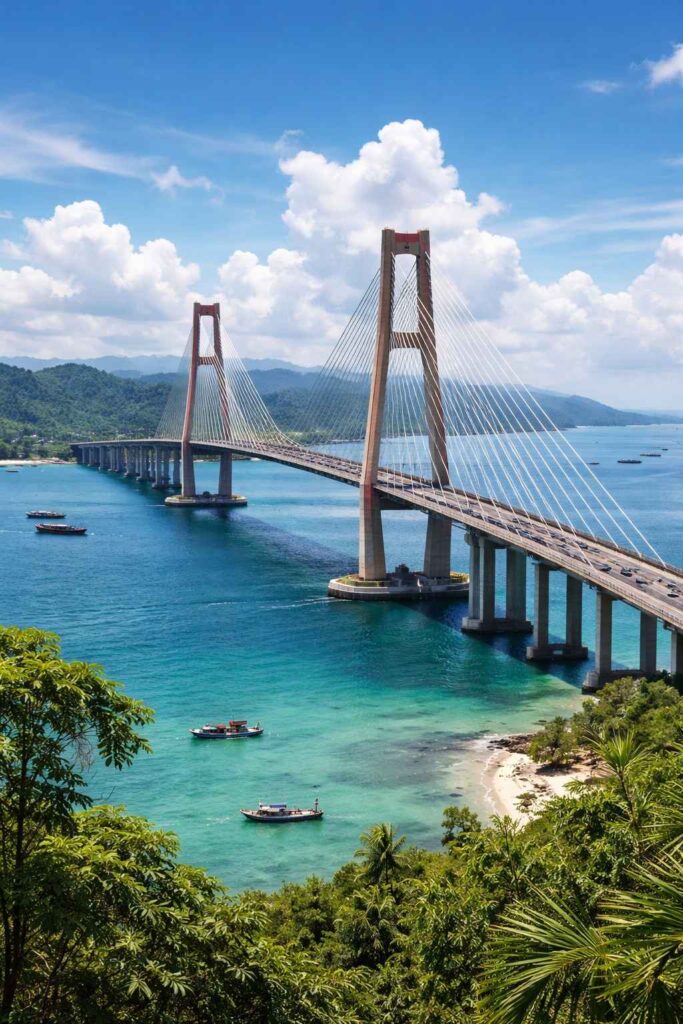
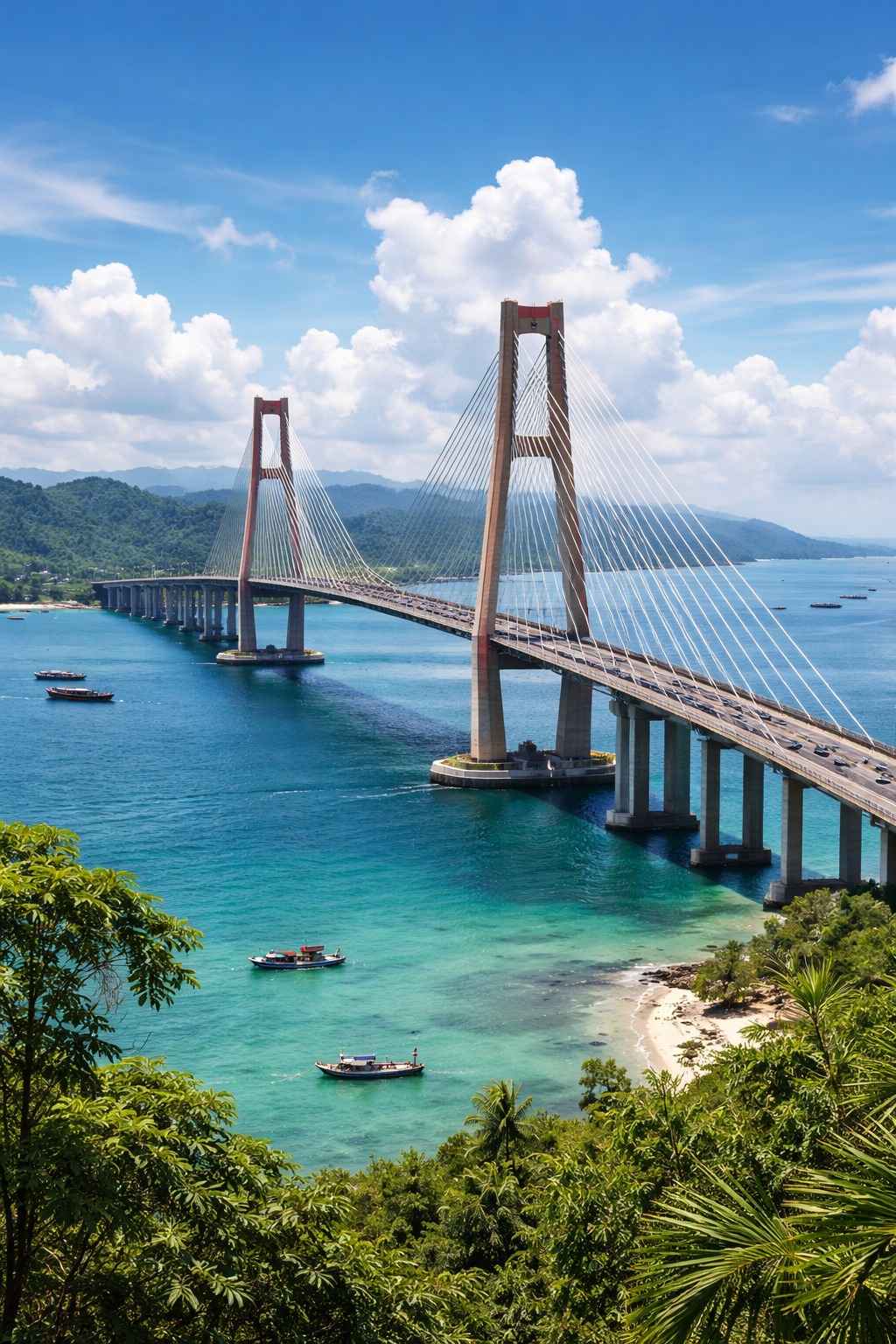
The Sunda Strait Bridge represents one of Indonesia’s most ambitious infrastructure undertakings, with government officials working intensively to meet President Susilo Bambang Yudhoyono’s target of beginning construction in 2014. This massive project could fundamentally reshape economic connectivity between Java and Sumatra, two of Indonesia’s most vital islands.
In a recent statement, Minister of Public Works Djoko Kirmanto revealed significant progress in organizing the project’s implementation structure. He disclosed that he has carefully selected several state-owned enterprises to form a consortium responsible for executing this monumental development. These recommendations have been forwarded to Coordinating Minister for Economic Affairs Hatta Rajasa for final consideration.
When pressed for details about which companies would participate, Djoko exercised diplomatic restraint. “The selection process is complete on my end, but I’ll defer to the Coordinating Minister to make the official announcements,” he explained, acknowledging the political sensitivity surrounding such high-value contracts.
Understanding the Project’s Scope and Significance
The financial scale of this undertaking is staggering. Current estimates place the total investment at Rp 250 trillion, with completion targeted for 2025. This figure encompasses far more than simple bridge construction. The project integrates multiple infrastructure systems including vehicular toll roads, railway connections, natural gas transmission pipelines, electrical power lines, and telecommunications networks.
This multi-modal approach reflects sophisticated planning that goes beyond traditional transportation projects. “We’re not just building a bridge for cars and trucks,” Djoko emphasized. “This infrastructure will support subsea pipelines and various utility systems, creating opportunities for comprehensive investment in the region.” The integrated design acknowledges that modern economic development requires simultaneous advancement across multiple infrastructure sectors.
State Enterprise Responses: Cautious Optimism Prevails
The response from contacted state-owned companies reveals a mixture of interest and prudent hesitation, reflecting the complexity of committing to such an unprecedented project.
Natal Argawan, Corporate Secretary at PT Wijaya Karya Tbk, offered a measured perspective on his company’s potential involvement. “Opportunities certainly exist within a project of this magnitude, but we must be realistic about the timelines involved,” he noted. “The financial structuring operates at the highest governmental levels, and the legal frameworks require extensive development before any construction can begin.”
PT Perusahaan Gas Negara Tbk took a different stance based on existing infrastructure. Their Corporate Communications representative, Ridha Ababil, pointed out a key consideration: “We currently operate a subsea pipeline connection between Java and Sumatra. Given this existing asset, our participation in this particular project may not align with our strategic priorities.”
The electricity sector showed openness to future involvement while acknowledging current uncertainties. PLN President Director Nur Pamudji stated, “We haven’t formalized any plans yet, but our position could evolve depending on the actual construction timeline and how it aligns with our expansion strategy.”
Perhaps the most enthusiastic response came from the railway sector. Mateta Rizalulhaq, Public Relations head at PT Kereta Api Indonesia, expressed strong interest in the rail component. “We see genuine potential for participation, though KAI would certainly work within a broader consortium of state enterprises,” he explained. “This project could finally realize the long-discussed vision of a Java-Sumatra railway connection, which would transform freight and passenger movement between the islands.”
Technical Specifications: Engineering at Unprecedented Scale
The bridge’s design specifications reveal engineering ambitions that would place it among the world’s most impressive infrastructure achievements.
Physical Dimensions and Capacity: The structure will span 29 kilometers across the Sunda Strait, featuring a 60-meter width that accommodates multiple transportation modes. The design allocates six meters for automobile traffic (divided into two 3-meter lanes), while motorcycles and pedestrians will have dedicated 2-meter by 1-meter pathways on both sides. The centerpiece is a double-track railway line positioned in the middle section.
Strategic Positioning: Engineers have planned the route to pass approximately 50 kilometers from Anak Krakatau volcano, a critical safety consideration given the region’s volcanic activity. The design incorporates advanced earthquake and tsunami resistance features, acknowledging Indonesia’s position along the Pacific Ring of Fire. The bridge will traverse three intermediate islands, Prajurit, Sangiang, and Ular, which serve as natural support points.
Structural Engineering: The project includes two ultra-long suspension bridge spans measuring 3.5 kilometers and 7 kilometers respectively, which would rank among the longest such spans globally. Additionally, three conventional bridges with spans between 6 and 7.5 kilometers will complete the connection.
Traffic Projections: Planners estimate maximum daily capacity at 160,000 vehicles and 31,318 passengers. For freight operations, the design accommodates approximately 1.75 million tonnes of cargo annually, including significant coal shipments, translating to roughly 4,700 tonnes per day.
Historical Evolution: Five Decades of Planning
Understanding the project’s extensive history provides crucial context for current development efforts.
1960s Origins: The conceptual foundation emerged in 1960 when Professor Sedyatmo of Bandung Institute of Technology first proposed connecting Sumatra, Java, and Bali through bridge infrastructure during President Soekarno’s administration. This visionary idea reflected post-independence aspirations to unify the archipelago through physical connections.
By 1965, ITB researchers began conducting preliminary design experiments, establishing the technical groundwork for what would become a multi-decade endeavor.
1980s Momentum: The project gained significant momentum in 1986 when President Soeharto assigned responsibility to State Minister of Research and Technology B.J. Habibie, who also headed the Agency for Application and Assessment of Technology. Habibie incorporated the bridge into the broader “Tri Nusa Bima Sakti” initiative, an ambitious program to link Indonesia’s three major western islands. This phase focused on comprehensive studies of geological conditions and technical feasibility.
Simultaneously, the Department of Public Works initiated socio-economic research to project future traffic patterns and economic impacts.
1990s Technical Refinement: A watershed moment arrived in 1997 when Professor Wiratman Wangsadinata, a respected ITB academic and principal of Wiratman & Associates, conducted detailed preliminary studies. His analysis concluded that a bridge represented the superior solution compared to tunnel alternatives. Wiratman’s cost estimates placed the project at approximately Rp 25 trillion with a projected 10-year construction timeline, figures that seem modest compared to current estimates but reflected the economic conditions of that era.
2000s International Collaboration: In 2002, the Department of Settlements and Regional Infrastructure formalized international cooperation by signing a memorandum of understanding with China’s Ministry of Transportation. This partnership aimed to leverage Chinese expertise in large-scale bridge construction and conduct geological investigations in the strait.
2007 Private Sector Entry: A significant shift occurred in 2007 with the signing of implementation agreements between Lampung and Banten provincial governments aboard the Tunas Wisesa ship, owned by businessman Tomi Winata. Professor Wiratman Wangsadinata and Tomi Winata, representing the Artha Graha Group specializing in inter-island highway development, signed as designated project executors. The ceremony included witnesses from the highest levels of government, including State Minister for National Development Planning Paskah Suzetta and State Secretary Minister Hatta Rajasa.
2009 Formal Government Structure: December 2009 marked institutional formalization with Presidential Decree No. 36 establishing the National Team for Preparations of Sunda Strait Bridge Construction. This team received comprehensive mandates covering feasibility assessments across technical, regional development, environmental, social, economic, financial, and institutional dimensions.
2011 Regulatory Framework: Presidential Regulation No. 86 in December 2011 established the Development of Sunda Strait Strategic Infrastructure and Region framework, superseding the earlier 2009 decree. The Banten-Lampung Consortium, operating as PT Graha Banten Lampung Sejahtera, received designation as the project initiator with responsibility for preparation activities, including financial structuring and completion of preliminary requirements.
2012 Funding Debates: Finance Minister Agus Martowardojo introduced complications by suggesting revisions to Presidential Regulation No. 86/2011. He proposed that feasibility studies should receive state budget funding rather than private financing. This intervention led to formation of “Team Seven” and created uncertainty that has left the feasibility study process in suspended animation.
Structural Design: Cross-Sectional Analysis
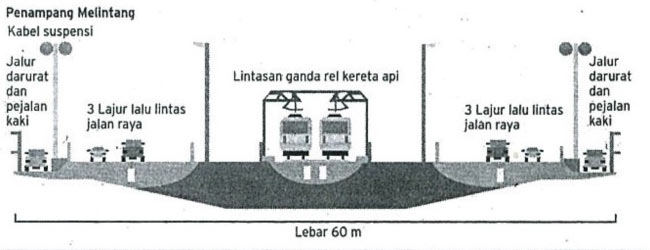
The bridge’s cross-sectional design illustrates the integration of multiple transportation and safety systems within a single structure.
Bridge Profile
| Length: | 29km |
| Width: | 60m |
| Car road: | 2m x 3m |
| Motorcycle and pedestrian pathways: | 2m x 1 m, the double track railway line is in the middle |
| Location: | 50km from Anak Krakatau Mountain, earthquake- and tsunami-resistant design |
| Passing through three islands: | Prajurit, Sangiang, and Ular |
| Comprising two ultra-long span suspended bridges: | 3.5km and 7km. |
| Comprising three conventional bridges with span length of: | 6km – 7.5km. |
| Maximum capacity: | 160,000 vehicles and 31,318 people per day; goods, such as coal, are about 1.75 million tonnes per year, or 4,700 tonnes per day. |
From one edge to the other, the 60-meter width incorporates:
- Emergency and pedestrian lanes on both outer edges, providing safety corridors and non-motorized access
- Massive suspension cables supporting the structure
- Three highway lanes on each side of the central railway, accommodating high-volume vehicular traffic
- A double-track railway line positioned centrally, enabling bidirectional train operations simultaneously
- Symmetrical design ensuring structural balance and redundancy
Future Implications and Challenges
This project represents more than infrastructure construction. Success would establish a new economic corridor fundamentally altering trade patterns, population movement, and regional development across western Indonesia. The integration of multiple utility systems positions the bridge as a comprehensive lifeline rather than merely a transportation link.
However, significant obstacles remain unresolved. The funding model continues generating debate between public and private financing approaches. Environmental assessments must address concerns about marine ecosystems and seismic risks. The complex coordination among numerous state enterprises and government agencies requires unprecedented administrative cooperation.
The 2014 groundbreaking target, ambitious from the outset, faces substantial headwinds from these unresolved issues. Whether Indonesia can overcome these challenges will determine if this decades-old vision finally transitions from planning documents to physical reality.
Cross Sectional Appearance
| Emergency and pedestrian lane | Suspension Cables | Three highway lanes | Double track railway line | Three highway lanes | Suspension Cables | Emergency and pedestrian lane |
| Total width: 60m | ||||||
Source material: Wiratman & Associates and various sources, compiled and analyzed