Opening bank accounts in Indonesia has become significantly more accessible for foreigners in 2026, thanks to recent regulatory changes by the Central Bank of Indonesia that now permit passport-only account opening at select institutions. Whether you’re an expatriate establishing long-term residence, a foreign investment professional setting up operations, or a digital nomad seeking banking convenience, understanding the requirements, choosing the right bank, and navigating the documentation process will ensure successful account establishment. This comprehensive guide draws on extensive banking consulting expertise to provide practical, step-by-step guidance for both personal and corporate bank account opening, covering everything from basic savings account requirements to complex foreign investment bank account Indonesia procedures.
Can Foreigners Open Bank Accounts in Indonesia?
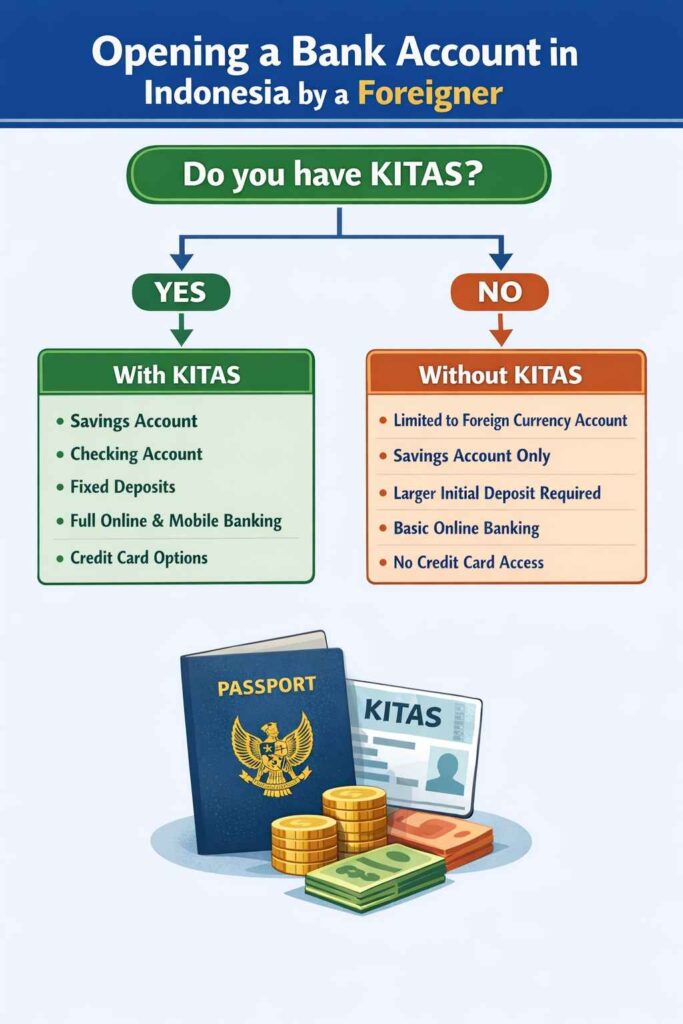
How to open a bank account in Indonesia as a foreigner begins with understanding eligibility. Yes, foreigners can definitively open bank accounts in Indonesia. The Central Bank of Indonesia recently liberalized regulations to facilitate greater financial inclusion for international visitors and residents. Previously, most banks required KITAS (Temporary Stay Permit) or KITAP (Permanent Resident License) as mandatory identity documents, creating barriers for short-term visitors and new arrivals.
The current regulatory environment offers substantial flexibility. Select banks now accept passport-only applications, eliminating the KITAS requirement for basic account types. This change particularly benefits tourists, digital nomads, and newly arrived expatriates who haven’t yet secured residence permits. However, requirements vary significantly between banks, with some maintaining stricter documentation standards while others embrace the passport-only approach.
Both resident and non-resident foreigners can access Indonesian banking services. Tourist bank accounts are now possible at major institutions, though they typically come with transaction limitations and reduced features compared to KITAS-holder accounts. The banking landscape continues evolving to accommodate Indonesia’s growing expatriate population and increasing foreign investment activity.
Indonesia Bank Account Types for Foreigners
Indonesia bank account types for foreigners include three primary categories, each serving distinct financial purposes and offering different features.
Savings Account
A savings account represents the most common account type for foreigners in Indonesia. These accounts facilitate daily financial transactions while providing secure storage for money and modest interest earnings. Savings account features include ATM access through a debit card, enabling cash withdrawals at thousands of locations nationwide. Transfer capabilities allow both sending and receiving Indonesian rupiah, with most banks also supporting debit transactions for purchases.
Savings accounts function as asset accumulation tools, paying interest rates typically ranging from 0.5% to 3% annually on deposited funds. Minimum balance requirements vary by institution, generally starting at IDR 500,000 for basic accounts. Monthly fees range from IDR 10,000 to IDR 25,000 depending on the bank and account tier. Currency options include Indonesian rupiah (IDR) as standard, with major banks offering foreign currency alternatives including United States dollar (USD), Singapore dollar (SGD), and Euro (EUR) for qualifying customers.
Checking Account (Current Account)
Checking accounts, locally termed “giro” or demand deposit accounts, enable payment using checks and provide greater transaction flexibility than savings accounts. The ability to delay payment retroactively through post-dated checks makes these accounts advantageous for business transactions requiring scheduled payments. Companies particularly benefit from checking accounts through detailed statement tracking that simplifies accounting and reconciliation processes.
Automatic payment setup for recurring obligations represents another checking account advantage. However, these accounts typically require KITAS or KITAP for foreigners, as banks view them as higher-risk products. Minimum balance requirements substantially exceed savings account thresholds, often starting at IDR 5,000,000 or USD 5,000. Fee structures include monthly maintenance charges, check processing fees, and transaction costs that make checking accounts more expensive than savings accounts.
Deposit Account (Time Deposit)
Deposit accounts, known as time deposits or certificates of deposit, offer significantly higher interest rates than savings accounts, making them attractive for accumulating wealth. These fixed-term agreements with the bank lock funds for predetermined periods ranging from one month to 24 months, with interest rates between 3% and 7% depending on term length and deposit amount.
Withdrawal conditions impose penalties for early termination, though certificates of deposit are transferable, allowing sale to other parties if liquidity becomes necessary. Currency options include both Indonesian rupiah and United States dollar, with IDR deposits generally earning higher rates. Minimum deposit amounts typically start at IDR 10,000,000 or USD 1,000, varying by bank and term selection. Interest rate comparison across banks reveals that Bank Central Asia, Bank Mandiri, and BNI offer competitive rates, with smaller banks sometimes providing slightly higher returns to attract deposits.
Indonesia Bank Account Requirements
Indonesia bank account requirements differ based on account type, applicant residency status, and individual bank policies. Understanding these requirements before visiting a branch prevents delays and ensures successful application.
Basic Requirements for Personal Accounts
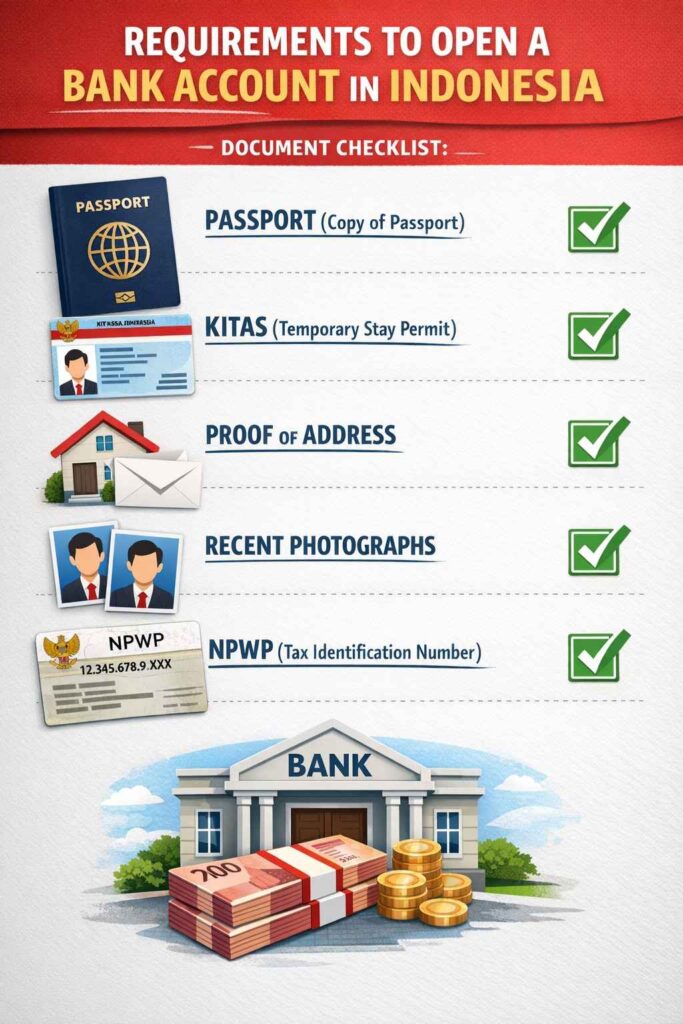
Opening bank accounts in Indonesia requirements for personal accounts include several core documents. A valid passport serves as the mandatory identity document for all foreign applicants, with most banks requiring at least six months remaining validity. KITAS (Temporary Stay Permit) or KITAP (Permanent Resident License) enhances account features and access but is now optional at select institutions.
Proof of address in Indonesia verifies local presence, accepted formats include rental agreements, utility bills showing the applicant’s name, or letters from landlords. Initial deposit requirements typically start at IDR 1,000,000 for Indonesian rupiah accounts or USD 1,000 for United States dollar accounts, though amounts vary by bank and account type.
Tax Identification Number (NPWP) requirements depend on the specific bank and account features requested. Some institutions mandate NPWP for account opening, while others allow initial opening without it, requesting the number later for interest payment reporting. Reference letters from employers or sponsors strengthen applications at certain banks, particularly for applicants without KITAS. Standard 4×6 centimeter photographs, typically two to four copies, accompany most applications. Age requirements generally specify 21 years or older, though married individuals under 21 may qualify at some institutions.
Opening Bank Account Without KITAS Indonesia
Opening bank account without KITAS Indonesia has become increasingly viable following regulatory changes. New government regulations permit passport-only account opening at select banks, expanding access for tourists, digital nomads, and newly arrived expatriates. Bank Central Asia, Bank Mandiri, and several other major institutions now offer this option, though policies vary by branch and region.
Banks accepting passport-only applications typically limit initial account features. Savings accounts represent the primary offering, with checking and certain deposit accounts remaining KITAS-restricted. Can tourist open bank account in Bali is a common question, and the answer is yes, particularly at tourist-oriented branches in popular areas like Seminyak, Canggu, and Ubud.
Transaction limits for non-resident accounts typically cap monthly transfers and withdrawals at lower thresholds than KITAS-holder accounts. Document verification processes are more stringent for passport-only applications, with banks conducting enhanced due diligence to comply with Know Your Customer (KYC) regulations. Some institutions require hotel confirmation letters or detailed travel itineraries to supplement passport documentation.
KITAS Bank Account Indonesia Requirements
KITAS bank account Indonesia holders enjoy enhanced account features and streamlined application processes. KITAS serves as the primary identity document, demonstrating legal residence and reducing banks’ perceived risk. Full access to all account types becomes available, including checking accounts, premium savings accounts, and specialized deposit products.
Higher transaction limits apply to KITAS holders, enabling larger transfers and withdrawals without triggering additional verification. Credit card eligibility opens after establishing account history, with KITAS confirming stable residence and income sources. Mobile banking features reach full functionality, including higher daily transfer limits and access to investment products through banking applications.
Corporate Bank Account Indonesia Requirements
Corporate bank account Indonesia requirements involve substantially more documentation than personal accounts, reflecting banks’ need to verify legitimate business operations and authorized signatories. Foreign investment bank account Indonesia applications face additional scrutiny and regulatory compliance steps.
Documents for Company Accounts
Companies must provide comprehensive formation and operational documents. The Memorandum and Articles of Association establish the company’s legal structure, ownership, and governance framework. Business licenses, including TDP (Tanda Daftar Perusahaan – Company Registration), verify legal authorization to operate in Indonesia. BKPM (Investment Coordinating Board) Initial Investment Approval proves mandatory for foreign investment entities, confirming regulatory approval for foreign capital participation.
The Deed of Establishment from a notary public provides foundational legal documentation. A domicile letter from local authorities confirms the company’s registered address. Tax Identification Number (NPWP) for the company entity enables tax compliance and reporting. Power of attorney documents designate authorized signatories with transaction authority on the account.
Copies of authorized persons’ passports or identity documents, along with photographs, verify individual identities. Minimum deposit requirements for corporate accounts generally start at IDR 1,000,000 or USD 1,000, though many banks recommend higher initial deposits to demonstrate financial stability.
Foreign Investment Bank Account Requirements
Central Bank of Indonesia regulations mandate that foreign investment companies utilize Foreign Exchange Banks (Bank Devisa) for international transactions. These designated institutions handle capital injection transactions, facilitating foreign currency transfers into Indonesia for investment purposes. Currency exchange regulations require documentation proving the source and purpose of foreign funds.
Capital injection protocols involve submitting detailed transaction plans to the bank, which then coordinates with Central Bank of Indonesia for approval. Approval timelines average approximately five days, though complex transactions may require additional review. Ongoing compliance requirements include periodic reporting of foreign currency holdings, transaction documentation, and adherence to repatriation rules for dividends and profits.
Representative Office Bank Accounts
Representative offices face unique restrictions as they cannot generate revenue in Indonesia. Account purposes limit strictly to marketing, promotion, and liaison expenses. Required documents include TDP specific to representative offices, business licenses authorizing representative activities, and company NPWP. Finance operation limitations prevent representative offices from conducting sales transactions or invoicing clients through Indonesian accounts, maintaining their non-commercial status.
Best Banks in Indonesia for Expats
Best banks in Indonesia for expats varies based on individual needs, location, and account purpose. Banks in Indonesia range from large state-owned institutions to international banks with global networks. The following best bank in Indonesia options consistently receive positive feedback from foreign account holders.
Bank Central Asia (BCA)
Bank Central Asia stands as the most commonly used bank in Indonesia, serving millions of customers through 135 branches and over 850 sub-branches nationwide. This extensive network ensures accessibility whether you’re in Jakarta, Bali, or regional cities. High-quality services and diverse banking products make BCA particularly attractive for expatriates seeking comprehensive banking solutions.
BCA open account foreigner processes have become increasingly streamlined, with major branches employing English-speaking staff to assist international clients. Bank BCA account opening now accepts passport-only applications at select locations, though KITAS remains advantageous for accessing premium features. Foreign currency accounts include United States dollar, Singapore dollar, and Euro options alongside standard Indonesian rupiah accounts.
The ATM network coverage ranks among Indonesia’s largest, with thousands of machines nationwide plus participation in the ATM Bersama shared network. Mobile banking through the BCA Mobile application provides comprehensive digital services, including transfers, bill payments, and QR code (QRIS) transactions in English language interface. Debit card and credit card options cater to varying needs, with credit cards available to KITAS holders after establishing account history.
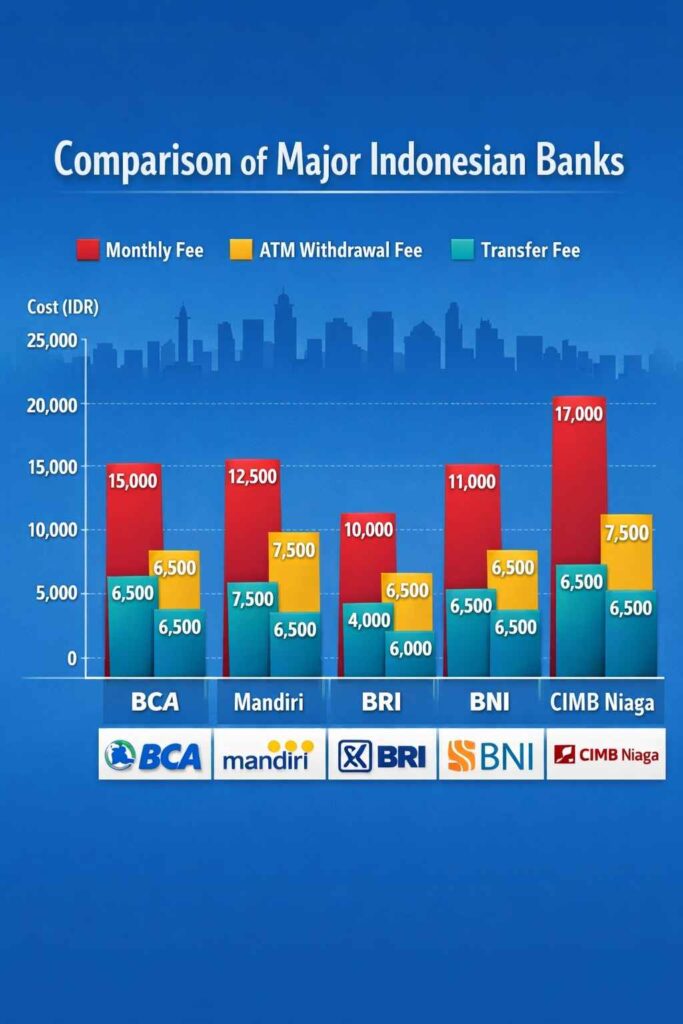
Initial deposit requirements start at IDR 500,000 for basic savings accounts, with premium accounts requiring IDR 5,000,000 or more. Fee structures include monthly maintenance charges around IDR 15,000 for standard accounts, ATM withdrawal fees of IDR 6,500 at other banks’ machines, and annual debit card fees of approximately IDR 20,000.
Bank Mandiri
Bank Mandiri for foreigners offers reliability as Indonesia’s state-owned bank with the second-highest asset base nationally. Government ownership provides certainty and stability, reassuring customers about long-term security. The extensive branch network spans urban centers and smaller cities, ensuring accessibility throughout the archipelago.
Foreign account services welcome expatriates and international investors, with dedicated international banking desks at major branches. Currency options include Indonesian rupiah and United States dollar accounts, with competitive interest rates on savings accounts and deposit accounts. Current savings account rates hover around 1% to 2.5% annually, while time deposits offer 3.5% to 6% depending on term and amount.
Mobile banking through Livin’ by Mandiri delivers modern digital banking features, including biometric login, instant transfers, investment product access, and comprehensive bill payment integration. The application supports English, facilitating navigation for non-Indonesian speakers. Foreigner-friendly services include passport-only account opening at select branches, though documentation requirements vary by location.
Standard initial deposits start at IDR 500,000, with monthly maintenance fees around IDR 12,000 to IDR 25,000 based on account type. ATM network access through both proprietary machines and the Prima network ensures widespread cash availability.
Bank Negara Indonesia (BNI)
Bank Negara Indonesia ranks among Indonesia’s largest state-owned banks, offering reliability and extensive services for expatriates. International presence spans Asia, the United States, and United Kingdom, facilitating cross-border banking for clients with connections to these regions. This global network proves particularly valuable for foreigners maintaining financial relationships across multiple countries.
Foreign currency accounts accommodate United States dollar, Euro, and other major currencies, enabling multi-currency finance management. Investment products through BNI include mutual funds, bonds, and structured products accessible to qualifying foreign residents. Deposit account options provide competitive interest rates, currently ranging from 3% to 6.5% for 12-month Indonesian rupiah deposits.
Branch accessibility in major cities and tourist areas ensures expatriates can access services conveniently. English-speaking staff availability varies by location, with Jakarta, Bali, and Surabaya branches generally offering better English support. Initial deposit requirements align with industry standards at IDR 500,000 to IDR 1,000,000, with monthly fees comparable to other major banks.
Other Banks Worth Considering
CIMB Niaga, as an international bank with Malaysian parentage, provides familiar services for Southeast Asian expatriates and strong regional connectivity. HSBC Indonesia leverages its global presence to serve expatriates seeking international banking integration, though minimum balance requirements tend toward the higher end. Standard Chartered Indonesia similarly caters to affluent expatriates and foreign professionals with premium banking needs.
Citibank Indonesia offers sophisticated services and global network access, though its branch presence has contracted in recent years. Digital banks including Jenius (operated by BTPN) and Jago provide modern, app-first banking experiences with lower fees, though they typically require Indonesian identity documents, limiting foreigner access. Comparison factors when selecting among these institutions include fee structures, ATM network coverage, English language support quality, and mobile banking application features.
Bank Comparison Matrix
| Bank Name | Min Deposit (IDR/USD) | Passport Only? | English Support | ATM Network | Mobile Banking Rating | Monthly Fee |
|---|---|---|---|---|---|---|
| Bank Central Asia | 500K / 1K | ✓ (Select Branches) | Excellent | 17,000+ | 4.5/5 | IDR 15,000 |
| Bank Mandiri | 500K / 1K | ✓ (Select Branches) | Very Good | 14,000+ | 4.3/5 | IDR 12,000-25,000 |
| BNI | 500K-1M / 1K | Limited | Good | 11,000+ | 4.2/5 | IDR 15,000-20,000 |
| CIMB Niaga | 1M / 1K | Limited | Excellent | 8,000+ | 4.0/5 | IDR 20,000 |
| HSBC | 10M / 10K | ✗ | Excellent | Limited | 4.4/5 | IDR 150,000 |
Step-by-Step Guide: How to Open Bank Account in Indonesia
How to open a bank account in Indonesia as a foreigner follows a straightforward process when properly prepared with required documentation.
Step 1: Choose Your Bank
Research banks based on specific needs, considering factors like account fees, interest rates, branch proximity to residence or office, and foreigner-friendliness. Consider branch locations carefully, as you’ll likely visit occasionally for services unavailable through mobile banking. Compare fee structures comprehensively, including monthly maintenance, ATM withdrawal costs, transfer fees, and debit card annual charges.
Evaluate ATM network coverage, particularly in areas you frequent. Check mobile banking application features and English language availability, as daily banking increasingly occurs digitally. Read expatriate reviews on forums and social media groups to understand real experiences at specific branches. Verify the bank explicitly accepts foreign account applications and confirm current passport-only availability if you lack KITAS.
Step 2: Prepare Required Documents
Gather your passport, ensuring validity exceeds six months and photo pages are clearly copied. If you possess KITAS or KITAP, include the original and clear copies. Obtain proof of address, such as a rental agreement showing your name, utility bill, or letter from your landlord on official letterhead. Prepare 4×6 centimeter passport photographs, typically four copies for bank records.
Secure a reference letter from your employer or sponsor if required by your chosen bank, formatted on company letterhead with signature and stamp. Obtain NPWP if you already possess Indonesian tax registration, though some banks allow initial opening without it. Organize all documents in a folder with originals separated from copies. Make extra copies of critical documents like passport and KITAS as backup.
Requirements Comparison Table
| Document Type | Tourist | KITAS Holder | Corporate |
|---|---|---|---|
| Passport | ✓ | ✓ | ✓ (Authorized Person) |
| KITAS/KITAP | ✗ | ✓ | ✓ (Some Directors) |
| Proof of Address | ✓ (Hotel Letter) | ✓ (Rental/Utility) | ✓ (Domicile Letter) |
| NPWP | ✗ | Optional | ✓ (Company) |
| Reference Letter | Optional | Optional | ✗ |
| Initial Deposit | IDR 1M / USD 1K | IDR 1M / USD 1K | IDR 1M / USD 1K+ |
| Company Documents | ✗ | ✗ | ✓ (Full Set) |
Step 3: Visit Bank Branch
Open Indonesia bank account online remains unavailable for most foreign applicants currently, making branch visits mandatory. Schedule your visit during weekday morning hours to avoid crowds, as queues can extend significantly during lunch hours and afternoons. Bring all original documents plus copies, as bank staff will verify originals and retain copies for records.
Expect the account opening process to consume one to two hours, including waiting time, application completion, and processing. Some branches offer appointment systems for foreign account opening, call ahead to inquire about reservation options. Arrive prepared with your initial deposit in cash or arrange a transfer from an existing account if permitted.
Step 4: Complete Application Forms
Fill out the account application document provided by bank staff, completing all fields accurately and legibly. Know Your Customer (KYC) forms require detailed personal information, including employment details, income sources, and purpose of account opening. Sign all required forms where indicated, as unsigned forms delay processing.
Provide accurate contact information, including phone number and email address, as the bank uses these for account notifications and security alerts. Declare tax residency honestly, as this affects reporting obligations and interest taxation. Choose your account currency, typically Indonesian rupiah for daily expenses or United States dollar for international transactions and wealth preservation.
Step 5: Make Initial Deposit
Deposit the required minimum money, which varies by bank and account type. Typical minimums range from IDR 1,000,000 to IDR 5,000,000 for rupiah accounts, or USD 1,000 to USD 5,000 for dollar accounts. You can deposit cash directly with the bank teller or arrange a transfer from another account if the bank permits.
Request and retain your deposit receipt as proof of transaction and initial funding. Confirm with bank staff that your account is now active and the deposit has been credited. Verify that your account number appears on the receipt and matches the number provided by the bank.
Step 6: Receive Account Materials
Your bank account number is typically issued immediately upon approval and initial deposit. The debit card (ATM card) may be issued during your visit or mailed to your address within three to seven days, depending on the bank’s card production process. PIN setup for your debit card occurs either at the branch using a PIN pad or later at an ATM upon first use.
Mobile banking registration is optional but highly recommended, ask bank staff for assistance with initial setup during your visit. Account terms and conditions are provided as a PDF file or printed booklet, review these to understand transaction limits, fees, and account features. Save branch contact information, including customer service phone numbers and branch manager details for future assistance.
Step 7: Activate Mobile Banking
Download your bank’s mobile banking application from Google Play Store or Apple App Store. Register using your account number and personal information, following the app’s guided setup process. Set up a mobile banking PIN distinct from your debit card PIN for added security. Link your debit card to the application for enhanced functionality.
Enable transaction notifications to receive instant alerts for all account activity, helping detect unauthorized transactions quickly. Test basic functions including balance inquiry, transfer to another account, and bill payment to familiarize yourself with the interface. Most apps offer English language options in settings, switch if needed for easier navigation.
Step-by-Step Visual Checklist
□ Research and choose bank based on location and features
□ Gather required documents (passport, KITAS if applicable, address proof)
□ Make clear copies of all documents
□ Prepare initial deposit (cash or transfer arrangements)
□ Visit bank branch during morning hours
□ Complete application forms with bank staff
□ Submit KYC documentation
□ Make initial deposit at counter
□ Receive account number and confirmation
□ Collect debit card or confirm delivery timeline
□ Set up mobile banking application
□ Test first transaction (transfer or ATM withdrawal)
Opening Bank Account Online Options
The open Indonesia bank account online limitation persists for most foreign applicants in 2026. Current regulations and KYC requirements mandate in-person verification for non-residents and foreign nationals. Digital banks like Jenius and Jago offer app-based account opening but require Indonesian identity documents (KTP), excluding foreigners without permanent residence.
An alternative for international transfers involves opening a Wise account. Open Wise account Indonesia enables multi-currency holdings and global transfers at competitive exchange rates. Wise multi-currency account benefits include holding over 50 currencies, receiving local bank details for multiple countries, and converting money at mid-market rates with transparent fees.
However, Wise does not replace a full Indonesian bank account, as it cannot receive direct employer payments in Indonesia, doesn’t provide local ATM cards usable everywhere, and lacks integration with Indonesian bill payment systems. Future digital banking developments may expand online account opening for foreigners, monitor regulatory announcements and bank websites for updates.
Understanding Fees and Costs
Fee structures vary significantly among Indonesian banks, impacting the total cost of maintaining your account. Monthly account maintenance fees range from IDR 10,000 to IDR 30,000 for basic savings accounts, with premium accounts charging IDR 50,000 or more. ATM withdrawal fees at your own bank’s machines are typically free, while using other banks’ ATMs incurs IDR 5,000 to IDR 7,500 per transaction.
Transfer fees differ between domestic Indonesian rupiah transfers and international transactions. Domestic transfers within the same bank are usually free via mobile banking, while interbank transfers cost IDR 2,500 to IDR 7,500. International transfers incur substantial fees, ranging from IDR 150,000 to IDR 500,000 depending on destination and amount, plus exchange rate margins.
Debit card annual fees average IDR 20,000 to IDR 50,000, automatically debited from your account. Credit card annual fees, if applicable after establishing account history, range from IDR 250,000 to several million for premium cards. Foreign currency exchange fees applied when converting between currencies typically include 1% to 3% spread above mid-market rates.
Early deposit account withdrawal penalties forfeit interest earnings and may charge additional fees of 1% to 3% of the deposit amount. Minimum balance penalties apply when your account falls below the required threshold, typically matching monthly maintenance fees. Fee comparison across Bank Central Asia, Bank Mandiri, and BNI reveals relatively similar structures, with slight variations in transfer costs and card fees.
Fee Structure Breakdown
| Service | Bank Central Asia | Bank Mandiri | BNI |
|---|---|---|---|
| Monthly Maintenance | IDR 15,000 | IDR 12,000-25,000 | IDR 15,000-20,000 |
| ATM Withdrawal (Own Bank) | Free | Free | Free |
| ATM Withdrawal (Other Bank) | IDR 6,500 | IDR 5,000 | IDR 6,000 |
| Domestic Transfer (Interbank) | IDR 6,500 | IDR 5,000-7,500 | IDR 7,500 |
| International Transfer | IDR 200,000+ | IDR 150,000+ | IDR 175,000+ |
| Debit Card Annual Fee | IDR 20,000 | IDR 15,000-25,000 | IDR 20,000 |
Interest Rates and Returns
Interest rate offerings on savings accounts in Indonesian banks typically range from 0.5% to 3% annually, calculated daily and credited monthly. Deposit account interest rates provide substantially better returns, ranging from 3% to 7% depending on term length and deposit amount. Interest payment frequency varies, with savings accounts crediting monthly and deposit accounts offering monthly, quarterly, or maturity-based payment options.
Interest Rate Comparison (2026 Rates)
| Account Type | BCA Rate | Mandiri Rate | BNI Rate |
|---|---|---|---|
| Savings Account (IDR) | 0.5%-2.5% | 1.0%-3.0% | 0.75%-2.75% |
| Savings Account (USD) | 0.25%-1.0% | 0.5%-1.25% | 0.5%-1.0% |
| 1-Month Deposit | 2.75%-3.5% | 3.0%-3.75% | 2.85%-3.6% |
| 3-Month Deposit | 3.25%-4.0% | 3.5%-4.25% | 3.4%-4.15% |
| 6-Month Deposit | 3.75%-4.75% | 4.0%-5.0% | 3.9%-4.85% |
| 12-Month Deposit | 4.25%-5.5% | 4.5%-6.0% | 4.4%-5.75% |
Tax on interest income applies at 20% as a final tax for tax residents, automatically withheld by the bank before interest credits to your account. Non-residents may face different taxation rates depending on tax treaties between Indonesia and their home country. Interest rate comparison among major banks shows Bank Central Asia offering savings account rates around 0.5% to 2.5%, Bank Mandiri providing 1% to 3%, and BNI offering similar ranges.
Foreign currency deposit rates are typically lower than Indonesian rupiah deposits, with United States dollar accounts earning 1% to 3% annually. Interest calculation methods use daily balance averages, meaning higher balances throughout the month earn proportionally more interest. Time deposits reward longer commitment, with 12-month deposits earning 1% to 2% more than one-month deposits of equivalent amounts.
Currency Considerations
Currency selection significantly impacts account utility and exchange rate exposure. Indonesian rupiah (IDR) accounts serve daily expenses optimally, as most transactions within Indonesia occur in local currency. Salaries, rent, utilities, and everyday purchases typically require rupiah, making an IDR account essential for residents.
United States dollar accounts facilitate international transactions, protect against rupiah volatility, and simplify repatriation of funds when leaving Indonesia. Other foreign currency options at major banks include Singapore dollar, Euro, Australian dollar, British pound, Japanese yen, Hong Kong dollar, and Swiss franc, though availability varies by institution and minimum balance requirements.
Currency exchange within your bank offers convenience but typically includes less favorable rates than dedicated money changers. Exchange rate considerations matter particularly for large conversions, where 1% to 2% rate differences translate to significant amounts. Multi-currency account benefits include holding various currencies simultaneously, converting at opportune times, and receiving foreign payments without forced immediate conversion.
When to use Indonesian rupiah versus foreign currency depends on your circumstances. Choose rupiah for daily living expenses, local employment income, and spending that remains within Indonesia. Select United States dollar or other foreign currencies for international income, wealth preservation during rupiah depreciation periods, or planned repatriation.
Currency Account Detailed Guidance
When to Open IDR vs USD Account:
Choose Indonesian Rupiah (IDR) accounts when:
- Your primary income source is Indonesian employment or local business
- Daily expenses occur mostly within Indonesia (rent, food, transportation)
- You plan extended residence without frequent international transfers
- You want higher interest rates on savings and time deposits
Select United States Dollar (USD) accounts when:
- You receive international income from foreign employers or clients
- You’re protecting wealth against rupiah depreciation
- You plan to repatriate funds when leaving Indonesia
- Your business involves regular cross-border transactions
Multi-Currency Account Benefits:
Holding both IDR and USD accounts within the same bank provides flexibility to convert currencies at opportune exchange rates rather than being forced to convert at unfavorable times. You can receive foreign payments directly into USD accounts without immediate conversion fees, then selectively transfer to IDR for local expenses. Major banks like Bank Central Asia and Bank Mandiri allow internal transfers between currency accounts with better exchange rates than external money changers.
Exchange Rate Strategic Considerations:
Monitor rupiah exchange rate trends, converting USD to IDR when the rupiah strengthens (lower USD/IDR rate) to maximize purchasing power. During periods of rupiah weakness, maintain higher USD balances to preserve value. Bank exchange rates typically include 1% to 2% spread above mid-market rates, large conversions may benefit from negotiating rates with relationship managers.
Transfer Fees for Currency Conversion:
Internal currency conversions within your bank typically incur no direct transfer fee but embed costs in exchange rate spreads. External transfers to convert currencies cost IDR 5,000 to IDR 10,000 plus wider exchange rate margins. For amounts exceeding USD 10,000 equivalent, compare bank rates against licensed money changers who often offer better rates despite requiring physical visits.
Using Your Indonesian Bank Account
ATM withdrawals provide cash access at thousands of locations nationwide, with daily limits typically ranging from IDR 5,000,000 to IDR 20,000,000 depending on your account type. Debit card usage at merchants enables cashless purchases at millions of retail locations accepting card payments. Online shopping with your debit card or credit card works for both domestic Indonesian websites and international e-commerce platforms.
Mobile banking facilitates instant transfers to other accounts, whether within the same bank or to different institutions. Bill payments through your bank cover utilities, phone services, internet, insurance, and government obligations like taxes and vehicle registration. International transfers enable sending money abroad to family or business contacts, though fees and exchange rates require careful comparison.
Receiving foreign currency payments works smoothly for United States dollar and other supported currencies, with the bank crediting your account at prevailing exchange rates. Finance management through banking applications provides transaction history, spending categorization, and balance tracking to maintain budget awareness.
Advantages of Having Indonesian Bank Account
An Indonesian bank account proves essential for receiving salary payments if employed within Indonesia, as most employers transfer wages electronically. Rental payments in Indonesia increasingly require bank transfers, with landlords preferring this documented payment method over cash. Easier bill payments through mobile banking save time compared to visiting payment centers or using convenience stores.
Lower transaction fees compared to using international cards for daily purchases reduce cumulative costs significantly over time. Building financial history in Indonesia establishes creditworthiness, enabling future credit card applications and potential loan eligibility. Access to local investment products including mutual funds, bonds, and time deposits expands wealth-building opportunities.
Credit card eligibility after establishing account history provides additional payment flexibility and rewards programs. Deposit accounts generate interest earnings substantially higher than international savings accounts in many developed countries. Currency exchange convenience within your bank simplifies converting between Indonesian rupiah and foreign currencies as needed.
Common Challenges and Solutions
Language Barriers
Not all bank staff speak English fluently, particularly at smaller branches outside major cities. Bringing an Indonesian-speaking translator helps navigate complex discussions and ensures accurate understanding of account terms. Major bank branches in Jakarta, Bali, and other expatriate-heavy areas typically staff international desks with English-speaking personnel.
Mobile banking applications increasingly offer English-enabled interfaces, simplifying digital transactions without language assistance. Document translation services can prepare English versions of Indonesian documents, though banks accept Indonesian originals as primary evidence. Learning basic Indonesian banking vocabulary for common transactions improves independence over time.
Mobile Banking Feature Deep Dive
BCA Mobile Comprehensive Walkthrough:
BCA Mobile supports English language, access via Settings > Language > English. Core features include balance inquiry across all linked accounts (IDR, USD), instant transfers to other BCA accounts (free), transfers to other Indonesian banks via ATM Bersama network (IDR 6,500), and scheduled future transfers. Bill payment integration covers electricity (PLN), water (PDAM), phone, internet, insurance, and credit cards from all major issuers.
QR code payment through QRIS enables merchant payments by scanning QR codes, widely accepted at restaurants, retail stores, and online platforms. The mobile banking daily transfer limit defaults to IDR 50,000,000 but can be increased to IDR 250,000,000 by visiting branch for limit upgrade requests. Security features include biometric login (fingerprint/face recognition), one-time password (OTP) via SMS for large transactions, and automatic logout after inactivity.
Livin’ by Mandiri Capabilities:
Bank Mandiri’s Livin’ application provides similar core banking functions with distinctive features like integrated investment product access including mutual funds and bonds. The interface supports English through Settings menu. Daily transfer limits start at IDR 25,000,000 with upgrade options to IDR 100,000,000 for KITAS holders. Virtual account creation enables receiving payments from clients or employers without sharing your primary account number.
Cardless ATM withdrawal allows generating one-time codes in the app for cash withdrawal at Mandiri ATMs without physical card, useful when card is lost or forgotten. Bill splitting features facilitate group expense management, common for shared apartment utilities among expatriates.
BNI Mobile Banking Features:
BNI Mobile supports English language and provides standard banking operations plus distinctive international transfer features leveraging BNI’s global correspondent network. The app integrates with BNI’s investment platform for accessing time deposits, mutual funds, and government bonds. Transaction limits default to IDR 50,000,000 daily with branch-approved increases available.
Security implementation includes both biometric and PIN authentication with OTP confirmation for transfers exceeding IDR 10,000,000. Push notifications for all transactions ensure immediate awareness of account activity, critical for detecting unauthorized access.
English Language Availability Assessment:
Bank Central Asia, Bank Mandiri, and BNI all offer English-language mobile banking applications, though translation quality varies. Menu items and primary functions translate well, but error messages occasionally appear in Indonesian. Customer service chatbots within apps typically respond in Indonesian, requiring translation apps for non-Indonesian speakers. Transaction confirmations and receipts generate in bilingual format at most banks.
Security Features Across Platforms:
All major Indonesian banks implement two-factor authentication combining device registration, PIN/biometric login, and OTP for high-value transactions. Automatic session timeout after 5-10 minutes of inactivity prevents unauthorized access on lost devices. Transaction notifications via SMS and push notification provide real-time alerts. Most apps allow setting transaction limits and temporarily blocking cards through the app without branch visits.
Documentation Issues
Passport validity must exceed six months at account opening, requiring renewal if expiration approaches. KITAS expiry concerns arise when residence permits near renewal dates, update the bank promptly after renewal to avoid account restrictions. Address proof difficulties occur for newcomers without lease agreements, solutions include hotel confirmation letters on official letterhead or temporary address documentation from sponsors.
Company reference letter formats should include specific elements, letterhead, date, employee name and passport number, position, salary, signature, and company stamp. Request this document from your employer’s HR department well before your bank visit to avoid delays.
Minimum Balance Requirements
Falling below minimum balance thresholds triggers monthly fees, often IDR 15,000 to IDR 25,000 per occurrence. Monitor your account regularly through mobile banking to ensure balances remain above required minimums. Set up balance alerts via mobile banking applications, receiving notifications when your balance approaches the minimum threshold.
Choose a bank with manageable minimum balance requirements aligned with your expected account usage and available funds. Some banks offer zero-balance accounts with reduced features, suitable for infrequent users willing to accept limitations.
Document Preparation Timeline Guide
Immediate (Already Possessed):
- Valid passport with 6+ months validity
- Passport photographs (obtain at photo shops in 30 minutes)
1-3 Days:
- Proof of address (rental contract from landlord, utility bill setup)
- Hotel confirmation letter (request from front desk)
1-2 Weeks:
- Reference letter from employer (HR department processing)
- NPWP application if required (tax office visit)
Variable Timeline:
- KITAS (30-60 days through sponsoring employer or agent)
- Company documents for corporate accounts (notary and licensing processes)
Document Translation:
- Professional translation services: 1-3 days
- Notarization of translations: additional 1-2 days
Digital vs Physical:
- All original documents required at branch visit
- Clear photocopies acceptable for bank retention
- PDF versions useful for email pre-verification at some banks
Tips for Maintaining Your Indonesian Bank Account

Monitor mobile banking regularly, checking transaction history daily to quickly identify any unauthorized activity. Set up transaction alerts for all account activities, receiving instant notifications via SMS or app push notifications. Keep your debit card secure by protecting your PIN, never sharing it with anyone, and shielding keypads when entering it at ATMs or merchants.
Report lost or stolen cards immediately to your bank’s customer service hotline to prevent unauthorized use. Maintain minimum balance requirements to avoid fees, setting reminders if you periodically transfer most funds elsewhere. Renew KITAS before expiration and update bank records promptly with new permit documents to maintain full account features.
Keep contact information current, notifying the bank when phone numbers or addresses change to ensure you receive important communications. Save bank customer service numbers in your phone for quick access during emergencies or issues. Understand transaction limits for your account type, planning large transfers or withdrawals accordingly to avoid processing delays.
Download monthly statements as PDF files through mobile banking for personal record-keeping and potential tax documentation needs. Regular statement review helps track spending patterns and verifies all transactions are legitimate.
Closing or Transferring Your Account
Account closure processes require visiting your branch with passport or KITAS and debit card. Final balance withdrawal occurs via cash or transfer to another account, with the bank processing any pending transactions before closure. Return your debit card to the bank during closure, as active cards remain bank property.
Obtain official closure confirmation documents for your records, particularly important for tax purposes if you’re leaving Indonesia permanently. Transferring balances to another Indonesia bank follows standard transfer procedures, though large amounts may require additional verification. Moving money abroad before departure involves international wire transfers, budget for fees and allow several business days for processing.
Tax clearance considerations apply if you’ve earned interest or maintained substantial balances, consult with a tax advisor regarding final tax obligations. Some banks impose closure fees if accounts are closed within a specified period after opening, typically within six to 12 months.
Real Experience Scenarios
Scenario 1: Australian Expat with KITAS in Bali
James, a 34-year-old Australian working remotely for a Perth-based company, arrived in Bali with a one-year KITAS sponsored by his Indonesian business partner. He visited Bank Central Asia’s Seminyak branch on a Tuesday morning with his passport, KITAS, rental agreement from his Canggu villa, and four photographs. The English-speaking staff processed his application in 90 minutes, requiring an initial IDR 1,000,000 deposit. He selected both IDR and USD savings accounts to manage his Australian dollar transfers and local expenses separately. His debit card arrived by courier three days later, and he activated BCA Mobile immediately. Six months later, after establishing account history, he successfully applied for a BCA credit card with a IDR 20,000,000 limit.
Scenario 2: American Tourist Passport-Only Account in Jakarta
Sarah, a 28-year-old American digital nomad, needed an Indonesian bank account for her three-month stay but lacked KITAS. She visited Bank Mandiri’s Grand Indonesia branch with only her passport, hotel confirmation letter from her Jakarta accommodation, and USD 1,000 cash. The bank accepted her passport-only application but limited her to a basic rupiah savings account with monthly transfer limits of IDR 50,000,000. She couldn’t access USD accounts or credit card products without KITAS. The process took two hours including waiting time, and she received her debit card immediately. Livin’ by Mandiri mobile banking provided sufficient functionality for bill payments and transfers, though she maintained her Wise account for receiving international client payments.
Scenario 3: Singapore Company Foreign Investment Corporate Account
TechVenture Pte Ltd, a Singapore-incorporated software company, established an Indonesian PT PMA (foreign investment company) to serve local clients. Their Indonesian director visited Bank Central Asia’s corporate banking center in Jakarta with comprehensive documentation including the company’s deed of establishment, BKPM investment approval, TDP business license, company NPWP, domicile letter, and his passport as authorized signatory. The bank required additional verification of the company’s paid-up capital and foreign ownership structure, extending the approval timeline to seven business days. Initial deposit of USD 10,000 activated both IDR and USD corporate accounts, enabling capital injection from Singapore and local client invoice payments. The bank assigned a relationship manager who facilitated ongoing compliance with Central Bank of Indonesia foreign exchange reporting requirements.
Can foreigners open bank accounts in Indonesia?
Yes, foreigners can open bank accounts in Indonesia. Recent Central Bank of Indonesia regulations now allow passport-only account opening at major banks like Bank Central Asia and Bank Mandiri. While KITAS (residence permit) provides enhanced features, basic savings accounts are accessible to tourists and new arrivals with just a valid passport, proof of address, and minimum deposit of IDR 1,000,000 or USD 1,000.
Conclusion
Opening bank accounts in Indonesia has become significantly more accessible and straightforward for foreigners or tourists in 2026, thanks to regulatory reforms permitting passport-only account establishment. Bank Central Asia, Bank Mandiri, and Bank Negara Indonesia stand out as top choices for expatriates, offering extensive networks, English support, and comprehensive services. Both personal savings accounts and complex corporate bank accounts remain accessible with proper documentation and preparation.
Understanding the specific requirements for your situation, whether tourist, KITAS holder, or foreign investment entity, ensures efficient processing and prevents delays. Choosing the right bank based on your location, transaction needs, and fee tolerance optimizes your banking experience. The process of opening bank accounts in Indonesia proves straightforward when you arrive prepared with necessary documents, required initial deposits, and realistic expectations about timelines.
The Indonesian banking system increasingly welcomes foreign customers, recognizing their importance to the economy and business landscape. With proper preparation and guidance from this comprehensive resource, establishing your Indonesian banking presence becomes a manageable step toward successful integration into Indonesia’s financial ecosystem.
Frequently Asked Questions
Can foreigners open bank accounts in Indonesia?
Yes, foreigners can absolutely open bank accounts in Indonesia. Recent regulatory changes by the Central Bank of Indonesia now permit passport-only account opening at select banks, eliminating the previous KITAS requirement for basic savings accounts. Both residents with KITAS/KITAP and tourists can establish accounts, though features and transaction limits vary based on residency status.
What documents do I need to open a bank account in Indonesia?
Essential documents include a valid passport with at least six months remaining validity, proof of Indonesian address such as rental agreement or utility bill, 4×6 centimeter photographs, and initial deposit funds. KITAS or KITAP enhances account access but isn’t mandatory at all banks. Some institutions require NPWP (Tax ID) and reference letters from employers, while others accept passport-only applications for basic accounts.
Can I open a bank account in Indonesia without KITAS?
Yes, opening bank account without KITAS Indonesia is now possible at major banks including Bank Central Asia and Bank Mandiri. The passport-only option suits tourists and newly arrived expatriates, though accounts typically limit to savings account types with reduced transaction thresholds. Enhanced features, checking accounts, and credit cards generally require KITAS for eligibility.
What is the best bank in Indonesia for foreigners?
Bank Central Asia ranks as the best bank in Indonesia for most expatriates due to its extensive ATM network, English-speaking staff at major branches, and comprehensive mobile banking application. Bank Mandiri offers stability as a state-owned institution with competitive rates, while Bank Negara Indonesia provides international presence and investment products. Your optimal choice depends on location, fee tolerance, and specific banking needs.
How much money do I need to deposit to open an Indonesian bank account?
Minimum initial deposits typically start at IDR 1,000,000 for Indonesian rupiah savings accounts or USD 1,000 for United States dollar accounts. Requirements vary by bank and account type, with premium accounts demanding IDR 5,000,000 or more. Corporate bank accounts often require similar minimums but may benefit from higher initial deposits to demonstrate company financial stability.
Can tourists open bank accounts in Bali?
Yes, tourists can open bank accounts in Bali at select branches of major banks. Bank Central Asia, Bank Mandiri, and other institutions in tourist areas like Seminyak, Canggu, and Ubud accept passport-only applications for basic savings accounts. These tourist accounts typically include transaction limitations and may require hotel confirmation letters or detailed travel documentation.
Can I open an Indonesian bank account online?
Currently, foreigners cannot open Indonesia bank account online at most Indonesian banks. Regulations require in-person verification for non-resident and foreign applicants. Digital banks like Jenius require Indonesian identity documents, excluding most foreigners. You must visit a physical branch with original documents to complete the application process, which typically takes one to two hours.
What types of bank accounts are available in Indonesia?
Indonesian banks offer three primary account types for foreigners. Savings accounts provide daily transaction access with debit cards and modest interest. Checking accounts (current accounts) enable check payments and automatic billing, typically requiring KITAS. Deposit accounts or time deposits offer higher interest rates on fixed-term commitments. Currency options include Indonesian rupiah and major foreign currencies like United States dollar.
How long does it take to open a bank account in Indonesia?
Opening a bank account requires one to two hours at the branch for application processing and initial deposit. Your account number is typically issued immediately upon approval. Debit cards are provided during the visit or mailed within three to seven days. Full mobile banking activation may require additional days for security verification, though basic account access begins immediately.
Do Indonesian banks offer foreign currency accounts?
Yes, major Indonesian banks including Bank Central Asia, Bank Mandiri, and BNI offer foreign currency savings accounts and deposit accounts. Common options include United States dollar, Singapore dollar, Euro, British pound, Australian dollar, Japanese yen, and Hong Kong dollar. Interest rates on foreign currency accounts are typically lower than Indonesian rupiah accounts. Minimum balance requirements vary by currency and bank.