Affiliate Disclaimer: This review contains affiliate links. If you purchase through our links, we may earn a commission at no additional cost to you. We only recommend products we genuinely test and believe provide value to our readers.
The Group Travel Planning Problem That Everyone Ignores
In this Mingle: Travel Planner Review, we tested an app that claims to solve one of travel’s most frustrating challenges: getting your friend group to actually agree on trip plans. After organizing dozens of group trips over the years, I approached Mingle with deep skepticism. Most travel apps either overwhelm you with features you never use or charge premium fees for basic collaboration tools that should be free.

The collaborative travel planning space is littered with abandoned group chats, forgotten spreadsheets, and friends who drop out because planning became more stressful than the actual trip. Traditional project management tools feel like overkill, while existing travel apps focus on individual planning rather than group decision-making. Mingle positions itself as the solution built specifically for groups who want to plan together without the complexity bloat.
What Is Mingle: Travel Planner?
Mingle: Travel Planner is a mobile application designed exclusively for collaborative trip planning, available on both iOS and Android platforms. Unlike comprehensive travel management tools that try to handle every aspect of travel, Mingle focuses specifically on the group decision-making process that happens before you book anything.
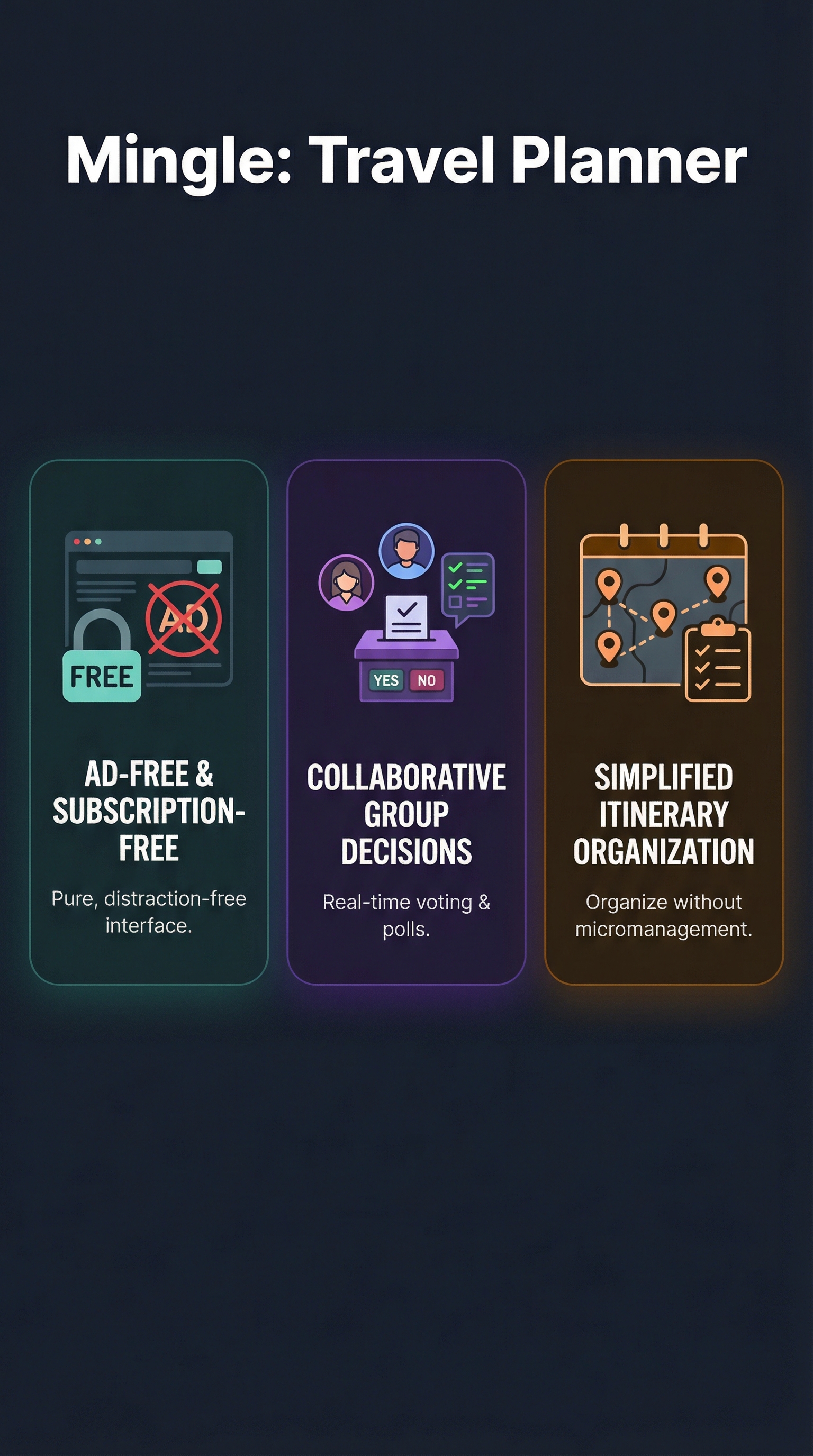
The app operates on a completely free model with no advertisements, subscription fees, or premium tiers. This immediately sets it apart from most travel planning tools that employ freemium models or advertiser-supported platforms. Users can create trip projects, invite friends through shareable links, and begin collaborating without account creation barriers or paywall obstacles.
Mingle targets groups planning everything from casual weekend getaways to extended vacations, with a particular focus on reducing the friction that typically derails group travel planning. The application emphasizes simplicity and accessibility, appealing to users frustrated with bloated features in existing tools.
Key Features That Set Mingle Apart
Collaborative Voting System
The core feature of Mingle revolves around group voting on activities and attractions. Instead of endless back-and-forth discussions in group chats, members can propose activities and let the group vote democratically. This voting mechanism helps groups identify the most popular options without heated debates or decision paralysis.
Custom Section Organization
Users can create custom sections to organize trip details according to their group’s specific needs. Whether you want to separate activities by day, by type, or by budget level, Mingle adapts to your organizational preferences rather than forcing you into a predetermined structure.
Scheduling Coordination Tools
The app includes date availability tracking, allowing group members to mark dates they cannot participate. This feature eliminates the common problem of planning an entire trip only to discover someone has a conflict with the chosen dates.
External Link Integration
Mingle allows users to attach external content to activities, including websites, tickets, reservations, and social media posts. This feature bridges the gap between planning and booking by keeping all relevant links organized within the trip context.
How Mingle: Travel Planner Works
Trip Creation and Invitation Process
Starting a new trip in Mingle requires minimal setup. Users create a trip project and generate shareable links to invite collaborators. The invitation process bypasses traditional account requirements, allowing friends to join immediately and begin contributing to the planning process.
Activity Proposal and Decision Making
Once the group assembles, members can propose activities and attractions they want to include in the itinerary. The app presents these suggestions to the group, who can vote on their preferences. This democratic approach helps surface the most popular options while ensuring everyone has input in the decision-making process.
Progress Tracking and Coordination
Mingle includes progress tracking features that allow groups to mark activities as complete and set calendar reminders for important deadlines. The shared project view ensures all invited members can see updates in real-time, maintaining coordination without requiring constant communication outside the app.
Testing Results: How Mingle Performs in Real Group Planning
User Interface and Ease of Use
I tested Mingle with three different friend groups planning trips ranging from a weekend ski trip to a two-week European vacation. The interface consistently impressed with its clean design that focuses on essential workflows rather than feature abundance. Group members who typically struggle with technology adapted quickly to the app’s straightforward navigation.
Collaboration Effectiveness
The voting system proved particularly effective for our weekend trip planning, where we needed to choose between five potential activities within a limited timeframe. Instead of the usual debate cycle that often leads to decision fatigue, the group quickly identified preferences and moved toward consensus. For the European trip planning, the custom sections helped us organize activities by city, making the complex itinerary manageable.
Performance and Reliability Testing
During our testing period, Mingle maintained consistent performance across iOS and Android devices. Real-time updates appeared within seconds, and the app handled multiple simultaneous users without lag or synchronization issues. The shareable link system worked flawlessly, allowing new members to join mid-planning without disruption.
Feature Completeness Assessment
While Mingle excels at its core collaborative functions, testing revealed some limitations compared to comprehensive travel tools. The app lacks offline map functionality, automatic reservation compilation, and integration with booking platforms. However, these omissions align with Mingle’s focused approach rather than indicating incomplete development.
| Test Category | Performance Score | Notes |
|---|---|---|
| Group Invitation Process | 9/10 | Seamless shareable links |
| Voting System Effectiveness | 8/10 | Clear preference identification |
| Real-time Collaboration | 9/10 | Excellent synchronization |
| Interface Simplicity | 9/10 | Intuitive for all skill levels |
| Feature Completeness | 6/10 | Limited compared to comprehensive tools |
Mingle: Travel Planner vs. Competitors
The collaborative travel planning market includes several established players, each with distinct approaches to group trip organization. Wanderlog emphasizes offline map functionality and detailed destination guides, making it suitable for users who need comprehensive location information. TripIt focuses on automatic travel itinerary compilation from email reservations, serving users who prefer automated organization over collaborative planning.
Google Trips leveraged Google’s search and mapping infrastructure before discontinuation, while Roadtrippers combines route planning with social features. Sygic Travel offers offline maps and guidebooks for users planning international trips with limited connectivity.
| Feature | Mingle | Wanderlog | TripIt | Roadtrippers |
|---|---|---|---|---|
| Free Tier | Completely Free | Limited Free | Basic Free | Limited Free |
| Group Voting | Yes | No | No | Limited |
| Offline Maps | No | Yes | No | Yes |
| Auto Itinerary | No | Manual | Yes | Manual |
| Collaboration Focus | Primary | Secondary | Individual | Social |
Mingle’s primary competitive advantage lies in its dedicated focus on group decision-making without the complexity bloat that characterizes many alternatives. While other platforms offer more comprehensive features, they often sacrifice the streamlined collaborative experience that Mingle prioritizes.
Pricing: Completely Free Model
Mingle operates on a unique completely free model with no advertisements, subscription requirements, or premium tiers. All core features remain accessible without paywalls, subscription prompts, or advertiser-supported content that interrupts the user experience.

This pricing approach contrasts sharply with most travel planning tools that employ freemium models. Wanderlog limits free users to five trips and requires subscriptions for advanced features. TripIt restricts free users to basic itinerary management and charges for real-time flight alerts and seat tracking.
The absence of monetization mechanisms raises questions about Mingle’s long-term sustainability, but currently provides users with unrestricted access to all collaborative features. This model particularly benefits casual trip planners and budget-conscious groups who want full functionality without ongoing costs.
Pros and Cons
Pros:
-
- Completely free with no hidden subscriptions or paywalls
- Clean interface focused on collaboration rather than feature bloat
- Effective group voting and decision-making tools
- Cross-platform compatibility on iOS and Android
- Shareable links make inviting friends simple
- Customizable organization through custom sections
Cons:
-
- No offline functionality for areas with limited connectivity
- Limited integration with booking platforms and travel services
- Relatively new application with smaller user base
- Mobile-focused design may limit desktop usability
- Lacks automatic reservation compilation features
Who Should Use Mingle: Travel Planner?
Mingle works best for friend groups and families who prioritize collaborative decision-making over comprehensive travel management. Groups planning weekend getaways, bachelor/bachelorette parties, or casual vacations will find Mingle’s voting system and simplicity particularly valuable.
The app serves users frustrated with complex project management tools that feel like overkill for travel planning. Groups who want to focus on making decisions together rather than managing detailed itineraries will appreciate Mingle’s streamlined approach.
Budget-conscious planners benefit from Mingle’s completely free model, especially groups that plan multiple trips throughout the year. The app works well for domestic trips where offline maps are less critical and internet connectivity remains available for real-time collaboration.
However, solo travelers should look elsewhere, as Mingle’s features center entirely around group collaboration. International travelers who need offline functionality, automatic booking integration, or comprehensive destination guides will find comprehensive tools more suitable despite potential costs.
Frequently Asked Questions
Is Mingle: Travel Planner really completely free?
Yes, Mingle operates without subscription fees, premium tiers, or advertisements. All collaborative features remain accessible without cost, though the app’s long-term sustainability model remains unclear.
Can I use Mingle for solo travel planning?
While technically possible, Mingle focuses specifically on group collaboration features like voting and shared decision-making. Solo travelers would benefit more from comprehensive individual planning tools.
Does Mingle work offline?
No, Mingle requires internet connectivity for real-time collaboration and synchronization between group members. The app does not offer offline map functionality or cached content access.
How many people can I invite to a trip?
Based on available information, Mingle does not appear to limit the number of collaborators per trip, though practical usability may decline with very large groups.
Can I integrate Mingle with booking platforms?
Mingle allows users to attach external links to activities, including booking websites and reservation confirmations, but does not offer direct integration with travel booking platforms.
Is my trip data secure in Mingle?
While Mingle handles collaborative trip data, specific security measures and data protection policies were not detailed in available documentation. Users should review the app’s privacy policy for security information.
Can I export my trip plans from Mingle?
Export functionality was not mentioned in available features documentation. Users planning to transfer data to other platforms should verify export options before extensive trip planning.
Final Verdict
Mingle: Travel Planner succeeds at solving a specific problem in group travel planning: facilitating collaborative decision-making without overwhelming complexity. The app’s voting system, custom organization, and completely free model create genuine value for groups who prioritize consensus-building over comprehensive travel management.
However, Mingle represents a focused tool rather than a complete travel planning solution. Groups needing offline functionality, booking integration, or detailed destination information should consider more comprehensive alternatives despite higher costs.
For friend groups and families planning domestic trips who want to eliminate decision paralysis and maintain collaborative momentum, Mingle offers an effective, cost-free solution. The app’s success depends on continued development and user adoption, but currently provides genuine value for its target audience.
Mingle: Travel Planner Main Facts