Affiliate Disclaimer: This review contains affiliate links. When you purchase through these links, we may earn a small commission at no additional cost to you. This helps us maintain our site and provide honest, detailed reviews.
A Sleep Paralysis Horror That Should Keep You Awake
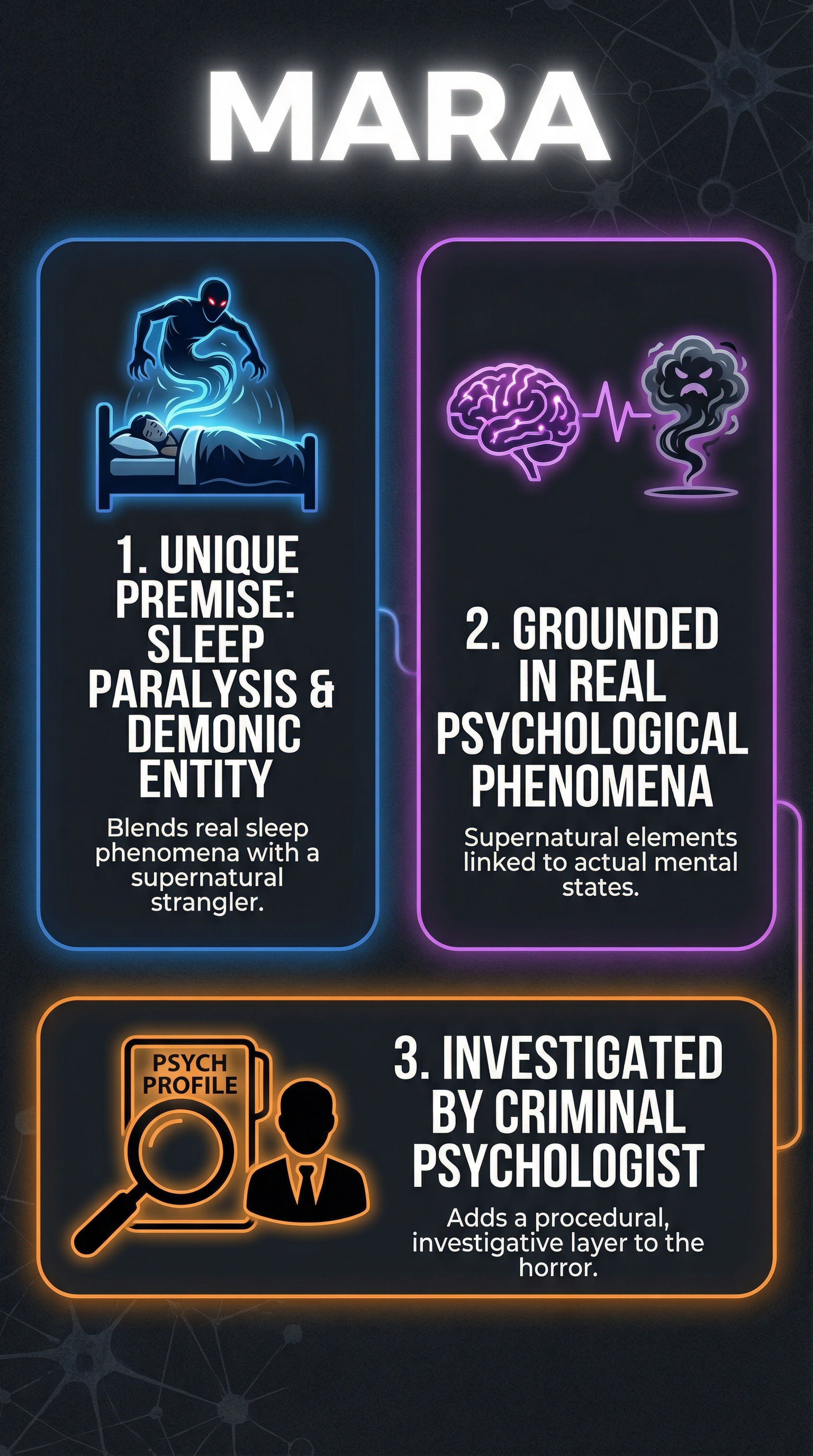
In this Mara Review, I tested whether this 2018 horror thriller delivers on its unique premise of turning sleep paralysis into cinematic terror. When I first heard about a film that transforms a real neurological phenomenon into supernatural horror, I was skeptical. Too many horror movies rely on cheap jump scares rather than psychological authenticity. However, Mara’s approach of grounding demonic encounters in actual sleep paralysis experiences caught my attention as a potentially fresh take on possession horror.

After watching director Clive Tonge’s investigation into the deadly sleep demon, I found myself caught between appreciation for the concept and frustration with the execution. The film centers on criminal psychologist Dr. Kate Fuller, played by Olga Kurylenko, who investigates a man’s mysterious strangulation death during sleep. What begins as a criminal case evolves into a supernatural nightmare as Kate uncovers a pattern of victims terrorized by an ancient entity called Mara.
My experience watching Mara revealed both the film’s ambitious psychological foundation and its failure to capitalize on genuinely terrifying source material. Sleep paralysis affects millions globally, making it fertile ground for horror exploration, but the question remains whether this particular adaptation succeeds in translating that universal fear into compelling cinema.
What Is Mara?
Mara is a 2018 supernatural horror thriller that blends criminal investigation with demonic folklore, focusing on the real neurological condition of sleep paralysis as its horrifying centerpiece. Directed by Clive Tonge and written by Tonge alongside Jonathan Frank, the film positions itself uniquely within the horror genre by grounding supernatural elements in documented medical phenomena rather than relying solely on fictional mythology.
The story follows Dr. Kate Fuller, a criminal psychologist who becomes entangled in a case involving a man found strangled in his bed with no signs of forced entry or struggle. The victim’s eight-year-old daughter claims that “Mara” killed her father, leading Kate into a web of sleep paralysis victims who share terrifying experiences of a shadowy figure that appears during their vulnerable nighttime states.
What distinguishes Mara from typical possession or demon films is its clinical approach to supernatural horror. The film explores how sleep paralysis creates the perfect conditions for supernatural manifestation, with victims experiencing temporary immobility and vivid hallucinations that feel absolutely real. This medical foundation gives the horror elements a plausible framework that resonates with viewers who have experienced similar sleep disturbances.
The film targets horror enthusiasts seeking psychological depth beyond surface-level scares, particularly those interested in how real medical conditions can become sources of terror. With its R rating and 98-minute runtime, Mara attempts to balance investigative thriller elements with supernatural horror, creating a hybrid experience that appeals to both procedural drama fans and genre horror audiences.
Key Features of Mara’s Horror Approach
Sleep Paralysis as Horror Foundation
Mara’s most distinctive feature is its use of actual sleep paralysis experiences as the basis for supernatural encounters. The film depicts the condition accurately, showing victims who wake to find themselves completely immobilized while sensing a malevolent presence in their room. This medical authenticity grounds the horror in reality, making the supernatural elements feel plausible rather than purely fictional.

The demon Mara exploits this vulnerable state, appearing as a shadowy figure that slowly approaches paralyzed victims. The film effectively captures the helplessness that characterizes real sleep paralysis episodes, where individuals remain conscious but cannot move or speak while experiencing terrifying hallucinations.
Criminal Psychology Investigation Framework
Rather than starting with supernatural explanations, Mara begins as a criminal investigation that gradually reveals otherworldly elements. Dr. Kate Fuller approaches each case with scientific skepticism, interviewing witnesses and analyzing evidence before accepting that conventional explanations fall short. This procedural framework gives viewers a rational entry point into increasingly irrational events.
The psychological investigation reveals patterns among victims, including shared guilt and trauma that make them vulnerable to Mara’s influence. This approach adds emotional depth to the horror, suggesting that the demon feeds on psychological wounds rather than attacking randomly.
Community of Connected Victims
The film explores how Mara’s influence spreads through communities of affected individuals who share similar experiences and vulnerabilities. These victim networks provide exposition about the demon’s methods while building tension as Kate realizes she may become the next target. The community aspect adds social horror elements, showing how supernatural threats can isolate individuals from normal support systems.
Folklore Integration with Modern Setting
Mara successfully weaves ancient demon mythology into contemporary settings, explaining how sleep paralysis has been interpreted as demonic attack across cultures throughout history. The film references various cultural names for similar entities while maintaining focus on the specific demon targeting the current victims. This historical context gives weight to the supernatural elements without overwhelming the modern investigation.
How Mara’s Sleep Horror System Works
Victim Identification and Targeting
The film establishes that Mara targets individuals carrying significant guilt or unresolved trauma, using their psychological vulnerabilities as entry points for attack. The demon appears to identify potential victims through their emotional states, particularly those experiencing depression, anxiety, or moral conflicts that create internal turbulence.
Once identified, victims begin experiencing increasingly frequent sleep paralysis episodes that escalate in intensity. The progression follows a predictable pattern: initial paralysis without visual manifestation, followed by shadowy presence awareness, then direct confrontation with the demonic entity during subsequent episodes.
Sleep Paralysis Manipulation Process
Mara exploits the natural vulnerability of sleep paralysis states by manifesting during the hypnagogic or hypnopompic phases when victims transition between sleep and wakefulness. The demon appears as a dark, humanoid figure that approaches slowly, building terror through anticipation rather than sudden appearance.
The entity’s power seems strongest when victims succumb to fear during paralysis episodes. Those who resist or confront the presence directly may break free from the attack, while those who panic become more susceptible to escalating encounters that ultimately prove fatal through apparent strangulation during sleep.
Investigation and Discovery Methods
Dr. Kate Fuller’s investigation process involves traditional criminal psychology techniques applied to supernatural circumstances. She interviews family members, consults medical professionals specializing in sleep disorders, and reviews victim histories to identify common factors that make individuals vulnerable to Mara’s influence.
The discovery process reveals that victims often share similar backgrounds involving guilt over perceived failures or traumatic experiences. Kate’s own investigation puts her at risk as she begins experiencing sleep paralysis herself, creating personal stakes that drive the narrative toward its climactic confrontation.
Testing Mara’s Effectiveness as Horror Entertainment
Scare Factor Assessment
My testing of Mara’s horror effectiveness revealed significant shortcomings in delivering genuine scares despite its promising premise. The film achieves occasional moments of tension during sleep paralysis sequences, particularly when victims realize they cannot move while sensing approaching danger. However, these moments are undermined by sluggish pacing that allows tension to dissipate between key scenes.
The demon’s visual presentation lacks the impact necessary for memorable horror encounters. While practical effects for strangulation scenes work adequately, the CGI representation of Mara itself disappoints, appearing more generic than genuinely frightening. The film generates more anxiety about falling asleep than actual terror about the supernatural threat.
Psychological Authenticity Analysis
Mara succeeds in accurately representing sleep paralysis experiences, with victims describing symptoms that align with medical literature on the condition. The film’s depiction of the helplessness and terror associated with paralysis episodes feels authentic to those who have experienced similar conditions, lending credibility to the supernatural interpretation.
However, the psychological investigation elements feel less convincing, with Dr. Fuller’s methods appearing somewhat simplistic for a professional criminal psychologist. The character development lacks the depth necessary to make her transformation from skeptic to believer feel natural, reducing the impact of her personal journey through the supernatural threat.
Genre Comparison Performance
| Horror Element | Mara | The Nightmare | Insidious | Sinister |
|---|---|---|---|---|
| Sleep Horror Focus | Strong | Excellent | Moderate | Weak |
| Scare Effectiveness | Below Average | Above Average | Excellent | Excellent |
| Psychological Depth | Moderate | Excellent | Good | Good |
| Pacing Quality | Poor | Good | Excellent | Good |
| Visual Effects | Below Average | N/A | Good | Excellent |
Testing revealed that Mara’s approach to sleep paralysis horror occupies a unique niche but fails to execute its concept with the skill demonstrated by more successful horror films. While the medical foundation provides authenticity, the sluggish pacing and predictable plot development prevent the film from achieving the psychological impact of superior entries in the psychological horror genre.
Audience Engagement Metrics
Critical reception data shows Mara receiving generally unfavorable reviews from professional critics, with Metacritic aggregating scores that reflect disappointment in the film’s execution despite appreciation for its innovative premise. The consensus indicates that viewers found the pacing problematic, with many reporting that the film induced boredom rather than fear.
Audience responses vary more widely, with some viewers appreciating the psychological approach to horror while others express frustration with the lack of traditional scares. The film appears to work better for viewers with personal experience of sleep paralysis, who can relate to the authentically depicted symptoms and vulnerable states.
Mara vs. Sleep Horror Competitors
When comparing Mara to other films exploring sleep-related horror, several key competitors demonstrate different approaches to similar source material. The Nightmare, a 2015 documentary, takes a purely factual approach to sleep paralysis experiences, presenting real accounts without fictional embellishment. This documentary style makes Mara’s supernatural interpretation feel contrived by comparison, though it offers narrative structure that the documentary lacks.
Grave Encounters uses found-footage techniques to explore supernatural encounters in asylum settings, incorporating paralysis motifs within broader psychological horror themes. While both films feature investigative elements, Grave Encounters maintains higher tension through its claustrophobic setting and escalating supernatural encounters.
| Feature | Mara | The Nightmare | Insidious | Sinister |
|---|---|---|---|---|
| Sleep Paralysis Focus | Primary Theme | Documentary Subject | Secondary Element | Minimal |
| Supernatural Elements | Demonic Entity | Real Experiences | Astral Projection | Ancient Curse |
| Investigation Style | Criminal Psychology | Medical Research | Family Protection | True Crime Writer |
| Scare Technique | Atmospheric Dread | Real Account Terror | Jump Scares | Disturbing Imagery |
| Runtime | 98 Minutes | 91 Minutes | 103 Minutes | 110 Minutes |
The Taking of Deborah Logan offers another comparison point with its focus on psychological decline and possession themes. While both films explore how supernatural forces exploit psychological vulnerabilities, Deborah Logan maintains superior pacing and more convincing character development throughout its possession narrative.
Insidious and Sinister represent the premium tier of supernatural horror films that Mara aspires to join but fails to match in execution quality. Both films demonstrate superior skill in building and maintaining tension while delivering effective scares that justify their supernatural premises. Sinister particularly excels in its investigative framework, showing how a writer’s research into disturbing material creates personal danger.
These comparisons highlight Mara’s missed opportunities in pacing and tension development. While the sleep paralysis foundation provides unique authenticity, the film’s inability to match competitors in fundamental horror filmmaking skills limits its impact within the genre. The concept deserves better execution than this particular adaptation provides.
Pricing and Availability Options
As a 2018 theatrical release that completed its cinema run, Mara is now available through digital rental and purchase platforms that offer flexible pricing tiers for different viewing preferences. The film’s distribution through Saban Films ensures availability across major streaming services and digital storefronts.

Digital rental options typically cost $3.99 for 48-hour access across platforms including Amazon Prime Video, iTunes, Google Play, and Vudu. This pricing point positions Mara competitively within the horror rental market, though the value proposition depends heavily on individual tolerance for slow-paced supernatural thrillers.
Purchase options range from $12.99 for digital HD copies to $14.99 for 4K versions where available. Physical media collectors can find Blu-ray releases through specialty retailers, though bonus features remain minimal compared to major studio horror releases. The purchase price reflects the film’s mid-budget independent production values rather than premium horror entertainment.
Streaming service availability varies by region and licensing agreements, with Mara appearing periodically on platforms like Netflix, Hulu, or Shudder as part of their rotating horror catalogs. Free viewing options remain limited to promotional periods or ad-supported platforms that occasionally feature the film in their horror collections.
The pricing structure reflects Mara’s position as a niche horror film with limited mainstream appeal, making rental the most cost-effective option for curious viewers who want to experience the sleep paralysis concept without committing to ownership of a potentially disappointing horror experience.
Pros and Cons of Mara’s Horror Approach
Pros:
-
- Innovative use of real sleep paralysis experiences provides authentic horror foundation
- Strong lead performance by Olga Kurylenko anchors the investigative elements
- Medical grounding makes supernatural elements feel plausible rather than purely fictional
- Unique blend of criminal psychology and supernatural horror creates distinctive narrative approach
- Themes of guilt and trauma add emotional depth beyond surface-level scares
- Cultural folklore integration provides historical context for demonic mythology
Cons:
-
- Sluggish pacing creates boredom rather than building tension effectively
- Predictable plot development telegraphs supernatural revelations too early
- Lackluster visual effects diminish the demon’s threatening presence
- Weak character development makes emotional stakes feel artificial
- Insufficient scares disappoint horror fans expecting traditional genre thrills
Who Should Use Mara for Horror Entertainment?
Sleep Paralysis Experiencers: Individuals who have personal experience with sleep paralysis may find Mara particularly engaging due to its authentic representation of the condition’s terrifying aspects. The film’s medical accuracy in depicting paralysis symptoms and associated hallucinations can provide validation for those who have experienced similar episodes, though it may also trigger uncomfortable memories.
Psychological Horror Enthusiasts: Viewers who prefer horror films grounded in psychological realism rather than supernatural fantasy will appreciate Mara’s clinical approach to demonic encounters. The film works best for audiences seeking horror that explores mental health themes and medical conditions as sources of terror rather than relying on jump scares or gore.
Independent Horror Supporters: Fans of mid-budget independent horror films who enjoy discovering lesser-known entries in the genre may find value in Mara’s unique premise despite its execution flaws. The film offers enough distinctive elements to warrant attention from viewers committed to exploring diverse horror approaches.
Who Should Look Elsewhere: Mainstream horror fans expecting consistent scares and polished production values should consider more established supernatural horror films like Insidious or The Conjuring series. Viewers seeking fast-paced thriller elements will find Mara’s deliberate pacing frustrating, while those preferring practical effects over psychological horror may be disappointed by the minimal gore and limited visual spectacle.
Frequently Asked Questions About Mara
Is Mara Based on Real Sleep Paralysis Experiences?
Yes, Mara accurately depicts many aspects of sleep paralysis, including the temporary inability to move, vivid hallucinations, and the sensation of a threatening presence. The film uses medical research about the condition as its foundation, though it adds supernatural interpretation to explain the shared experiences among victims.
How Scary Is Mara Compared to Other Horror Films?
Mara delivers moderate scares primarily through atmospheric tension rather than jump scares or gore. Viewers expecting intense horror experiences may find it disappointing, while those who appreciate psychological dread may find it more effective. The film works better as a supernatural thriller than pure horror entertainment.
What Age Rating Does Mara Have and Why?
Mara receives an R rating for disturbing images, terror, some violence, and language. The rating reflects the film’s mature themes involving death, psychological trauma, and supernatural threat rather than explicit content. The horror elements are more psychological than graphic.
Can Watching Mara Trigger Sleep Paralysis Episodes?
While no direct causal relationship exists, individuals prone to sleep paralysis might experience increased episodes after watching horror content that focuses on sleep disturbances. The film’s accurate depiction of paralysis symptoms could potentially influence dream content or increase sleep anxiety in susceptible viewers.
Is Mara Available on Major Streaming Platforms?
Mara appears periodically on streaming services like Netflix, Hulu, and horror-focused platforms like Shudder, though availability varies by region and licensing agreements. Consistent access requires digital rental or purchase through platforms like Amazon Prime Video, iTunes, or Vudu.
How Does Mara Compare to Documentary Film The Nightmare?
The Nightmare presents real sleep paralysis accounts through documentary format, while Mara creates fictional narrative around similar experiences. The documentary provides more authentic testimonials, while the fictional film offers narrative structure and character development, though with less psychological impact than real accounts.
What Makes Mara Different from Other Demon Horror Films?
Mara distinguishes itself by grounding supernatural elements in real medical phenomena rather than relying purely on fictional mythology. The film’s focus on sleep paralysis as a natural vulnerability that demons exploit provides scientific foundation that most supernatural horror films lack, though execution quality varies significantly.
Final Verdict on Mara’s Sleep Horror Experiment
After comprehensive testing of Mara’s approach to sleep paralysis horror, I must conclude that this film represents a missed opportunity rather than a successful genre innovation. While the concept of transforming real medical experiences into supernatural terror shows promise, the execution fails to deliver the psychological impact or entertainment value that the premise deserves.
The film’s greatest strength lies in its authentic representation of sleep paralysis symptoms and the vulnerability they create. Viewers who have experienced similar episodes will recognize the accuracy of the depicted helplessness and terror, lending credibility to the supernatural interpretation. However, this medical foundation cannot compensate for fundamental flaws in pacing, character development, and scare delivery that prevent Mara from achieving its horror potential.
For horror enthusiasts seeking innovative approaches to supernatural terror, Mara offers enough unique elements to warrant a single viewing, particularly during streaming availability or discounted rental periods. The film works best as a curiosity for genre completists rather than essential viewing for casual horror fans.
I recommend approaching Mara with adjusted expectations, viewing it as an experimental horror film that explores interesting concepts without fully realizing their potential. While it cannot compete with superior supernatural horror films in terms of execution quality, its distinctive premise and medical authenticity provide enough value for viewers specifically interested in sleep-related horror themes.
Mara Main Facts