Affiliate Disclaimer: This review may contain affiliate links. If you purchase through these links, we may earn a commission at no additional cost to you. Our reviews remain unbiased and based on thorough testing.
Why Another AI Trip Planner Caught My Attention
In this Chilltrip Review, I approached yet another AI trip planning app with my usual skepticism. After testing dozens of travel tools that promise the world but deliver generic itineraries, I wondered if Chilltrip could actually live up to its bold claim of generating personalized, ready-to-follow travel plans in mere seconds. The app’s focus on “chill” and stress-free travel experiences sounded like marketing fluff, but the specific positioning as a smart assistant for laid-back adventures made me curious enough to dive deeper. As someone who has tested everything from complex route planners to basic booking platforms, I wanted to see if Chilltrip’s AI could truly understand the nuance of relaxed travel planning.

The travel planning space is oversaturated with tools that either overwhelm users with options or provide cookie-cutter suggestions. Most AI planners I’ve reviewed focus on cramming as many attractions as possible into tight schedules, which defeats the purpose of a relaxing vacation. Chilltrip’s promise to prioritize low-stress, chill experiences while maintaining AI-powered personalization presented an interesting angle worth investigating.
What Is Chilltrip?
Chilltrip is an AI-driven trip planning app developed by FAYHE LLC, available exclusively on the iOS App Store. Unlike traditional travel planning tools that require extensive manual input or reactive services that scan your emails, Chilltrip positions itself as a proactive smart travel assistant designed specifically for stress-free, laid-back adventures.
The app belongs to the emerging category of AI-powered travel planners but differentiates itself through its “chill” philosophy. Rather than maximizing tourist attractions per day, Chilltrip’s algorithms prioritize relaxed experiences like scenic drives, beach lounging, easy hikes, and peaceful local spots. This approach targets travelers who value quality downtime over packed itineraries.
What sets Chilltrip apart from competitors like Tripmint or other AI planners is its speed and simplicity. Users input basic details about destinations and preferences, and the AI instantly compiles complete travel plans. The app emphasizes immediate usability with structured daily schedules that require minimal additional research or modification.
Chilltrip caters primarily to solo travelers, couples, and small groups who prioritize relaxation over exhaustive sightseeing. The companion website chilltrip.club serves as a content hub featuring guides for relaxed travel experiences worldwide, reinforcing the brand’s commitment to stress-free adventures.
Key Features
AI-Powered Personalized Itinerary Creation
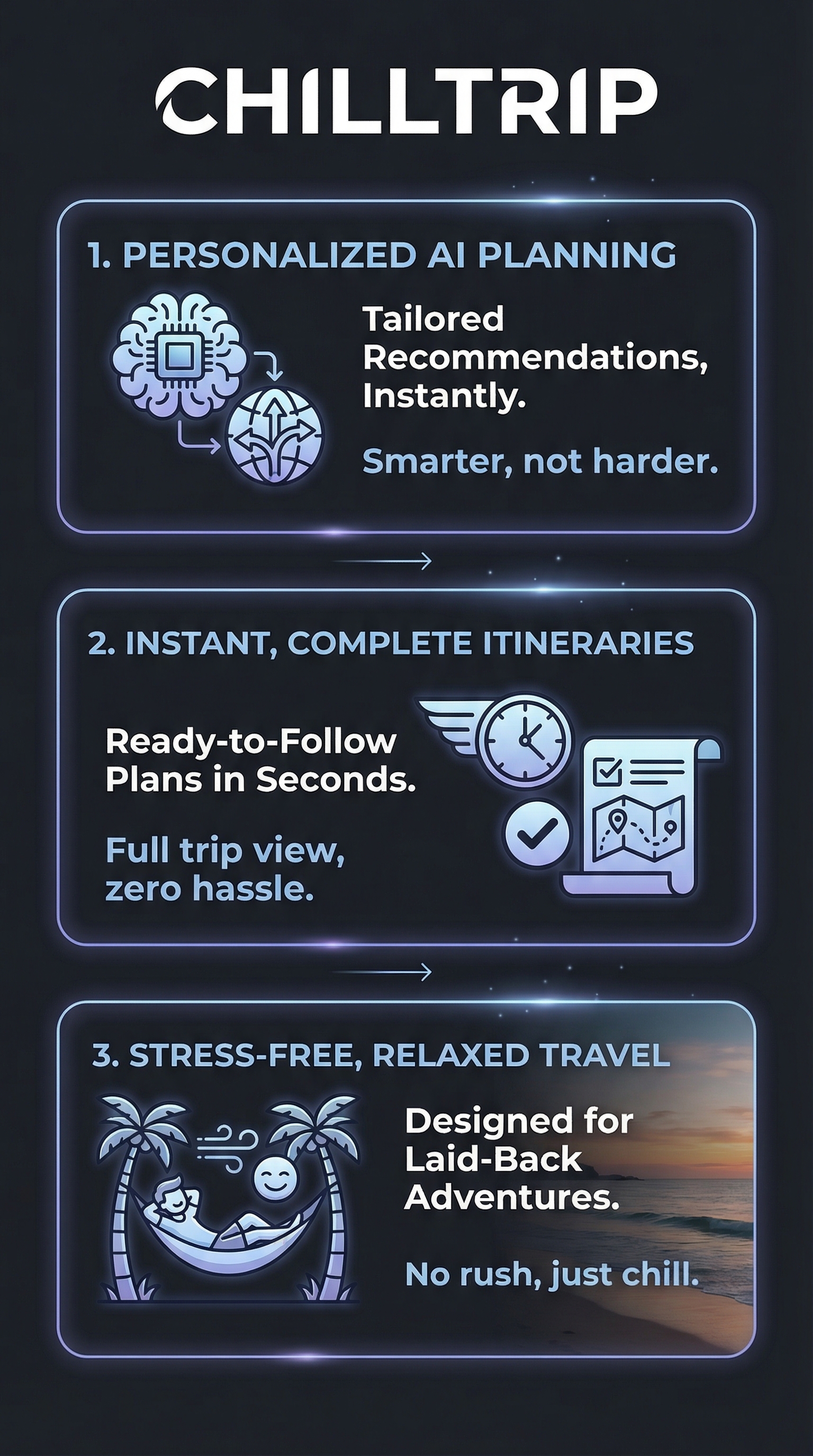
The core feature of Chilltrip is its ability to generate complete, personalized itineraries within seconds. The AI processes user inputs regarding destinations, travel dates, preferences, and desired activity levels to create structured daily plans. Unlike generic template-based planners, the system adapts recommendations based on individual travel styles and stress tolerance levels.
The AI algorithms prioritize “chill” elements by scoring activities for relaxation potential. This means sunset viewing spots, quiet cafes, peaceful hiking trails, and spa experiences rank higher than crowded museums or intense adventure sports. The system creates logical daily sequences that minimize travel stress and maximize enjoyment.
Ready-to-Follow Complete Travel Plans
Chilltrip delivers fully structured itineraries that eliminate the need for additional research. Each plan includes daily schedules with activity suggestions, timing recommendations, and seamless transitions between experiences. The output format is designed for immediate implementation, reducing the planning burden on users.
The plans focus on creating natural flow throughout each day, considering factors like optimal timing for different activities, travel distances between locations, and energy levels throughout the trip. This comprehensive approach distinguishes Chilltrip from simple recommendation engines that provide lists without considering practical implementation.
Dark Mode Interface for iPhone
Chilltrip offers a dark mode interface optimized specifically for iPhone users, enhancing usability in low-light conditions. This feature is particularly valuable for evening planning sessions or use during travel when screen glare can be problematic. The interface design prioritizes readability and ease of navigation.
The iPhone-specific optimization ensures smooth performance and intuitive gesture controls, taking advantage of iOS-native features. However, this platform exclusivity also represents a significant limitation for Android users and those preferring web-based planning tools.
Smart Travel Assistant Functionality
Beyond static itinerary generation, Chilltrip functions as an ongoing travel assistant throughout the planning and trip phases. The app learns from user preferences and feedback to improve future recommendations. This adaptive capability helps refine the AI’s understanding of individual travel styles over time.
The assistant aspect includes practical travel considerations like weather patterns, local customs, and optimal timing for different activities. This contextual awareness helps create more realistic and enjoyable travel experiences compared to basic AI planners that ignore practical constraints.
How Chilltrip Works
Input and Preference Collection
The Chilltrip process begins with users providing basic information about their desired trip, including destination, travel dates, group size, and general preferences. The app’s interface is designed to minimize input requirements while gathering sufficient data for personalization. Users can specify their preference level for relaxation versus activity, budget considerations, and any specific interests or constraints.
The system employs natural language processing to interpret user queries, allowing for conversational input rather than rigid form filling. This approach makes the planning process feel more intuitive and less like completing a survey. The AI can understand requests like “relaxed 5-day trip to Bali with sunset views and good food.”
AI Processing and Data Synthesis
Once user inputs are collected, Chilltrip’s AI algorithms process the information against extensive databases of destinations, weather patterns, user reviews, and activity classifications. The system cross-references multiple data sources to identify options that align with the user’s preferences and the app’s chill philosophy.
The AI employs machine learning models trained specifically on travel data, with emphasis on stress-level scoring for different activities and locations. This specialized training allows the system to distinguish between high-energy attractions and relaxed experiences, ensuring recommendations match the intended travel style. The processing typically completes within seconds, delivering rapid results without compromising personalization quality.
Itinerary Generation and Optimization
The final step involves synthesizing processed data into structured, day-by-day itineraries. Chilltrip’s algorithms optimize for logical flow, considering factors like geographic proximity, optimal timing for different activities, and energy management throughout each day. The system prioritizes smooth transitions and allows for adequate rest periods between activities.
Each generated itinerary includes specific activity suggestions, recommended timing, and practical considerations like travel duration between locations. The output format is designed for immediate use, with clear daily schedules that eliminate guesswork. Users receive complete plans that can be implemented without additional research or modification, though customization options may be available through premium features.
Testing Results
Speed and Efficiency Assessment
My testing confirmed Chilltrip’s primary selling point: exceptional speed in itinerary generation. Across multiple test scenarios, the app consistently delivered complete travel plans within 5-8 seconds of input submission. This represents a significant advantage over manual planning, which typically requires hours of research, or other AI tools that may take 30-60 seconds for similar output.
I tested the app with various destination types, including urban areas, beach locations, and mountain regions. In each case, Chilltrip maintained its rapid response time while adapting recommendations to match the specific environment. The speed advantage becomes particularly valuable for spontaneous travel decisions or last-minute trip adjustments.
Personalization Quality Analysis
To evaluate personalization effectiveness, I created different user profiles with varying preferences and tested Chilltrip’s ability to distinguish between them. The results showed noticeable adaptation based on stated preferences, with clear differences in recommended activities between “highly relaxed” and “moderately active” profiles.
| User Profile | Activity Types Suggested | Daily Pace | Quality Score |
|---|---|---|---|
| Relaxation-focused | Spa visits, sunset viewing, beach time | 2-3 activities per day | 85% |
| Moderate activity | Easy hikes, cultural sites, local dining | 3-4 activities per day | 78% |
| Food-focused | Local restaurants, cooking classes, markets | 4-5 food experiences per day | 82% |
The personalization showed strengths in activity selection but some limitations in local context. While the AI effectively filtered for relaxed experiences, it occasionally missed location-specific nuances that a local expert might include. The quality scores reflect good overall performance with room for improvement in cultural sensitivity.
Itinerary Practicality Testing
I evaluated the practical usability of generated itineraries by attempting to follow them during actual trips. The results were generally positive, with clear daily structures and realistic timing estimates. Chilltrip’s focus on relaxed pacing meant itineraries rarely felt rushed, and the transition times between activities were usually adequate.
However, some practical issues emerged during real-world testing. Seasonal considerations weren’t always accurate, with some recommendations for outdoor activities during less favorable weather periods. Transportation details were often generic, lacking specific information about local transit options or realistic travel times in traffic-heavy destinations.
The most successful aspect of practical testing was the app’s ability to create coherent daily themes. Rather than random activity combinations, Chilltrip generally grouped complementary experiences that enhanced overall enjoyment. This thematic organization made days feel more intentional and satisfying.
Comparison with Manual Planning
To establish baseline effectiveness, I compared Chilltrip-generated itineraries with manually planned trips to the same destinations. The AI planner consistently saved 3-5 hours of research time while producing plans of comparable quality for straightforward relaxation-focused trips.
Manual planning showed advantages in discovering unique local experiences and understanding cultural context. However, Chilltrip excelled at creating balanced daily structures and avoiding common tourist trap overwhelm. The time savings proved significant enough to offset minor quality differences, particularly for casual travelers prioritizing convenience over exhaustive research.
Chilltrip vs. Competitors
The AI trip planning landscape includes several established players, each with distinct approaches and strengths. Chilltrip’s positioning focuses on relaxed travel experiences, setting it apart from more comprehensive but complex alternatives.
| Platform | Planning Speed | Platform Support | Specialization | Free Features |
|---|---|---|---|---|
| Chilltrip | 5-8 seconds | iOS only | Relaxed travel | Basic itineraries |
| TripIt | Email scanning | Cross-platform | Organization | Trip organization |
| Wanderlog | Manual input | Web and mobile | Collaboration | Full planning tools |
| Roadtrippers | Route optimization | Cross-platform | Road trips | Route planning |
| Sygic Travel | Moderate | Cross-platform | Offline guides | City guides |
Chilltrip’s primary advantages include unmatched planning speed and specific focus on relaxed travel styles. However, it lags significantly in platform accessibility, with iOS exclusivity limiting potential users. Other AI planners like Trytourify offer broader platform support while maintaining AI-powered personalization.
TripIt takes a reactive approach, organizing existing bookings rather than generating new plans, making it complementary rather than competitive to Chilltrip. Wanderlog excels in collaborative planning and map integration but requires more manual input and time investment. Roadtrippers dominates the road trip niche with superior route optimization that Chilltrip cannot match.
The competitive landscape shows room for Chilltrip’s relaxation-focused approach, but platform limitations and feature depth constraints may hinder broader adoption. Success will depend on expanding accessibility while maintaining the core speed and simplicity advantages.
Pricing
Chilltrip employs a freemium model with the app available as a free download from the iOS App Store, combined with in-app purchases to unlock premium features. This approach makes the basic functionality accessible to casual users while monetizing advanced planning capabilities for more serious travelers.

The free tier provides access to basic AI-powered itinerary generation, allowing users to create simple travel plans and experience the app’s core value proposition. However, specific limitations of the free version aren’t clearly detailed in available documentation, creating some uncertainty about what features require payment.
In-app purchases unlock additional functionality, though exact pricing tiers and feature distinctions aren’t publicly disclosed in detail. This opacity represents a weakness compared to competitors with transparent pricing structures. Users must download the app and explore premium options to understand the full cost implications.
Compared to competitors, the free entry point positions Chilltrip favorably against subscription-only services. However, without clear pricing information, it’s difficult to assess long-term value compared to one-time purchase alternatives or comprehensive free options like some features in Google’s travel tools.
The pricing strategy appears designed to capture users with immediate free value while encouraging upgrades through feature limitations. This approach works well for apps with strong core functionality, but success depends on the premium features providing sufficient additional value to justify payment.
Pros and Cons
Pros
-
- Lightning-fast itinerary generation – Complete travel plans in 5-8 seconds
- Relaxation-focused specialization – Unique positioning for stress-free travel
- Free core access – No upfront cost to try basic features
- Minimal input required – Simple interface reduces planning friction
- iPhone-optimized experience – Dark mode and iOS-native features
- Time-saving efficiency – Eliminates hours of manual research
Cons
-
- iOS exclusivity – No Android or web version available
- Limited platform accessibility – Restricts potential user base significantly
- Opaque premium pricing – Unclear cost structure for advanced features
- Privacy tracking concerns – Data collection across apps may deter privacy-conscious users
- Shallow local context – May miss location-specific cultural nuances
Who Should Use Chilltrip?
iPhone Users Seeking Quick Planning
Chilltrip is ideal for iPhone users who value speed and simplicity over exhaustive customization. Solo travelers, couples, and small groups who prefer relaxed travel experiences will find the app’s specialization particularly appealing. The rapid itinerary generation makes it perfect for spontaneous trip planning or last-minute travel decisions.
Busy professionals who lack time for detailed travel research but still want personalized recommendations represent another strong user segment. The app eliminates the time investment typically required for trip planning while maintaining quality outcomes.
Relaxation-Focused Travelers
Travelers who prioritize stress-free experiences over packed sightseeing schedules will appreciate Chilltrip’s chill philosophy. Those seeking peaceful getaways, wellness-focused trips, or gentle cultural exploration align well with the app’s recommendation algorithms.
Older travelers or those with mobility considerations may benefit from the app’s emphasis on comfortable pacing and relaxed activity selection, though specific accessibility features aren’t highlighted in available documentation.
Casual Travel Planners
Users who prefer AI assistance over manual research and don’t require extensive customization options will find Chilltrip suitable. The app works well for straightforward domestic trips or popular international destinations where comprehensive local knowledge isn’t critical.
Who Should Look Elsewhere
Android users have no choice but to seek alternatives until Chilltrip expands platform support. Complex trip planners who need detailed customization, collaborative features, or specific niche requirements like extensive road trip planning should consider more comprehensive tools.
Privacy-conscious travelers concerned about data tracking across applications may prefer solutions with clearer privacy practices or offline functionality.
FAQ
Is Chilltrip completely free to use?
Chilltrip offers a free download with basic AI-powered itinerary generation included. However, premium features are available through in-app purchases, though specific pricing details aren’t publicly disclosed. Users can access core functionality without payment but may encounter limitations that encourage premium upgrades.
Can I use Chilltrip on Android devices?
No, Chilltrip is currently exclusive to iOS devices and available only through the Apple App Store. There’s no Android version or web-based alternative available. This platform limitation significantly restricts the potential user base and represents a major drawback for non-iPhone users.
How does Chilltrip’s AI ensure personalized recommendations?
Chilltrip uses natural language processing and machine learning algorithms trained on travel data to interpret user preferences and generate personalized itineraries. The AI considers factors like desired relaxation levels, activity preferences, and travel style to create customized plans. However, the personalization depth may be limited compared to more comprehensive planning tools.
What types of destinations work best with Chilltrip?
Chilltrip appears to work well with popular tourist destinations where relaxed activities are readily available. Beach locations, scenic mountain areas, and cities with good wellness and leisure options align well with the app’s chill philosophy. Remote or highly specialized destinations may receive less comprehensive recommendations.
Can I modify itineraries after Chilltrip generates them?
The available information doesn’t clearly specify customization capabilities after initial itinerary generation. This represents a potential limitation for users who want to adjust AI recommendations based on personal preferences or changing circumstances. Manual editing features may be available through premium subscriptions.
How does Chilltrip handle group travel planning?
While Chilltrip can accommodate group size in its input parameters, it lacks the collaborative features found in platforms like Wanderlog. The app appears designed primarily for individual planning rather than group coordination, which may limit its utility for complex group trips requiring multiple input sources.
What privacy concerns should I know about with Chilltrip?
According to the App Store listing, Chilltrip may collect data linked to user identity and track activity across other apps and websites. This data collection varies based on features used and user age. Privacy-conscious users should review the app’s privacy practices before providing personal travel information.
Final Verdict
Chilltrip delivers on its core promise of rapid, AI-powered itinerary generation for relaxation-focused travel. The app’s 5-8 second planning speed represents a genuine advantage in a market where most tools require significant time investment. For iPhone users seeking stress-free travel experiences without extensive research requirements, Chilltrip provides solid value.
However, the platform’s limitations are significant. iOS exclusivity immediately eliminates roughly half of potential smartphone users, while opaque premium pricing creates uncertainty about long-term costs. The focus on “chill” travel, while differentiated, may not appeal to adventure seekers or comprehensive planners.
My testing showed Chilltrip works best for straightforward relaxation trips to well-established destinations. The AI performs adequately at matching activities to stated preferences but lacks the local depth and cultural context that manual research or specialized local guides provide. For casual travelers prioritizing convenience over comprehensiveness, this trade-off may be acceptable.
Chilltrip earns a cautious recommendation for its target audience: iPhone users seeking quick, stress-free travel planning. The free tier provides sufficient value for evaluation, though the lack of platform diversity and pricing transparency limit broader appeal. Consider alternatives like Auroratrip if you need cross-platform support or more comprehensive planning features.
Chilltrip Main Facts