
A quiet transformation is reshaping global healthcare delivery, one that has little to do with pharmaceutical breakthroughs or surgical innovations. Instead, it involves airline route planners, hotel concierges, and government tourism boards working alongside cardiac surgeons and cosmetic dentists. This convergence represents a fundamental shift in how people access medical care, and it’s generating billions in revenue across Southeast Asia and the Middle East.
Why Patients Are Boarding Planes for Surgery
The economics driving medical tourism reveal deep structural problems in Western healthcare systems. A hip replacement costing $40,000 in the United States can be performed in India for $7,000, with comparable quality and outcomes. But cost alone doesn’t explain the phenomenon. Patients increasingly face months-long waiting lists for procedures in their home countries, particularly in systems with universal healthcare like the UK’s NHS or Canada’s provincial systems.
This creates a strange paradox: countries that have solved the access problem through universal coverage now struggle with capacity, while countries with emerging healthcare systems can offer immediate availability precisely because they’ve built infrastructure targeting international patients with purchasing power.
The Airlines That Became Healthcare Logistics Companies
Traditional airlines transport passengers between destinations. Medical tourism has forced carriers to become something more sophisticated, essentially healthcare logistics companies that happen to operate aircraft.
Thai Airways now coordinates with Bangkok’s hospital network to ensure patients can move seamlessly from aircraft to operating theater. The airline has trained cabin crew in basic post-operative care recognition, knowing that some passengers may be traveling shortly after procedures. Air India has developed specialized booking systems that flag medical travelers, allowing ground staff to expedite their passage through airports.
Emirates has perhaps gone furthest, creating what amounts to a medical travel concierge service. The airline works directly with Dubai’s American Hospital and other facilities to coordinate appointment scheduling with flight times, reducing the stress of international medical logistics.
This represents a significant revenue opportunity beyond ticket sales. Medical travelers often bring family members, book premium cabins for comfort during recovery, and make multiple trips for consultations and follow-ups. Malaysia Airlines has recognized this pattern, positioning Kuala Lumpur as a hub where patients can access quality care while family members explore the region.
Hotels Transforming Into Recovery Centers

The traditional hotel business model assumes guests are there for leisure or business, active and mobile. Medical tourism has created a different guest entirely, someone who needs medical-grade amenities wrapped in hospitality service.
The Mandarin Oriental Bangkok now offers what it calls “recovery suites” with hospital-grade beds, in-room medical equipment, and 24-hour nursing staff available on-call. The Banyan Tree has partnered with nearby hospitals to provide post-surgical care protocols that meet international standards. These aren’t simply luxury touches, they’re essential components of the medical tourism value chain.
India’s Taj Coromandel has developed packages that include pre-surgical consultations with hospital staff in hotel conference rooms, eliminating the clinical atmosphere that can increase patient anxiety. The Leela Palace offers Ayurvedic treatments designed to complement Western surgical procedures, creating a hybrid recovery approach that appeals to international patients seeking holistic healing.
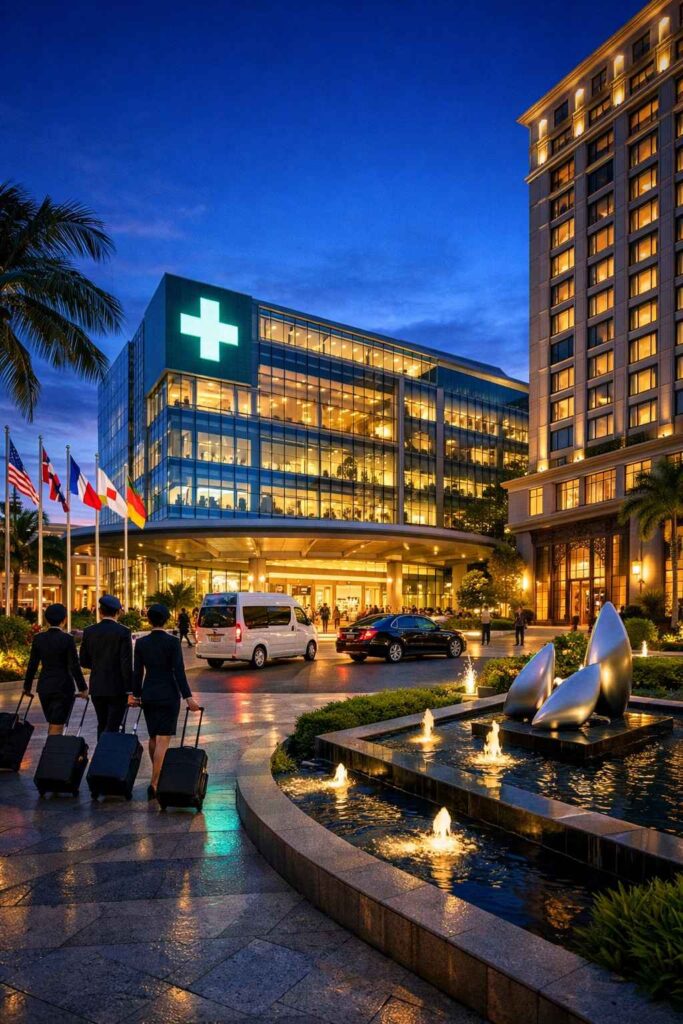
Dubai’s Burj Al Arab and Atlantis The Palm have become de facto extensions of the city’s medical facilities. Patients recovering from cosmetic procedures or orthopedic surgeries can rehabilitate in environments that rival five-star resorts anywhere in the world, a stark contrast to the sterile recovery wards of Western hospitals.
Government Strategy and Market Forces
Thailand’s $1.6 billion medical tourism sector didn’t emerge organically. The Thai government made deliberate policy choices, streamlining medical visas, accrediting hospitals to international standards, and marketing the country as a healthcare destination. This represents industrial policy in action, identifying a competitive advantage and building infrastructure to exploit it.
India’s projected $9 billion medical tourism market by 2026 reflects similar strategic thinking. The country recognized that it had a surplus of highly trained doctors, many educated in Western institutions, and could offer care at price points inaccessible to Western providers. Cities like Chennai have positioned themselves as specialized medical hubs, much like Rochester, Minnesota built itself around the Mayo Clinic.
The UAE took a different approach, targeting the ultra-premium segment. Dubai isn’t competing on price with Thailand or India, instead it offers cutting-edge treatments, internationally renowned specialists, and luxury accommodations for wealthy patients from neighboring Gulf states and beyond. This market segmentation prevents a race to the bottom on pricing.
Malaysia has found success as what might be called the “value option” in the premium segment, less expensive than Dubai but more developed than Thailand for certain specialties. Prince Court Medical Centre has become particularly known for fertility treatments, an area where patients often require multiple visits, making geographic proximity and travel convenience crucial factors.
The Risk Factors Nobody Discusses
Medical tourism’s rapid growth obscures significant risks that neither providers nor governments fully address. Legal liability becomes extraordinarily complex when a Malaysian surgeon operates on a British patient who experiences complications after returning home. Which country’s medical malpractice standards apply? Where would a lawsuit be filed?
Insurance companies have been slow to adapt. Most standard health insurance policies don’t cover complications from elective procedures performed abroad, leaving patients potentially responsible for enormous bills if something goes wrong. Travel insurance rarely covers medical complications beyond emergency stabilization.
Quality control remains inconsistent. While flagship hospitals in Bangkok, Chennai, and Dubai meet rigorous international standards, the medical tourism industry includes many smaller facilities making grandiose claims about capabilities and outcomes. Patients doing research online struggle to distinguish genuinely world-class providers from mediocre ones with sophisticated marketing.
The post-operative care gap presents another challenge. A patient who undergoes spinal surgery in India and returns to Germany two weeks later may face difficulties finding local physicians willing to provide follow-up care for a procedure they didn’t perform and can’t fully evaluate without complete medical records.
Future Trajectories and Market Evolution
The medical tourism industry appears positioned for continued expansion, but its evolution will likely follow several distinct paths. Specialization seems inevitable, with specific cities or countries becoming known for particular procedures. Chennai is already heading this direction with cardiac care, while Goa has carved out a niche in dental tourism.
Technology will reshape the sector significantly. Telemedicine consultations are already reducing the number of in-person visits required, allowing patients to have initial assessments and follow-up appointments remotely. Advanced imaging can be transmitted digitally for specialist review. This reduces travel costs and makes medical tourism accessible to more patients.
We may see the emergence of “medical tourism insurance” as a distinct product category, specifically designed to cover complications and extended stays related to procedures performed abroad. This would remove one of the major psychological barriers preventing people from seeking care internationally.
Regional competition will intensify. Turkey has positioned itself as a medical tourism destination for European patients, offering proximity advantages over Asian destinations. Latin American countries are developing similar strategies for North American patients. This geographic diversification could pressure Asian providers on pricing while spurring quality improvements.
The relationship between airlines and healthcare providers will likely deepen. We might see formal partnerships or even equity investments, with carriers developing medical tourism as a core business vertical rather than an opportunistic sideline.
What This Means for Global Healthcare
Medical tourism fundamentally challenges assumptions about healthcare as a local service. When patients can access high-quality care across borders, it creates competitive pressure that domestic healthcare systems cannot ignore. British patients traveling to Thailand for hip replacements represents a market signal that NHS waiting times have become unacceptable.
This market-driven quality improvement cycle could ultimately benefit patients globally. As hospitals in Bangkok and Chennai compete for international patients, they invest in cutting-edge equipment and recruit top specialists. That expertise and infrastructure also serves local populations, raising overall healthcare standards in countries that might otherwise struggle to make such investments.
However, medical tourism also risks creating two-tier healthcare systems where international patients receive premium service while local populations get whatever remains. India’s best hospitals cater extensively to foreign patients, raising questions about resource allocation in a country where hundreds of millions lack basic healthcare access.
The $1.6 billion flowing into Thailand’s medical tourism sector represents genuine economic development, creating jobs for doctors, nurses, hotel workers, and airline employees. But it also reflects deeper dysfunction in global healthcare, where price differentials for identical procedures can vary by factors of ten depending on geography.
Medical tourism won’t replace domestic healthcare systems, but it will increasingly function as a pressure valve, allowing patients to route around failures in their home systems. Airlines and hotels capitalizing on this trend aren’t creating the phenomenon, they’re responding rationally to market opportunities created by misaligned incentives in global healthcare delivery. The question isn’t whether this industry will continue growing, it’s whether healthcare systems in developed countries will adapt to the competitive pressure it creates.