Healthcare for retirees in Bali has evolved dramatically over the past decade, transforming from a concern into a genuine advantage for expatriates choosing Indonesia’s island paradise for their retirement years. As someone who has guided hundreds of retirees through their transition to Bali since 2009, I’ve witnessed firsthand how the island’s medical infrastructure has matured to meet international standards while maintaining the affordability that makes Southeast Asian retirement so attractive.
This comprehensive guide draws from 15 years of on-the-ground experience helping expatriates navigate Bali’s healthcare system. Whether you’re exploring retirement visa Bali requirements or finalizing your move, understanding your medical options is essential. The good news? Bali offers quality healthcare at a fraction of Western costs, with accessibility that rivals many developed nations, particularly in expat-friendly areas like Sanur, Canggu, and Seminyak.
I’ll walk you through everything you need to know: the real costs you’ll face, the best facilities for your needs, insurance strategies that actually work, and the practical realities of managing your health in retirement abroad. By the end of this guide, you’ll have the knowledge to make confident healthcare decisions for your Bali retirement.
Read more: Healthcare Options in Bali: Complete 2026 Guide for Expats & Tourists
Understanding the Healthcare System in Bali
Bali’s health care landscape operates on a two-tier system that works surprisingly well for retirees. At the top tier, you’ll find internationally accredited private hospitals staffed with English-speaking doctors, many trained in Australia, the United States, or Europe. These facilities rival what you’d find in Singapore or Bangkok. The second tier includes local clinics and public hospitals, which serve the Indonesian population and budget-conscious travelers.
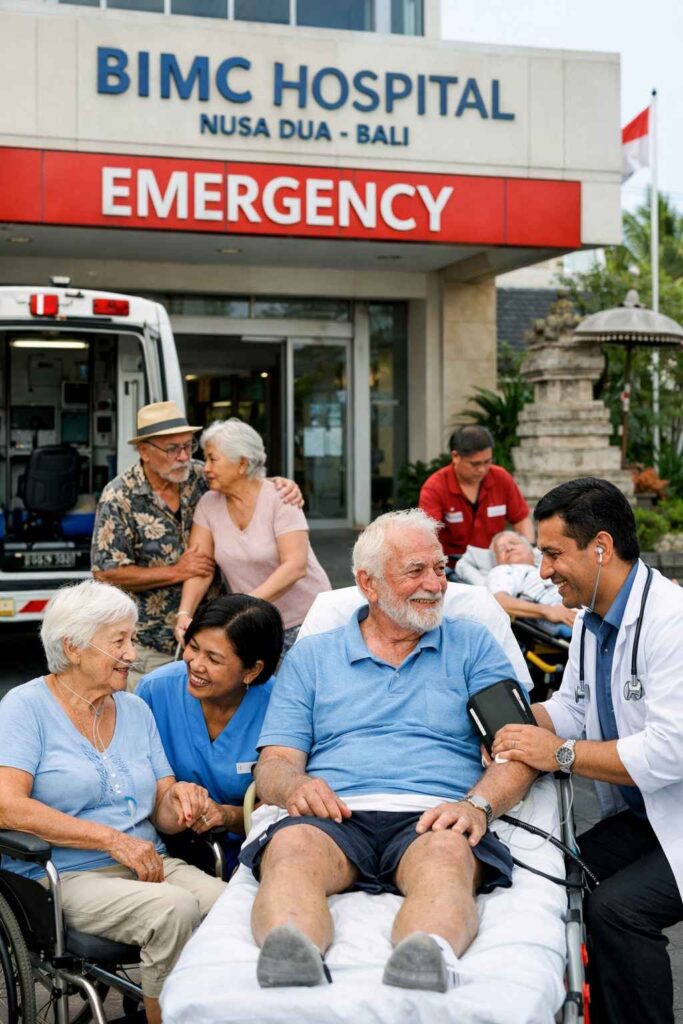
For retirees, the private hospital network is where you’ll receive most of your care. BIMC Hospital in Nusa Dua holds international accreditations from organizations like JCI (Joint Commission International), ensuring standards comparable to Western facilities. Siloam Hospitals Denpasar and Kasih Ibu Hospital maintain similar quality levels. These institutions offer comprehensive services including cardiology, orthopedics, oncology, and advanced diagnostic imaging.
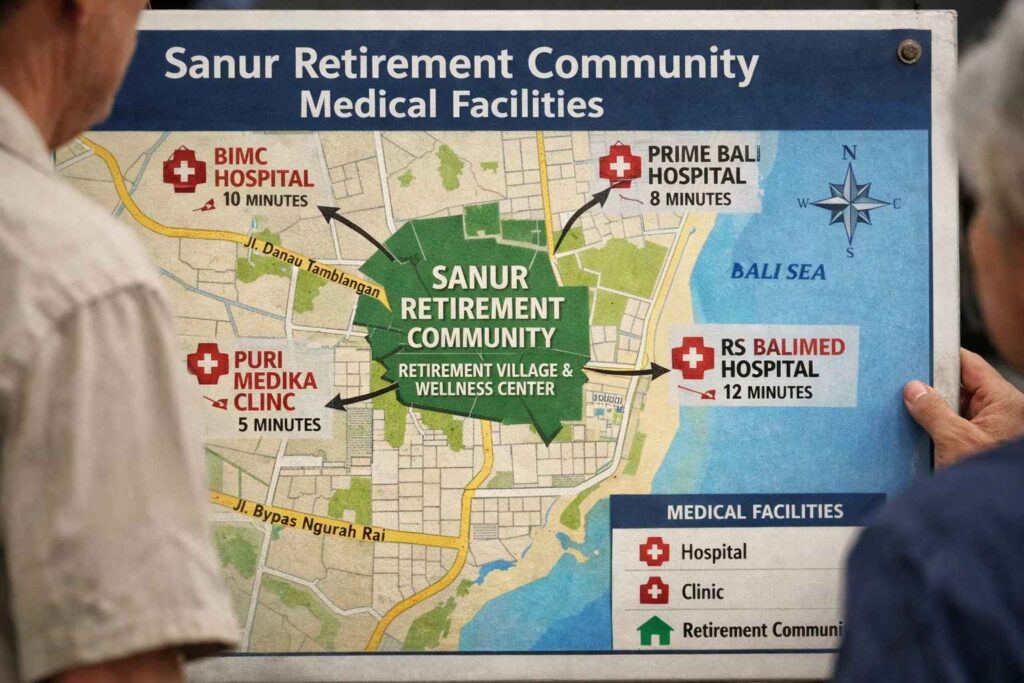
Clinic facilities dot the island’s expat areas, providing convenient access for routine care. In Sanur, you’ll find multiple international clinics within a 10-minute drive of any location. Language accessibility is excellent in these areas. Most doctors speak fluent English, and many nurses have functional English skills. Medical records can be maintained in English, and pharmacists in expat areas communicate comfortably with foreign patients.
The quality gap between international and local facilities is significant. While local public hospitals serve Indonesia’s population adequately, retirees typically prefer private facilities for the communication ease, shorter wait times, and Western medical protocols.
Cost of Healthcare for Retirees in Bali
Here’s where Bali truly shines for retirees on a budget. The cost of living advantage extends powerfully to healthcare, delivering savings of 60-80% compared to Australia, the United States, or Europe.
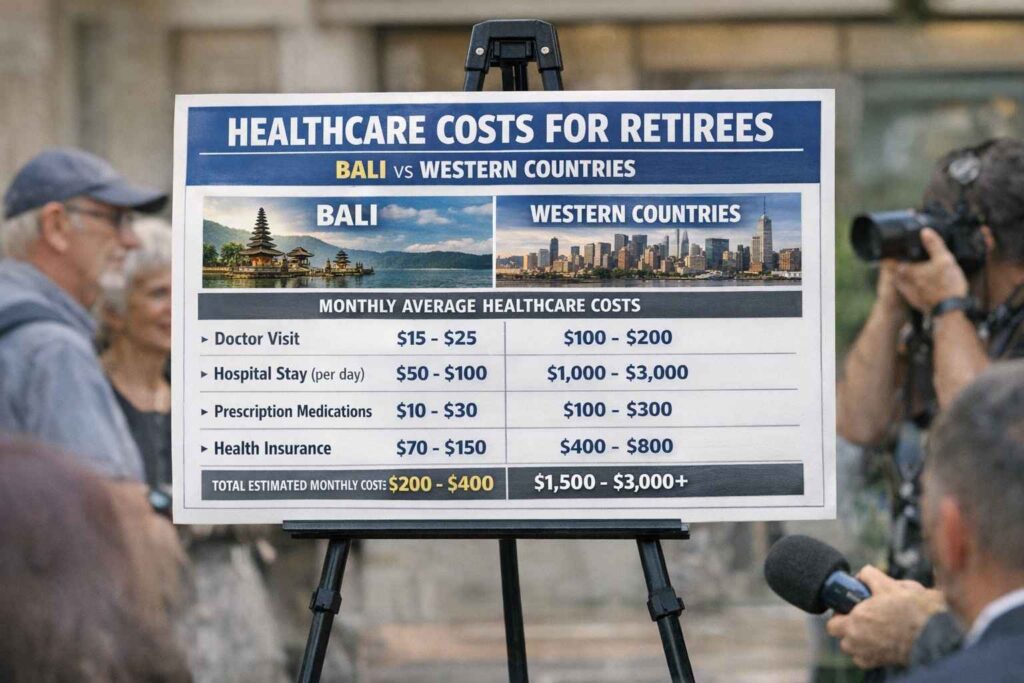
How much does it cost to see a doctor in Bali? A general practitioner consultation at an international clinic runs 400,000-600,000 Indonesian rupiah (IDR), approximately $25-38 USD. Specialist consultations range from 600,000-1,000,000 IDR ($38-63 USD). Compare this to $150-300+ in Australia or the United States for equivalent care.
Common Procedure Costs
Here’s a realistic cost breakdown based on 2026 pricing at Bali’s international hospitals:
Diagnostic Services:
- Comprehensive blood panel: $40-60 USD
- X-ray: $25-40 USD
- CT scan: $200-350 USD
- MRI: $350-550 USD
Common Procedures:
- Dental cleaning and check-up: $30-50 USD
- Dental crown: $250-400 USD
- Cataract surgery (one eye): $1,200-2,000 USD
- Hip replacement: $8,000-12,000 USD
- Colonoscopy: $400-700 USD
Medication costs remain remarkably affordable. A month’s supply of common prescriptions (blood pressure, cholesterol, diabetes medications) typically costs $10-30 USD, depending on whether you choose brand-name or generic options. Most Western medication is available, though you may encounter different brand names.
Dental care deserves special mention. Many retirees actually use Bali for medical tourism, flying in for extensive dental work that costs a quarter of Western prices. A full set of implants might run $15,000-20,000 USD compared to $60,000+ in Australia.
Cost Comparison Table: Bali vs. Western Countries
| Service | Bali (USD) | Australia (USD) | United States (USD) |
|---|---|---|---|
| GP Consultation | $25-38 | $80-120 | $150-300 |
| Specialist Visit | $38-63 | $150-250 | $200-400 |
| Blood Panel | $40-60 | $80-150 | $100-300 |
| MRI Scan | $350-550 | $500-900 | $1,000-3,000 |
| Hip Replacement | $8,000-12,000 | $25,000-40,000 | $40,000-80,000 |
| Dental Crown | $250-400 | $1,200-2,000 | $1,000-2,500 |
These savings make a significant difference for retirees managing their retirement funds strategically.
Health Insurance Options for Expat Retirees
Navigating health insurance for Bali retirement requires understanding three distinct approaches I’ve seen work successfully over the years.
International Health Insurance Plans
Premium international plans from providers like Cigna Global, Allianz Care, or Pacific Prime offer comprehensive worldwide coverage including evacuation services. Annual premiums for retirees (60-70 years old) typically range from $3,000-8,000 USD depending on coverage levels and deductibles. These plans work well if you split time between countries or want the security of treatment anywhere globally.
The advantage? Complete peace of mind and coverage for treatments outside Indonesia, including medical evacuation to Singapore or Australia if needed. The disadvantage? High premiums that may exceed your actual healthcare spending in Bali.
Local Indonesian Insurance Options
Companies like Astra, Allianz Indonesia, and AXA Mandiri offer local policies designed for the Indonesian market. Annual premiums for retirees run $800-2,500 USD for solid coverage at Bali’s international hospitals. These policies cover treatment within Indonesia only.
I’ve seen retirees successfully manage their healthcare needs entirely with local insurance, particularly those committed to staying in Bali long-term. The key is choosing policies accepted at BIMC and Siloam hospitals.
Hybrid Approach (Recommended)
The strategy I most often recommend combines a high-deductible international plan ($5,000-10,000 deductible) with strong local coverage. Pay routine care out-of-pocket or through local insurance, while maintaining catastrophic coverage for major illness or injury requiring evacuation.
This approach typically costs $2,000-4,000 annually while providing comprehensive protection. Given Bali’s low routine healthcare costs, you’ll likely never hit the international deductible for ordinary care.
Insurance Requirements for Retirement Visas
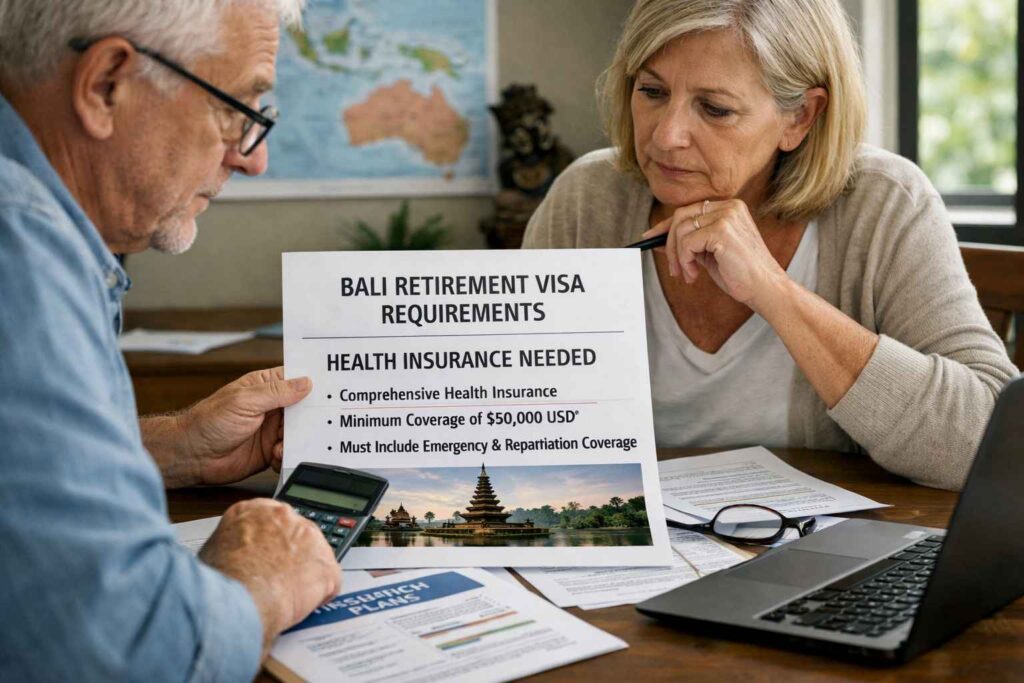
The retirement KITAS application process requires proof of health insurance covering your stay in Indonesia. Minimum coverage is typically $50,000 USD, though requirements may vary. Both international and local Indonesian policies can satisfy this requirement, provided they meet the coverage minimums and are recognized by Indonesian immigration.
Services like Padma Care Bali specialize in matching retirees with appropriate insurance solutions that satisfy visa requirements while providing practical coverage for daily healthcare needs.
Top Medical Facilities for Retirees

Knowing where to go for quality care is crucial for healthcare for retirees in Bali. Here are the facilities I consistently recommend:
BIMC Hospital Nusa Dua
The gold standard for expatriate care in Bali, BIMC holds JCI accreditation and operates 24/7 emergency services. Located near the beach resorts of Nusa Dua, it’s a 20-30 minute drive from Sanur and other major retirement areas. The facility offers comprehensive specialist services, modern equipment, and an entirely English-speaking staff.
Emergency response is excellent, with ambulance services covering the southern peninsula efficiently. BIMC also operates clinics in Ubud, Kuta, and Nusa Dua for routine consultations.
Siloam Hospitals Denpasar
Located in Denpasar, Siloam provides comprehensive hospital services with strong cardiology and oncology departments. The facility is particularly well-regarded for surgical procedures and maintains international equipment standards. English-language services are excellent, though slightly less tailored to expatriates than BIMC.
From Sanur, Siloam is approximately 15-20 minutes by car. The hospital accepts most international insurance policies and offers direct billing for many providers.
Kasih Ibu Hospital
This facility in East Denpasar offers excellent value and quality care, popular among long-term expats who’ve developed relationships with doctors there. While less internationally marketed than BIMC, Kasih Ibu maintains high standards and significantly lower costs for out-of-pocket patients.
Specialty Clinics in Retirement Areas
Sanur hosts multiple international clinics including Toya Medika and Bali International Medical Centre’s Sanur branch. These handle routine consultations, minor procedures, and prescriptions without the need to visit a full hospital.
Ubud has seen remarkable healthcare development with BIMC’s Ubud clinic and several well-equipped facilities serving the area’s substantial expat community. Canggu and Seminyak are similarly well-served, with multiple clinics offering English-speaking doctors and modern equipment.
Healthcare Access by Retirement Location
Your choice of where to retire in Bali significantly impacts healthcare accessibility.
Sanur: The Retirement Healthcare Hub
Sanur stands out as the premier retirement location partly due to healthcare access. The Sanur retirement community Bali enjoys proximity to multiple clinics, pharmacies every few blocks, and 20-minute access to both BIMC and Siloam hospitals. Ambulance response times are excellent, and many doctors make house calls to Sanur residences.
For retirees managing chronic conditions, Sanur’s infrastructure is unmatched. You can walk to medical appointments, build relationships with English-speaking doctors, and access emergency care quickly.
Ubud: Countryside Healthcare
Ubud offers a different retirement experience, trading beach proximity for cultural immersion and cooler temperatures. Healthcare access has improved dramatically with BIMC’s clinic opening and several private practices establishing presence. However, serious emergencies require a 60-90 minute transfer to southern Bali hospitals.
Retirees in excellent health who prioritize Ubud’s culture and community manage well. Those with significant health concerns should consider the distance to comprehensive hospital services.
Canggu and Seminyak: Modern Convenience
Canggu and Seminyak provide modern amenities with good healthcare access. Multiple clinics serve these areas, and hospital access is comparable to Sanur. These locations suit retirees who want contemporary lifestyle options alongside quality medical care.
Remote Areas: Proceed with Caution
Beautiful coastal areas like Amed or Lovina in North Bali offer stunning scenery but limited healthcare infrastructure. Retirees in these areas must accept 2-3 hour drives to comprehensive medical facilities. This works for healthy, adventurous retirees but isn’t advisable for those with significant health needs.
Pre-existing Conditions and Chronic Care Management
Managing ongoing health conditions in Bali requires planning but is entirely feasible. I’ve worked with retirees successfully managing diabetes, heart disease, arthritis, and various chronic conditions.
Most common medication is readily available at Bali’s pharmacies. Brand names may differ, so bring documentation of your medication’s generic name. Major pharmacies in expat areas stock Western medications, though some specialized drugs may require ordering from Jakarta (typically 3-7 days).
Specialist care quality depends on the condition. Cardiology, orthopedics, and general internal medicine are well-represented with excellent doctors. Highly specialized care (rare cancers, complex neurological conditions) may require travel to Singapore or back to your home country.
When to Travel for Treatment
Experienced Bali retirees develop a practical approach: routine care and common conditions in Bali, complex procedures or specialized treatments abroad. The cost savings on Bali-based care often fund occasional trips to Singapore or Australia for specialized needs.
Many retirees maintain relationships with doctors in their home countries for complex management, using telemedicine for consultations and traveling annually for comprehensive check-ups.
Healthcare Apps and Modern Medical Services
Bali’s digital health infrastructure has advanced significantly, benefiting retirees who appreciate modern convenience.
Halodoc and similar telemedicine platforms connect you with doctors via video consultation, typically for 50,000-100,000 IDR ($3-6 USD). English-speaking doctors are available, and prescriptions can be delivered to your villa or apartment within hours.
Pharmacy delivery apps like Go-Med (part of Gojek) bring medications to your door in 30-60 minutes. This is particularly valuable during Bali’s rainy season or when you’re unwell.
Several clinics offer online appointment booking and digital medical records accessible via patient portals. This modernization makes managing your healthcare surprisingly efficient.
Elderly Care and Support Services
Beyond medical treatment, retirees eventually need support services. Bali’s offerings are developing but still lag behind Western standards.
In-home nursing care is available through agencies charging approximately $15-25 USD per day for a full-time caregiver. This represents tremendous value compared to Western costs but requires careful vetting of providers.
Rehabilitation services exist at major hospitals, with physical therapy sessions costing $20-40 USD. Quality is good, though highly specialized rehabilitation may be better accessed in Singapore.
Assisted living facilities remain limited. Most long-term Bali expats either hire live-in caregivers or eventually return to their home countries when independent living becomes impossible. This is an honest limitation worth acknowledging in your planning.
The expat healthcare Bali affordable options approach works best for active, independent retirees in the 55-75 age range. Beyond that, family support or a plan for eventual relocation becomes important.
Healthcare Considerations When Planning Your Move
Before committing to Bali retirement, address these healthcare planning essentials:
Pre-Move Health Assessment
Get comprehensive health screening in your home country before moving. Establish baselines, identify conditions requiring ongoing management, and discuss your Bali plans with doctors. Bring copies of all medical records, test results, and prescription information.
Medication Strategy
Build a 3-6 month supply of essential medications before moving. This buffer lets you identify Bali equivalents without stress. Many retirees have family ship periodic medication supplies for drugs difficult to source locally.
Visa Medical Requirements
The Bali retirement visa for foreigners over 55 (officially the Retirement KITAS or silver hair visa Bali requirements) requires medical documentation. You’ll need health certificates, proof of insurance, and sometimes specific tests. Requirements vary and change periodically, so work with a visa agent familiar with current regulations.
Financial Preparation
Open an Indonesian bank account upon arrival. Most hospitals and clinics accept credit cards, but having local currency access simplifies transactions. Understand exchange rates between your home currency and Indonesian rupiah or United States dollar equivalent.
Pros and Cons of Bali’s Healthcare System for Retirees
After 15 years of experience, here’s my balanced assessment:
Advantages
Affordability is transformative. Retirees save 60-80% compared to Western healthcare costs, making comprehensive care accessible even on modest pension income. Many Australian retirees ask, “Can I live in Bali on Australian pension?” The answer is yes, and healthcare affordability is a major reason why.
Accessibility in expat areas rivals developed nations. In Sanur, you’re never more than 10 minutes from quality medical care. Appointment wait times are minimal, specialist access is quick, and doctors spend time with patients.
Quality at international facilities meets Western standards for routine and moderately complex care. Modern equipment, well-trained doctors, and professional nursing make these facilities genuinely competitive.
Limitations
Specialized care for rare conditions may require travel to Singapore, Bangkok, or your home country. Bali excels at common conditions but lacks the depth of tertiary care centers.
Emergency response in remote areas remains a concern. Living outside major expat zones means accepting longer response times.
Assisted living infrastructure is underdeveloped. Long-term care for dependent elderly isn’t a strength of Bali’s current system.
Language barriers outside expat areas can complicate care. Stick to international facilities for important health matters.
Expert Recommendations: Strategic Healthcare Planning for Bali Retirement
Based on hundreds of successful retirements I’ve facilitated, follow these strategic recommendations:
1. Choose Your Location Wisely
Healthcare access should heavily influence your retirement location decision. If you’re over 65 or managing health conditions, prioritize Sanur, southern Canggu, or Seminyak over remote areas. The best areas to retire in Bali from a healthcare perspective offer 15-20 minute hospital access.
2. Build a Healthcare Team Early
Within your first month, establish relationships with a general practitioner, dentist, and relevant specialists. Regular check-ups build rapport and medical history, making crisis care smoother. Join Facebook groups like “Bali Expats” or “Sanur Expats” for doctor recommendations.
3. Implement the Hybrid Insurance Strategy
Unless you’re splitting time internationally or have complex health needs, combine local insurance or self-pay for routine care with high-deductible catastrophic coverage. This typically saves $3,000-5,000 annually while maintaining comprehensive protection.
4. Maintain Health Insurance in Your Home Country
If possible, keep Medicare, private health insurance, or equivalent coverage in your home country. Many retirees time return visits for complex procedures covered by their home insurance.
5. Plan for Aging
Be realistic about the cost of retiring in Bali long-term. While healthcare for active retirees is excellent, plan for eventual return home or relocation to Singapore if you require extensive assisted care. Building this into your retirement planning prevents difficult decisions during health crises.
Real-World Healthcare Experience: Managing Retirement Health in Bali
Consider Margaret, a 68-year-old Australian retiree I helped relocate to Sanur in 2019. She manages Type 2 diabetes and mild hypertension. Margaret established care at a Sanur clinic, seeing her doctor monthly for check-ups costing just $30 USD. Her medications run $25 monthly, compared to $80+ in Australia even with insurance.
Over five years, Margaret has had no major health crises but dealt with a broken wrist (treatment cost $800 including X-rays and follow-up), a dental crown ($320), and regular health monitoring. Her total annual healthcare spending averages $1,200-1,500 including insurance, compared to $4,000+ she paid in Australia.
She maintains Australian Medicare during annual visits home, timing her comprehensive health screenings and any complex procedures for these trips. This hybrid approach gives her the best of both worlds: affordable daily healthcare in Bali and access to Australia’s system for major needs.
Margaret’s experience illustrates what healthcare for retirees in Bali looks like in practice: highly affordable, accessible, and sufficient for most needs, supplemented by strategic use of home country healthcare.
Read more: Bali versus Bangkok Medical Facilities: Complete 2026 Comparison
Complete Healthcare Checklist for Bali Retirees
Pre-Departure (3-6 months before):
- ✓ Comprehensive health screening in home country
- ✓ Obtain all medical records and test results
- ✓ Build 3-6 month medication supply
- ✓ Research health insurance options
- ✓ Verify retirement visa health requirements
First Month in Bali:
- ✓ Establish care with English-speaking GP
- ✓ Find dentist and relevant specialists
- ✓ Locate nearest pharmacy with Western medications
- ✓ Save emergency contact numbers
- ✓ Finalize insurance arrangements
- ✓ Open local bank account for healthcare payments
Ongoing Maintenance:
- ✓ Schedule regular check-ups (quarterly recommended)
- ✓ Monitor medication supply and reorder timely
- ✓ Review insurance coverage annually
- ✓ Maintain digital copies of medical records
- ✓ Stay connected with home country doctors via telemedicine
- ✓ Join expat healthcare Facebook groups for updates
Conclusion: Your Healthcare Roadmap for Bali Retirement
Healthcare for retirees in Bali has evolved into a compelling advantage rather than a concern for those planning their retirement abroad. The combination of international-standard facilities, English-speaking doctors, comprehensive services, and costs 60-80% below Western countries creates an ideal environment for retirees managing health budgets.
The key to success lies in strategic planning: choosing retirement locations near quality facilities, implementing smart insurance strategies, building relationships with healthcare providers early, and maintaining realistic expectations about when to access care abroad. Whether you’re exploring the Bali retirement living cost breakdown or finalizing your retirement KITAS application process, prioritizing healthcare access ensures your retirement years remain active, comfortable, and secure.
Bali offers the rare combination of tropical beauty, vibrant culture, welcoming community, and genuinely accessible healthcare. With proper planning and the insights shared in this guide, you can confidently build your retirement knowing that quality medical care is both available and affordable.
The island is ready for you. Your health is in good hands.
Frequently Asked Questions
How much does it cost to see a doctor in Bali?
A general practitioner consultation at an international clinic costs 400,000-600,000 Indonesian rupiah ($25-38 USD). Specialist appointments range from $38-63 USD. Local clinics charge less (approximately $10-20 USD) but may have language barriers. These costs are 60-80% lower than equivalent care in Western countries, making routine healthcare remarkably affordable for retirees managing budgets carefully.
What is the best healthcare after retirement?
The best healthcare after retirement combines accessibility, affordability, and quality. For Bali retirees, this means choosing locations near international hospitals (Sanur, Seminyak, Canggu), establishing relationships with English-speaking doctors, maintaining comprehensive insurance, and keeping connections to home country healthcare for complex needs. A hybrid approach using Bali for routine care and home country or Singapore for specialized treatment offers optimal value and security.
Can I live in Bali on Australian pension?
Yes, many retirees successfully live in Bali on Australian pension income. The Australian Age Pension (approximately $2,000-2,500 AUD monthly for couples) covers comfortable living in Bali including housing, food, healthcare, and lifestyle expenses. Healthcare costs are significantly lower than Australia, with most retirees spending under $2,000 USD annually. Budget carefully for insurance, housing, and visa costs, but Bali’s cost of living makes pension-funded retirement entirely feasible.
Does Bali have free healthcare?
Bali does not offer free healthcare for foreign retirees. Indonesia has a national health insurance scheme (BPJS) for citizens and some visa holders, but coverage is limited and facilities are basic. Foreign retirees use private healthcare, which is affordable but not free. However, the low costs make healthcare accessible even without insurance. Comprehensive health insurance for retirees costs $800-4,000 annually depending on coverage levels.
Do I need health insurance to get a retirement visa in Bali?
Yes, the retirement KITAS application process requires proof of health insurance with minimum coverage of approximately $50,000 USD for medical expenses and evacuation. Both international and Indonesian insurance policies can satisfy this requirement. Immigration officials verify insurance documentation during application and periodic renewal. Without appropriate insurance, your retirement visa application will be rejected. Work with reputable visa agents to ensure your insurance meets current requirements.
Are Bali hospitals up to international standards?
Bali’s top international hospitals like BIMC and Siloam meet international standards for routine and moderately complex care. BIMC holds JCI accreditation, indicating compliance with global healthcare quality benchmarks. Equipment is modern, doctors are well-trained (often in Western countries), and protocols follow international best practices. However, for highly specialized care or rare conditions, facilities in Singapore, Bangkok, or your home country may offer more advanced options.
Can I get my prescription medications in Bali?
Most common prescription medications are available in Bali, though brand names may differ from your home country. Bring documentation showing your medication’s generic name to help pharmacists identify local equivalents. Major pharmacies in expat areas stock Western medications. Some specialized or newer drugs may require ordering from Jakarta (3-7 days delivery). Many retirees bring a 3-6 month supply initially and have family periodically ship medications difficult to source locally.
What happens if I need emergency medical care in Bali?
Bali’s international hospitals operate 24/7 emergency departments with ambulance services covering major expat areas. Response times in Sanur, Seminyak, and Canggu are typically 10-20 minutes. Call BIMC emergency (+62 361 761263) or Siloam (+62 361 779900) directly. Emergency care quality at these facilities is good for trauma, heart attacks, strokes, and other common emergencies. For highly complex emergencies, medical evacuation to Singapore is available through international insurance.
Is medical tourism a good option for retirees in Bali?
Medical tourism works exceptionally well for Bali retirees, particularly for dental work, elective surgeries, and routine procedures. Costs are 60-80% lower than Western countries with quality comparable at top facilities. Many retirees combine healthcare with retirement living, accessing both routine care and planned procedures affordably. However, research facilities carefully, verify doctor credentials, and ensure proper post-procedure follow-up care is available before committing to complex treatments.
How far is the nearest hospital from popular retirement areas?
Sanur residents are 15-20 minutes from both BIMC and Siloam hospitals, with multiple clinics within 5-10 minutes. Seminyak and Canggu are 20-30 minutes from major hospitals with several local clinics nearby. Ubud is 60-90 minutes from comprehensive hospital care, though local clinics handle routine needs. Remote areas like Amed or Lovina are 2-3 hours from major facilities. Choose your retirement location based partly on your health needs and comfort with hospital distance.
About the Expert
Jason Reynolds has spent 15 years as a healthcare and retirement relocation specialist in Southeast Asia, personally guiding over 500 expatriates through their transition to Bali. His expertise spans Indonesian healthcare systems, insurance navigation, visa requirements, and property investment for retirees. Jason holds certifications in international health insurance consulting and maintains partnerships with Bali’s leading medical facilities and visa agencies. He splits his time between Sanur and consulting with retirees across the island.