Table of Contents
- What is Ngaben? Understanding Bali’s Sacred Cremation Ceremony
- The Spiritual Foundation of Balinese Hindu Death Rituals
- The Complete Ngaben Ceremony Process
- Key Elements: Bade, Lembu, and Sacred Offerings
- Preparation, Timing, and Community Involvement
- Cost Breakdown: How Much Does Ngaben Cost
- Pelebon vs. Ngaben: Understanding the Differences
- Visitor Etiquette and Ngaben Dress Code
- Cultural Significance in Balinese Hinduism
- FAQ: Your Questions About Ngaben Answered
Balinese cremation ceremonies represent one of the most visually spectacular and spiritually profound traditions in Indonesia. When flames consume the towering cremation structure and Gamelan orchestras fill the air with resonant melodies, you’re witnessing more than a funeral, you’re experiencing Bali’s ultimate act of love and liberation.
The Ngaben ceremony in Bali transforms what many cultures view as somber into a vibrant celebration. Hundreds of villagers parade through streets carrying elaborate towers, families drain their savings for days-long festivities, and observers from around the world witness the physical release of a soul on its journey toward reincarnation.
This comprehensive guide reveals everything about Balinese cremation ceremonies, from the Hindu cremation ritual Bali practices rooted in ancient texts to practical information about costs, etiquette, and whether tourists can attend these sacred events. You’ll understand the Ngaben ceremony meaning, witness the process step-by-step, and gain insights that transform cultural observation into meaningful understanding.
What is Ngaben? Understanding Bali’s Sacred Cremation Ceremony
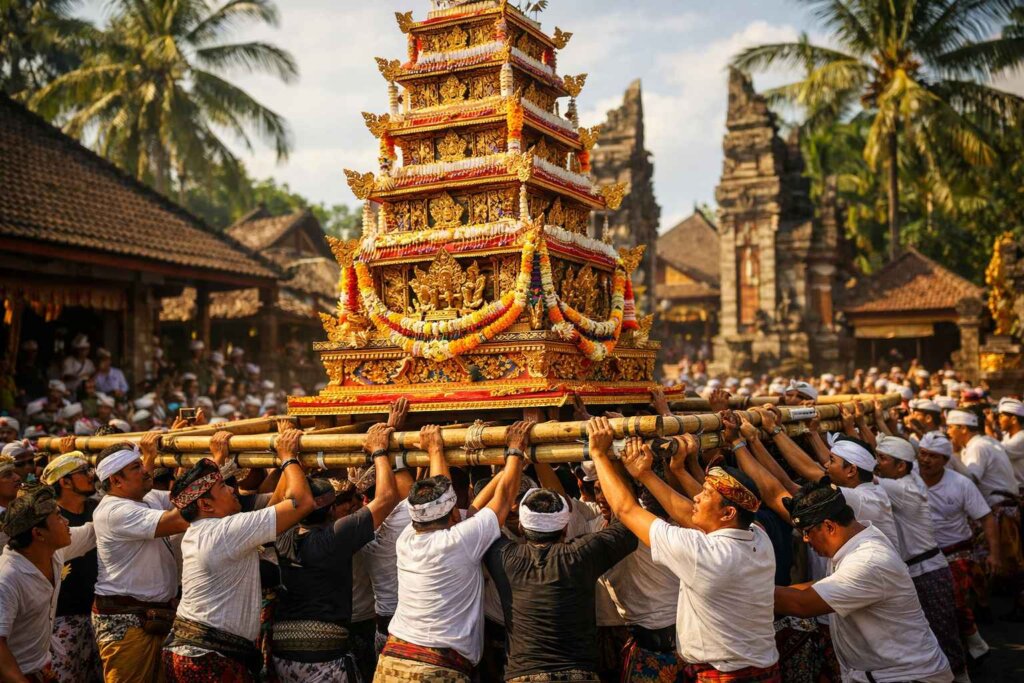
Ngaben is the traditional Balinese cremation ceremony where the deceased’s body is cremated to liberate the soul (atman) from its physical form, allowing it to journey toward Moksha or reincarnation. This Hindu death ritual combines elaborate processions, towering cremation structures, and community celebration.
What is Ngaben ceremony? At its core, Ngaben (also called Pitra Yadnya or Pelebon for nobility) is the Balinese Hindu death ritual that releases the spirit from its earthly vessel. The word “Ngaben” derives from the Balinese word “beya” or “bawa,” meaning to escort or accompany.
Unlike Western funerals focused on grief and finality, Balinese funeral traditions celebrate transition. The ceremony serves a singular purpose: freeing the atman (soul) from panca maha butha, the five elements that compose the human body, so it can return to the divine source or enter a new cycle of life.
The Core Beliefs Behind Traditional Balinese Cremation
Balinese Hinduism teaches that humans consist of two essential components:
- Physical body (stula sarira): Composed of earth, water, fire, air, and ether
- Spiritual essence (atman): The eternal soul that transcends physical existence
Death doesn’t end existence in Balinese philosophy. Instead, it marks transition. Without proper cremation, the soul remains trapped, unable to reach Moksha (liberation) or continue the reincarnation cycle. This belief drives families to extraordinary lengths, often spending years’ worth of savings to ensure proper rites.
The Ngaben ceremony process accomplishes three critical objectives:
- Physical purification: Fire cleanses the body and returns elements to nature
- Spiritual liberation: Prayers and mantras guide the soul’s journey
- Community renewal: The ritual reinforces social bonds and cultural identity
The Spiritual Foundation of Balinese Hindu Death Rituals
Understanding Balinese cremation ceremonies requires examining the philosophical framework that shapes every aspect of the ritual. These practices didn’t emerge in isolation—they evolved from centuries of Hindu tradition blended with indigenous Balinese beliefs.
The Concept of Moksha in Balinese Hinduism
Moksha in Balinese Hinduism represents the ultimate spiritual achievement: liberation from samsara, the endless cycle of birth, death, and rebirth. While Indian Hinduism emphasizes individual spiritual practice leading to Moksha, Balinese interpretations focus heavily on proper ritual and community support.
The cremation fire symbolizes several transformative forces:
- Agni, the Hindu god of fire, serves as messenger between earthly and divine realms
- Flames purify karma accumulated during life
- Heat transforms gross matter into subtle energy
- Smoke carries prayers and the soul skyward toward heaven
Tri Hita Karana: The Three Causes of Prosperity
Every Ngaben ceremony in Bali reflects Tri Hita Karana, the philosophy governing Balinese life:
- Harmony with God (Parahyangan): Prayers, offerings, and priestly blessings
- Harmony with people (Pawongan): Community cooperation and mutual support
- Harmony with nature (Palemahan): Returning body elements to earth, water, fire, air
This worldview explains why traditional Balinese cremation involves entire villages. The ceremony isn’t a private family affair, it’s a communal obligation strengthening all three harmonious relationships.
The Caste System and Cremation Variations
Bali’s social structure significantly influences funeral practices. Four primary castes exist:
- Brahmana (priests and scholars)
- Ksatriya (warriors and rulers)
- Waisya (merchants)
- Sudra (common people, comprising 90% of the population)
Higher castes perform Pelebon ceremony Bali traditions with more elaborate structures and extended rituals. However, the spiritual goal remains identical across all castes: liberating the soul regardless of social status.
The Complete Ngaben Ceremony Process
How long does Ngaben last? The complete Balinese cremation ceremony steps typically span 3-7 days, though preparations may take months or even years. Here’s the comprehensive breakdown of Ngaben ceremony preparations through final rites.
Pre-Cremation Phase: Preparation and Purification
Balinese Hindu death rituals begin immediately after death:
Day 1-3: Initial Preparations
- Body washing and purification by family members
- Wrapping in white cloth and yellow sashes
- Temporary burial or above-ground storage until auspicious cremation date
- Consultation with priest to determine proper timing based on Balinese calendars
The Balinese use two calendars simultaneously: the 210-day Pawukon and lunar Saka calendar. When is Ngaben celebrated? Auspicious dates align planetary positions, avoiding inauspicious periods like Kajeng Kliwon or Panchawara.
Weeks to Months Before: Community Mobilization
- Village meetings allocate responsibilities
- Construction of Bade (cremation tower) and Lembu (animal-shaped coffin)
- Gathering materials: bamboo, coconut wood, decorative cloth, flowers
- Gamelan orchestras prepare traditional compositions
- Families save money or borrow for expenses
The Main Ceremony Day: Cremation Procession in Bali
Morning Rituals (6:00-10:00 AM)
The day begins with intense activity. Family members bathe and dress in traditional Balinese ceremonial attire. Priests arrive to perform Prayascitta (purification mantras) while offerings accumulate: incense, flowers, holy water, rice, coconut offerings.
The body, if temporarily buried, undergoes Ngumbah Layon (ritual washing) at the cemetery before transfer to the family compound.
Procession Preparation (10:00 AM-12:00 PM)
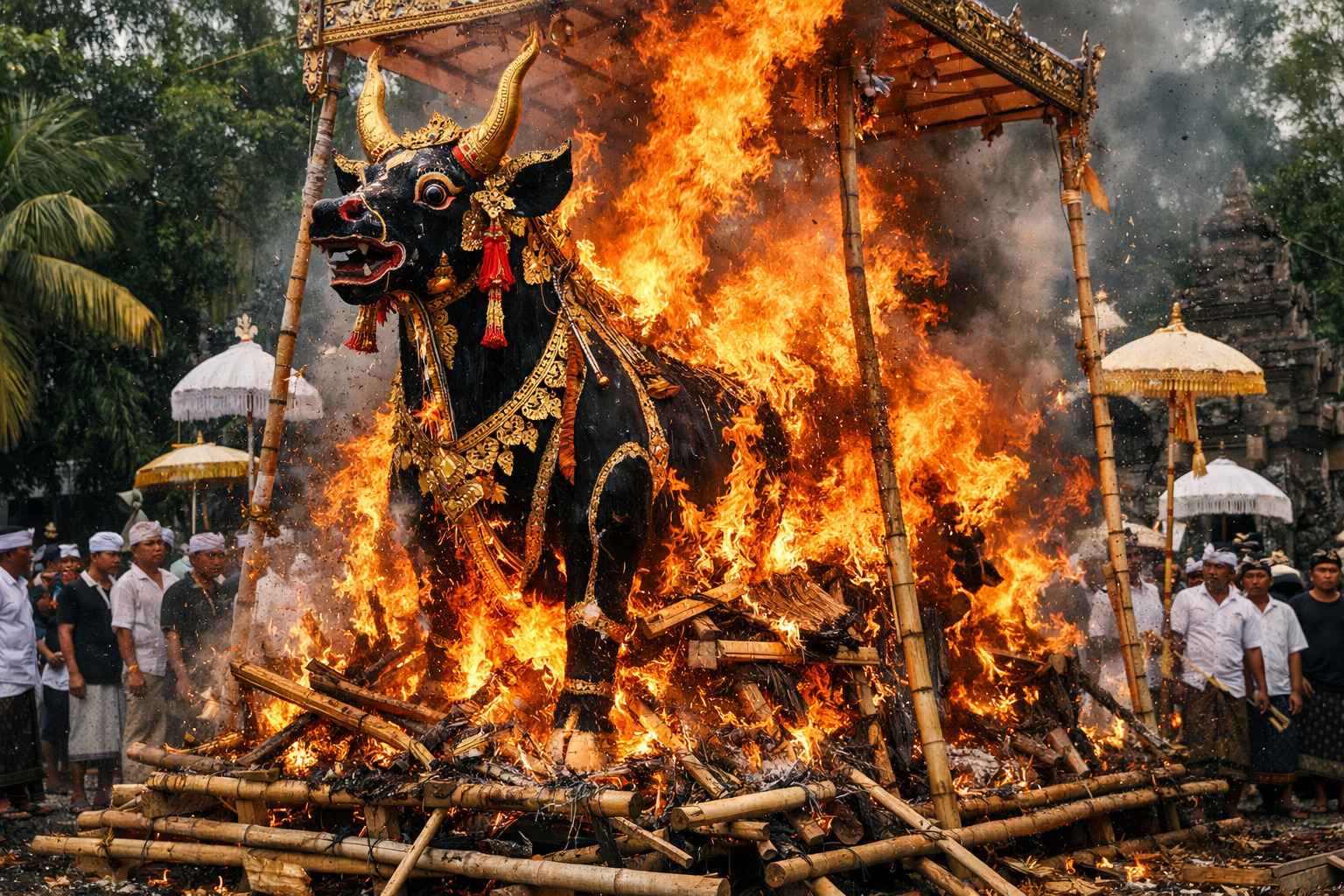
The deceased is placed in the Lembu cremation coffin Bali artisans spent weeks creating. For commoners, this takes the form of a bull (lembu). Royal cremation might use a lion, elephant, or mythical dragon called naga banda.
The Lembu is then secured atop the Balinese cremation tower Bade, which can reach 30 feet for royalty or 15 feet for common people. These multi-tiered structures represent Mount Meru, the sacred mountain at the center of the Hindu universe.
The Grand Procession (12:00-2:00 PM)
This spectacle defines Balinese cremation ceremonies. Dozens of men hoist the Bade onto their shoulders while the Gamelan orchestra creates thunderous rhythms mixing drums, gongs, and metallophones.
The procession doesn’t follow a direct route to the cremation ground. Pallbearers deliberately:
- Spin the tower in circles to disorient the spirit
- Take unexpected turns and detours
- Shake and jostle the structure vigorously
- Create chaos and confusion
Why? These actions prevent the soul from finding its way back home, ensuring it focuses on the spiritual journey ahead rather than earthly attachments.
Photography Note: Visitors wondering about camera etiquette should ask permission before photographing. Most families welcome respectful documentation, but approaching the pyre too closely shows disrespect.
Cremation Ground Rituals (2:00-5:00 PM)
Upon reaching the cemetery or designated cremation area:
- Priests perform Panca Sembah (five-direction prayers)
- Family circumambulates the Bade three times clockwise
- Body transferred from Lembu to waiting pyre
- Priest recites mantras while sprinkling holy water
- Fire ignited using sacred flames from temple braziers
- Additional offerings cast into flames: photos, favorite possessions, symbolic items
The cremation generates intense heat. Modern Ngaben increasingly uses accelerants to ensure complete combustion, as incomplete burning requires repeat ceremonies—considered inauspicious and expensive.
Post-Cremation Ceremonies: Patulangan and Nyekah
Cremation doesn’t end the Ngaben ceremony process. Critical follow-up rituals complete the spiritual transformation:
Patulangan (Bone Collection)
Twelve days after cremation, family returns to collect remaining bone fragments and ashes. These undergo grinding into powder while priests chant purification mantras. The powder is placed in yellow coconut shells adorned with flowers and sacred symbols.
Water Ceremony (Nganyut or Nyiramin)
The family processes to the ocean, river, or sacred spring to release ashes into flowing water. This ritual returns the physical elements to nature while symbolically cleansing the soul before its onward journey.
In coastal areas like Ubud (though Ubud is inland, many residents travel to the coast), families wade into the ocean at dawn, releasing coconut shells containing ashes as priests perform final blessings. The floating shells drift seaward while relatives pray for the soul’s peaceful transition.
Nyekah (Deification Ceremony)
For families who can afford it, Nyekah occurs 12 days, 42 days, or even years after cremation. This ceremony elevates the soul to divine ancestor status (dewa pitara), completing the transformation from mortal to venerated ancestor worthy of shrine offerings.
Key Elements: Bade, Lembu, and Sacred Offerings
Balinese cremation ceremonies incorporate specific ritual objects, each laden with symbolic meaning. Understanding these elements reveals the depth of Balinese spiritual artistry.
The Bade: Cremation Tower Architecture
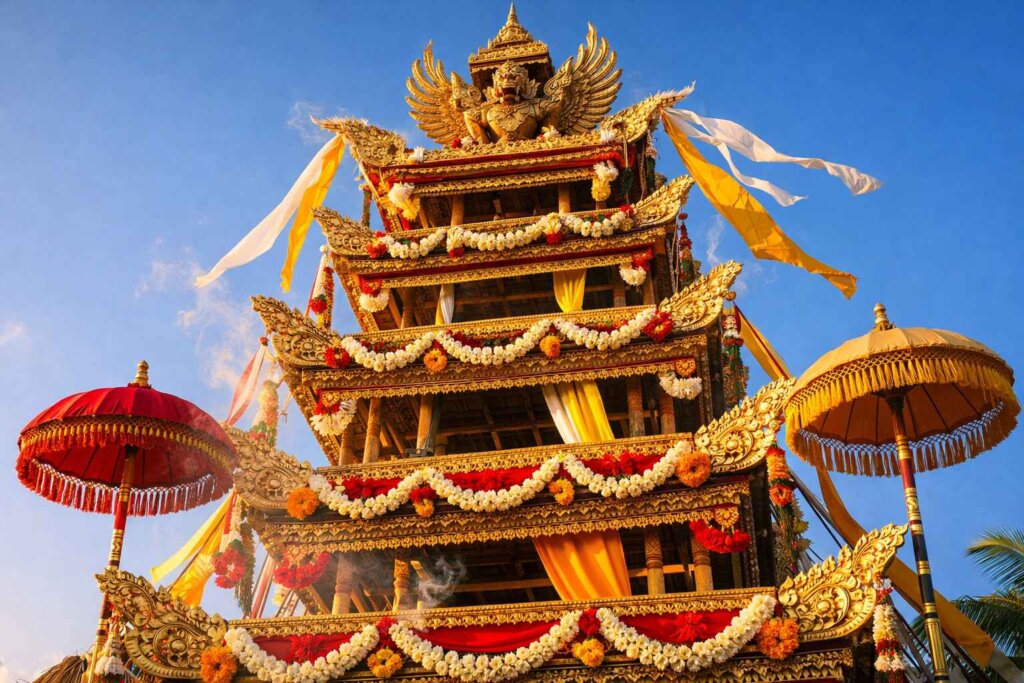
The Balinese cremation tower Bade represents the ultimate meeting of artistic expression and spiritual purpose. Construction requires:
Materials
- Bamboo framework (symbolizing strength in flexibility)
- Colored cloth panels (different colors for each caste)
- Gold-painted decorations
- Fresh flower garlands
- Sacred symbols: swastika (representing prosperity), padma (lotus)
Structure The tower’s tiers indicate social status:
- Sudra (commoners): 1, 3, 5, or 7 tiers
- Waisya: 7 or 9 tiers
- Ksatriya: 9 or 11 tiers
- Brahmana: 11 tiers
Each tier represents a spiritual level the soul must transcend. The pinnacle features ornate carvings of Garuda (the mount of Vishnu) or other sacred figures.
The Lembu: Sacred Cremation Coffin
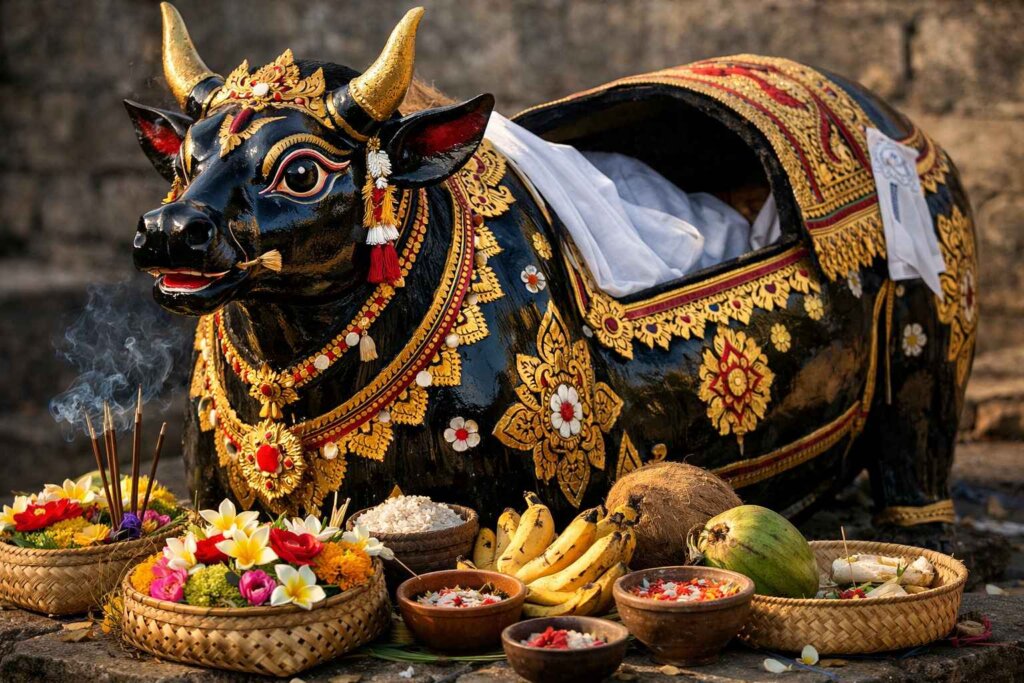
Lembu cremation coffin Bali craftsmen create these animal-shaped sarcophagi from specific materials:
For Commoners
- Bull shape (black for men, white for women)
- Woven bamboo body covered in paper and cloth
- Painted details: eyes, horns, decorative saddles
- Opening in the back to insert the body
For Nobility
- Lions (singa) with elaborate manes
- Winged lions (singa ambara) featuring mythical elements
- Dragon-serpents (naga banda) with scaled bodies
- Multiple heads or supernatural attributes
The animal choice isn’t arbitrary. In Hindu cosmology, these creatures serve as vahanas (divine vehicles) carrying the soul to spiritual realms. The bull, sacred to Shiva, represents strength and purity essential for the journey.
Gamelan Music: The Soundtrack of Transition
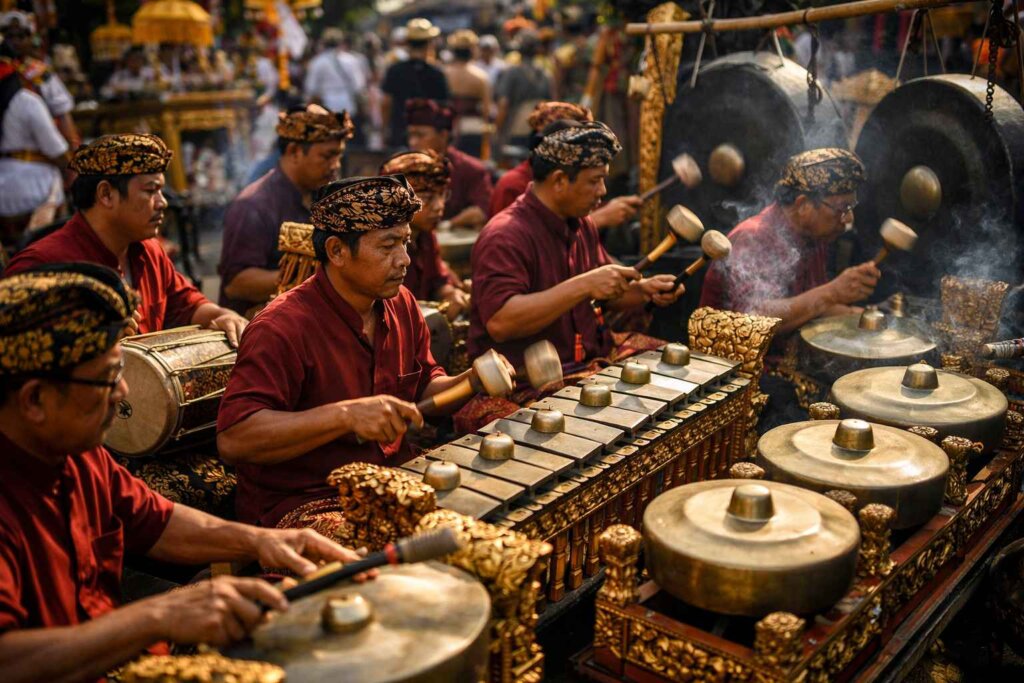
Gamelan orchestras don’t merely provide atmosphere—they’re considered spiritually essential. The bronze instruments create vibrations believed to:
- Guide the soul along its path
- Ward off negative spirits
- Honor celestial beings
- Express community grief and celebration simultaneously
Traditional Balinese cremation employs specific compositions:
- Beleganjur: Processional marching music with driving rhythms
- Angklung: Softer bamboo instruments for reflective moments
- Gong Kebyar: Powerful ceremonial pieces during cremation
Musicians play continuously for hours, faces dripping with sweat, fingers moving in synchronized precision. The sound carries for miles, announcing to the spiritual world that a soul is in transition.
Essential Offerings: Banten and Sesajen
Offerings permeate every moment of Ngaben ceremony in Bali:
Types of Offerings
- Banten Pejati: Large ceremonial offerings with tiered arrangements
- Canang sari: Small daily offerings of flowers, incense, rice
- Penyeneng: Ancestral shrine offerings
- Segehan: Ground offerings for lower spirits
Each offering contains symbolic elements:
- White rice (purity)
- Red hibiscus (passion, life force)
- Incense (prayers ascending)
- Holy water (tirta) from sacred springs
- Betel nut and leaves (traditional respect)
Offerings aren’t symbolic gestures, Balinese people believe deities and spirits literally consume the essence (sari), leaving only physical remains.
Preparation, Timing, and Community Involvement
Ngaben ceremony preparations reveal the collective nature of Balinese culture. No family undertakes this massive effort alone.
Community Organization: Banjar System
Every Balinese village contains banjar (neighborhood associations) that function as mutual support networks. When a death occurs:
Immediate Response
- Banjar leaders (kelihan banjar) call emergency meeting
- Tasks distributed: construction, cooking, entertainment, logistics
- Materials sourced through collective contribution
Labor Division
- Young men build Bade and Lembu
- Women prepare offerings and ceremonial food
- Elders advise on proper ritual procedures
- Gamelan musicians rehearse
- Children assist with simple tasks
This system ensures even poor families can conduct proper cremation. Wealthier community members contribute more financially, while everyone provides labor. Social reciprocity dictates that today’s helpers will receive help when they face their own family deaths.
Timing Considerations: When is Ngaben Celebrated
When is Ngaben celebrated? Several factors determine scheduling:
Astrological Alignment
- Priest consultations identify auspicious dates
- Planetary positions must favor transitions
- Avoidance of pengerebongan (new moon darkness periods)
- Preference for specific wuku (weeks in Balinese calendar)
Practical Factors
- Financial readiness (families may wait years saving money)
- Harvesting seasons (rice harvest provides funds and food)
- Family member availability (relatives from Indonesia and abroad)
- Mass cremation opportunities (sharing costs with other families)
Climate
- Dry season preferred (April-September)
- Rainy season complicates procession and open-air cremation
- Extreme heat makes daytime rituals physically demanding
Mass Cremations: Economic and Social Solutions
Individual Ngaben ceremonies can cost $5,000-$50,000 USD—devastating for average families. Mass cremations (Ngaben Massal) solve this problem:
Benefits
- Shared Bade construction costs
- Combined Gamelan and priest fees
- Bulk purchasing of offerings materials
- Social prestige through community unity
Ubud cremation ceremony 2026 will likely include mass events, as this practice grows increasingly common. Villages coordinate dates so multiple families cremate loved ones simultaneously, sometimes including 20-50 deceased in one spectacular event.
Cost Breakdown: How Much Does Ngaben Cost
How much does Ngaben cost? Financial realities significantly impact modern Balinese funeral traditions.
Expense Categories
Basic Ngaben (Commoner Ceremony)
- Bade construction: $500-$1,500
- Lembu coffin: $200-$800
- Priest fees: $100-$300
- Offerings materials: $300-$700
- Gamelan orchestra: $200-$500
- Food for guests: $500-$2,000
- Miscellaneous (cloth, decorations, labor): $300-$1,000
- Total: $2,100-$6,800
Elaborate Ngaben (Upper Class)
- Multi-tier Bade: $3,000-$10,000
- Ornate Lembu: $1,500-$5,000
- High priest (pedanda): $500-$2,000
- Extensive offerings: $1,500-$5,000
- Professional Gamelan: $800-$2,000
- Banquet for hundreds: $3,000-$10,000
- Gold leaf, special materials: $1,000-$5,000
- Total: $11,300-$39,000
Royal Pelebon Ceremony These can exceed $100,000, involving:
- 30-foot tall Bade with 11 tiers
- Multiple Lembu or mythical creature coffins
- International guests and media coverage
- Days of continuous rituals
- Entire village mobilization
Hidden Costs
Families often underestimate:
- Temporary burial maintenance (if waiting years for cremation)
- Pre-ceremony rituals performed at home
- Post-cremation Nyekah deification ceremony
- Transportation for family members traveling to Bali
- Lost work days during preparation and ceremony
Cultural pressure drives some families into debt. However, the Balinese believe failing to properly cremate parents or spouses brings spiritual consequences: ancestral souls haunting descendants, bad karma accumulating, future generations suffering misfortune.
Modern Economic Adaptations
Contemporary Balinese balance tradition with financial reality:
Delayed Cremation
- Temporary burial until funds accumulate
- Some wait 5-10 years before Ngaben
- Multiple family members cremated together
Simplified Elements
- Smaller Bade designs
- Rented decorative materials
- Recorded music instead of live Gamelan (controversial)
- Reduced guest lists and feast scales
Community Support
- Arisan (rotating savings clubs) specifically for funeral expenses
- Banjar loans with flexible repayment
- Crowdfunding through social media (increasingly common)
Despite economic pressure, most Balinese people prioritize Ngaben above other expenses. Houses remain unfinished, education delayed, vehicles not purchased, but the cremation ceremony receives full investment. This reflects the profound spiritual importance outweighing material considerations.
Pelebon vs. Ngaben: Understanding the Differences
Pelebon ceremony Bali traditions differ from standard Ngaben primarily in scale, expense, and social significance.
Comparison Table: Ngaben vs. Pelebon
| Aspect | Ngaben (Common) | Pelebon (Noble/Royal) |
|---|---|---|
| Social Class | Sudra, Waisya castes | Brahmana, Ksatriya castes |
| Bade Tiers | 1-7 tiers | 9-11 tiers |
| Coffin Shape | Bull (lembu) | Lion, dragon, mythical creatures |
| Duration | 3-5 days | 7-14 days |
| Priest Level | Village priest (pemangku) | High priest (pedanda) |
| Cost Range | $2,000-$10,000 | $20,000-$100,000+ |
| Attendees | Village community | Regional/international guests |
| Media Coverage | Local/family photos | National news, documentaries |
| Procession Size | 50-200 people | 500-5,000+ people |
| Musical Groups | 1 Gamelan ensemble | Multiple orchestras |
| Offerings Scale | Standard banten | Elaborate multi-day offerings |
| Location | Village cemetery | Special ceremonial grounds |
Notable Royal Pelebon Ceremonies
Pelebon ceremony Bali history includes spectacular royal events:
2013: Tjokorda Gde Agung Suyasa (Ubud) This cremation ceremony Ubud attracted thousands. The former king of Ubud’s Pelebon featured:
- 13-meter tall Bade
- Black bull Lembu with gold decorations
- International tourists and dignitaries
- Procession requiring 300+ pallbearers
- Multiple Gamelan orchestras playing simultaneously
2008: Royal Family of Gianyar Mass royal cremation of three family members:
- Each received individual 11-tier Bade
- Lion-shaped sarcophagi
- Six-hour procession through multiple villages
- Estimated cost: $500,000
These elaborate ceremonies demonstrate that while spiritual goals remain identical (liberating the soul toward Moksha), social status dictates ceremonial magnificence. However, a poor farmer’s simple Ngaben holds equal spiritual validity, the gods judge hearts and prayers, not tower height or gold leaf quantity.
Visitor Etiquette and Ngaben Dress Code
Can tourists attend Ngaben? Yes, but respectful behavior is essential. Understanding Balinese cremation etiquette ensures you witness this profound ritual without causing offense.
Dress Code Requirements
Ngaben dress code follows strict Balinese temple standards:
For Men
- Long pants (no shorts, even knee-length)
- Collared shirt or traditional Balinese shirt
- Sash (saput) wrapped around waist
- Headcloth (udeng) if entering temple areas
- Closed-toe shoes or sandals
For Women
- Sarong covering legs to ankles
- Modest blouse covering shoulders (no tank tops or revealing clothing)
- Sash (senteng) tied around waist
- Kebaya (traditional lace blouse) for more formal participation
- No menstruation (considered spiritually impure for temple entrance)
Color Guidelines
- White or light colors preferred
- Avoid full black (reserved for priests in certain contexts)
- Respectful solid colors or subtle patterns
- No flashy, overly casual beachwear
Many tourist-attended ceremonies provide rental sarongs and sashes. However, arriving properly dressed demonstrates respect and cultural awareness.
Behavioral Etiquette
Can tourists attend Ngaben? Yes, with these critical guidelines:
Before the Ceremony
- Secure invitation or permission from family (never assume access)
- If attending organized tours, verify the family has consented to tourist presence
- Research basic Balinese customs beforehand
- Bring small offering or monetary contribution in white envelope
During Procession
- Stay on ceremony periphery, never blocking Balinese participants
- Don’t touch the Bade or Lembu
- Keep voice volume low and conversation minimal
- Stand when procession passes (sitting shows disrespect)
- Follow local crowd’s lead for standing, sitting, or circumambulating
Photography Considerations
- Camera use generally permitted but ask permission
- Never use flash during prayers or intimate family moments
- Avoid inserting yourself/camera between worshippers and priest
- Don’t climb on structures or sacred objects for “better angles”
- Drones increasingly prohibited at sacred ceremonies
At Cremation Ground
- Maintain respectful distance from pyre (heat is intense anyway)
- Don’t laugh or treat the event as entertainment
- Remove sunglasses when priests perform rituals
- If smoke causes coughing, step away quietly rather than making disruption
Common Mistakes to Avoid
- Pointing feet toward sacred objects or people
- Touching heads (considered most sacred body part)
- Standing higher than priests during prayers
- Eating or drinking during ritual moments
- Complaining about heat, length, or discomfort within earshot
How to Find Ceremonies Respectfully
Ubud cremation ceremony 2026 and other events can be located through:
Ethical Methods
- Hotel concierges with village connections
- Authorized cultural tour operators
- Balinese friends or guides who can arrange family introductions
- Community bulletin boards announcing mass cremations
Problematic Approaches
- Crashing ceremonies uninvited
- Paying families to attend (commodifies sacred ritual)
- “Ceremony tourism” that disrupts authentic practice
- Treating the event as theme park entertainment
The respectful observer recognizes their privilege in witnessing Balinese funeral traditions. You’re not entitled to access, you’re receiving a generous gift of cultural sharing that demands humility and gratitude in return.
Cultural Significance in Balinese Hinduism
Balinese cremation ceremonies function as far more than individual funeral rites. They represent the living heart of Balinese identity, spiritual continuity, and social cohesion.
Preservation of Cultural Heritage
Bali remains one of India’s few Hindu cultural descendants outside South Asia that has maintained unbroken temple traditions and elaborate ritual cycles. Every Ngaben reinforces this cultural continuity by:
Transmitting Knowledge
- Elders teach younger generations ritual procedures
- Artisans pass down Bade and Lembu construction techniques
- Musicians train apprentices in sacred Gamelan compositions
- Priests mentor students in Sanskrit mantras and prayers
Maintaining Social Structures
- Banjar system proves its value through mutual aid
- Caste distinctions (controversial in modern Indonesia) find expression
- Family lineages demonstrated through ancestral rituals
- Village identity strengthened through collective effort
Economic Impact
- Thousands employed as craftsmen, musicians, caterers
- Tourism revenue from respectful cultural observers
- Material suppliers (flowers, incense, food, cloth) sustained
- Traditional arts remaining economically viable
- Explore the Captivating Bali Arts Festival
The Cycle of Life and Death
Balinese Hinduism doesn’t separate life and death into opposing categories. Instead, both represent phases of eternal existence. Ngaben ceremonies mark transformation points where visible becomes invisible, but energy continues.
Philosophical Foundations
“Tan hana dharma mangrwa” (There is no religion that brings dual outcomes)—Balinese saying
This teaching emphasizes that whether Hindu, Buddhist, or other spiritual paths, all seek the same ultimate truth. Cremation physically demonstrates this philosophy: the diverse elements forming our bodies return to undifferentiated natural origins, just as diverse souls return to divine source.
Reincarnation beliefs deeply influence Balinese behavior throughout life. Good deeds, proper ritual participation, and ethical conduct create positive karma affecting future births. The elaborate care given to Ngaben reflects belief that how we honor the dead influences both their next incarnation and our own karmic accumulation.
Contemporary Challenges and Adaptations
Modern Bali faces tensions between tradition and contemporary pressures:
Tourism Impact
- Increased interest brings revenue but risks commodification
- Some families modify traditions for tourist consumption
- Authenticity debates within Balinese communities
- “Instagram-worthy” elements sometimes prioritized over spiritual depth
Economic Pressure
- Rising costs make traditional cremation increasingly difficult
- Urban migration disperses family support networks
- Wage labor economies conflict with time-intensive ritual demands
- Debt from elaborate ceremonies creates financial hardship
Environmental Concerns
- Wood scarcity prompts questions about sustainable cremation
- Pollution from offerings in rivers and oceans
- Land pressure on traditional cemetery spaces
- Modern alternatives (electric crematoria) considered sacrilegious by purists
Generational Shifts
- Young Balinese seeking simplified rituals
- Education about spiritual meaning sometimes lacking
- Global connectivity exposes alternatives to traditional practices
- Pride in culture competing with practical considerations
Despite these challenges, Balinese cremation ceremonies persist with remarkable resilience. The fundamental belief that proper ritual liberates souls remains powerful enough to motivate extraordinary sacrifice and community mobilization.
Why Ngaben Matters Beyond Bali
Traditional Balinese cremation offers insights valuable far beyond Indonesia:
Death Acceptance While many modern cultures hide death and dying, Balinese funeral traditions demonstrate healthy integration of mortality into community life. Children attend ceremonies, learning that death deserves celebration rather than denial.
Community Strength In an increasingly atomized world, Ngaben proves the power of mutual support. No family faces loss alone, entire villages rally with practical help, emotional support, and spiritual solidarity.
Spiritual Ecology The ritual reminds us that human bodies literally consist of earth, water, fire, air. Cremation returns these elements to nature, completing the cycle. This ecological wisdom predates modern environmental movements by millennia.
Beauty in Transition Balinese people create extraordinary beauty—towering sculptures, intricate offerings, sublime music, knowing it will exist for mere hours before flames consume it. This demonstrates profound acceptance of impermanence, teaching that value lies in the act of creation and honoring, not in permanent preservation.
Quick Facts: Ngaben at a Glance
Duration: 3-7 days (preparation to completion)
Average Cost: $2,000-$10,000 (common), $20,000-$100,000+ (royal)
Best Time: Dry season (April-September), auspicious calendar dates
Key Location: Village cemeteries, ceremonial grounds throughout Bali
Dress Code: Formal Balinese temple attire (sarong, sash, modest coverage)
Photography: Generally permitted with permission and respect
Tourist Attendance: Yes, with invitation or through authorized tours
Frequency: Varies by village, some weekly, others monthly
Unique Features: Towering Bade, animal-shaped coffins, Gamelan music, elaborate processions
Spiritual Goal: Liberation of soul toward Moksha or reincarnation
Expert Quote Highlights
“The Ngaben ceremony is not a goodbye, it’s a celebration of successful completion. We honor the life lived and assist the soul’s journey forward. Without fire’s purification, the spirit remains trapped between worlds.”
— Balinese High Priest perspective
“When tourists watch our cremation ceremonies with genuine respect and curiosity, they help preserve our traditions. Their interest reminds younger Balinese that our culture holds value worth maintaining. But when visitors treat it as spectacle, photographing without permission or dressing inappropriately, they wound the spirit of what we’re doing.”
— Community organizer, Ubud
Conclusion: The Eternal Flame of Balinese Tradition
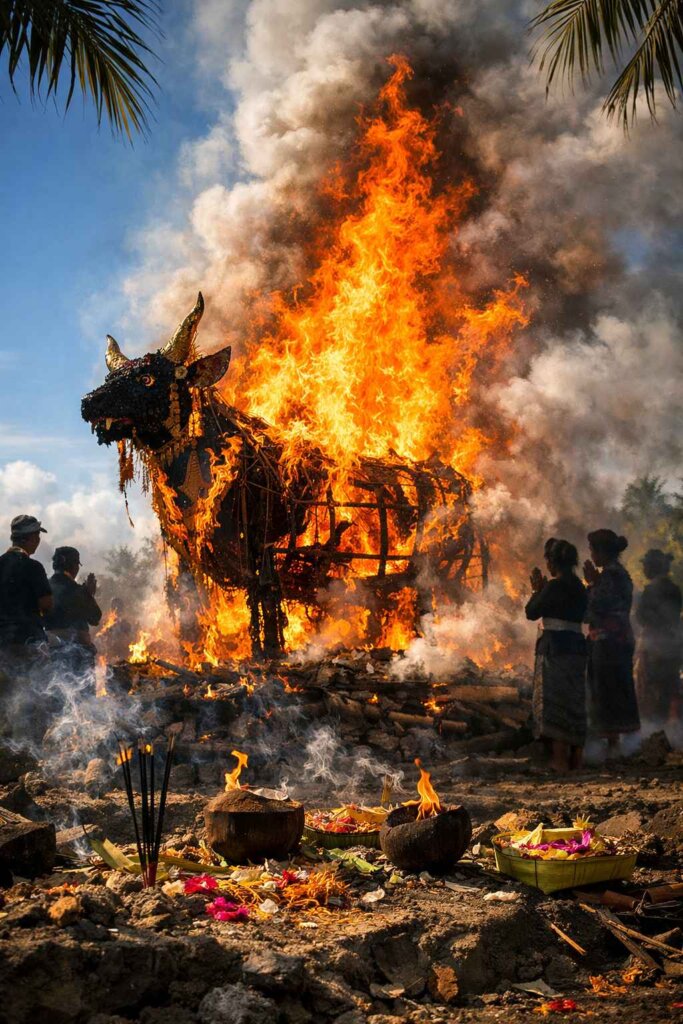
Balinese cremation ceremonies stand as testament to humanity’s capacity for transforming inevitable grief into transcendent beauty. When flames consume the Bade and Lembu, when Gamelan vibrations fade into tropical air, when ashes drift into ocean currents, the Balinese see not loss but successful completion.
The Ngaben ceremony in Bali teaches what modern cultures often forget: death deserves neither denial nor excessive sorrow, but rather mindful honoring. The elaborate rituals, staggering expenses, and community mobilization demonstrate that properly releasing the dead ranks among life’s highest responsibilities.
For Balinese people, these Hindu cremation rituals maintain cosmic balance. Unpurified souls disrupt harmony between earthly and divine realms. Proper cremation liberates spirits while strengthening family bonds, village cohesion, and cultural continuity across generations.
Whether you witness a simple Ngaben or spectacular royal Pelebon, you’re experiencing spiritual wisdom refined across millennia. The ceremony reveals that while bodies return to elements, love transcends physical forms, and community support carries us through life’s most challenging transitions.
As Bali navigates modernization’s pressures, traditional Balinese cremation persists with remarkable resilience. Young people still learn ancient prayers. Artisans still craft towers knowing they’ll burn within hours. Communities still rally to support grieving families. The eternal flame of Balinese funeral traditions continues illuminating humanity’s oldest questions about death, transformation, and what lies beyond.
Understanding Ngaben offers more than cultural knowledge, it provides alternative perspectives on mortality, community, beauty, and the sacred. In an age of increasing isolation, perhaps the greatest lesson from Balinese cremation ceremonies is simply this: we need not face life’s ultimate transition alone.
Major Balinese Hindu Holidays: Complete 2026 Festival Guide
Frequently Asked Questions About Balinese Cremation Ceremonies
What is the cremation ritual in Bali?
The cremation ritual in Bali, called Ngaben or Pitra Yadnya, is a Hindu ceremony that cremates the deceased to liberate their soul from physical form. The ritual involves elaborate processions with towering Bade structures, animal-shaped Lembu coffins, Gamelan music, and community participation. Fire purifies the body and releases the spirit for its journey toward Moksha or reincarnation. The complete process includes pre-cremation prayers, procession to the cremation ground, burning of the body, collection of ashes, and water ceremony to release remains into nature.
What to expect at a cremation ceremony?
Expect a vibrant, loud, celebratory atmosphere rather than somber mourning. You’ll witness hundreds of participants in colorful traditional dress carrying a multi-tiered tower while Gamelan orchestras create intense rhythmic music. The procession deliberately spins and takes chaotic routes to confuse the spirit. At the cremation ground, priests perform prayers while family circles the pyre. The burning itself generates significant heat and smoke. The entire event lasts 4-8 hours with continuous activity, music, and community participation. Bring water, wear appropriate clothing, and prepare for sensory intensity.
Can tourists attend Ngaben?
Yes, tourists can attend Ngaben ceremonies, but only with proper invitation or through respectful channels. Never crash ceremonies uninvited. Ethical access includes: hotel concierges with family connections, authorized cultural tour guides, personal Balinese friends who can introduce you, or publicly announced mass cremations. When attending, follow strict dress code (sarong, sash, modest coverage), maintain respectful behavior, ask permission before photographing, stay on ceremony periphery, and consider bringing a small monetary contribution in a white envelope as appreciation to the family.
How long does a cremation ceremony last?
A complete Ngaben ceremony lasts 3-7 days from initial rituals to final water ceremony. The main cremation day itself runs 6-10 hours: morning preparations (2-3 hours), procession to cremation ground (2-4 hours depending on distance and deliberate delays), cremation ritual and burning (3-4 hours), and immediate post-cremation prayers (1 hour). However, preparations may span months before the ceremony, and follow-up rituals like Patulangan (bone collection) occur 12 days later. The Nyekah deification ceremony may happen weeks, months, or years afterward.
Balinese cremation ceremony steps
Balinese cremation ceremony steps follow this sequence: (1) Body preparation, washing, wrapping in white cloth; (2) Temporary burial or storage until auspicious date; (3) Construction of Bade tower and Lembu coffin; (4) Purification rituals by priest on ceremony morning; (5) Transfer of body to Lembu atop Bade; (6) Grand procession with spinning, circuitous route to cremation ground; (7) Prayers and offerings at cemetery; (8) Transfer to pyre and ignition; (9) Complete burning; (10) Collection of ashes and bone fragments; (11) Patulangan—grinding bones 12 days later; (12) Water ceremony releasing ashes; (13) Optional Nyekah deification ritual.
When is Ngaben celebrated?
Ngaben is celebrated when multiple conditions align: (1) Auspicious dates according to Balinese Pawukon and Saka calendars determined by priest consultation; (2) Financial readiness of the family; (3) Practical timing during dry season (April-September preferred); (4) Completion of required preparation period (varies by individual circumstances). There’s no fixed annual date, each family determines timing based on these factors. Some families cremate within weeks of death if finances allow and calendars align; others wait years. Mass cremations (Ngaben Massal) occur when villages coordinate multiple families to share costs on pre-announced dates.
Ubud cremation ceremony 2026
Ubud cremation ceremony 2026 events will likely include both individual royal Pelebon and mass community Ngaben ceremonies. Ubud, as a cultural center with royal heritage, hosts spectacular cremations attracting international attention. To find 2026 ceremonies: contact Ubud tourism offices, consult with hotel concierges who have village connections, monitor Bali cultural event calendars, or work with authorized tour operators specializing in cultural experiences. Major royal cremations are announced months in advance and covered by international media. Respectful visitor attendance is generally welcome for publicly announced events, provided you follow proper dress code and etiquette.
Cremation ceremony Ubud
Cremation ceremony Ubud traditions reflect the town’s status as Bali’s cultural and artistic heart. Ubud ceremonies typically feature exceptionally elaborate Bade towers, highly skilled Gamelan musicians, and intricate artistic details in offerings and decorations. The royal family (puri) of Ubud conducts Pelebon ceremonies that draw thousands of observers. Even common Ngaben in Ubud often exceed other regions in artistic sophistication due to the concentration of artisans and cultural practitioners. Visitors interested in witnessing Balinese funeral traditions find Ubud ceremonies particularly accessible, well-organized, and culturally significant while still maintaining authentic spiritual practice.
Bali funeral traditions
Bali funeral traditions extend beyond cremation to encompass pre-death preparations, immediate post-death rituals, temporary burial practices, elaborate Ngaben ceremonies, and post-cremation ancestral veneration. Key elements include: belief that death represents transition rather than ending; responsibility of family to ensure proper rituals for soul liberation; community-based support through banjar system; temporary burial until auspicious cremation date (sometimes years later); spectacular cremation with Bade towers and Gamelan music; purification rituals by priests; return of ashes to water; elevation of ancestors to divine status (dewa pitara); ongoing shrine offerings to venerated ancestors. These traditions maintain unbroken connection between living and dead, past and present, earthly and divine realms.
Ngaben ceremony in Bali
The Ngaben ceremony in Bali represents the island’s most visually spectacular and spiritually significant ritual. Uniquely Balinese elements include the towering multi-tiered Bade structures (unlike cremation practices elsewhere in Hindu world), animal-shaped Lembu coffins, chaotic processions designed to disorient spirits, integration of indigenous animistic beliefs with Hindu philosophy, elaborate Gamelan orchestras, coconut-based offerings, community-wide participation through banjar system, and transformation of potentially sorrowful events into celebrations. While Hindu cremation occurs throughout India and South Asia, Bali’s version evolved distinctive characteristics reflecting 1,000+ years of cultural synthesis between Hindu traditions brought from Java and native Balinese practices.
Hindu cremation ceremony
Hindu cremation ceremony practices vary significantly between India, Nepal, Bali, and diaspora communities. Core similarities include belief in soul immortality and reincarnation, use of fire for purification, return of body elements to nature, and priest-led mantras. In India, cremation typically occurs within 24 hours at riverside ghats with simpler processions and immediate burning. Balinese adaptations include delayed cremation (sometimes years), elaborate towers and coffins, extensive community involvement, deliberate spirit confusion tactics, and integration with local animistic beliefs. Moksha in Balinese Hinduism emphasizes proper ritual performance and community support more than individual spiritual achievement, distinguishing it from Indian Hindu philosophical approaches while maintaining fundamental goal of soul liberation.
What Else People Want to Know: Related Topics
Readers interested in Balinese cremation ceremonies frequently explore these related subjects:
- Balinese Hindu Temple Ceremonies — Understanding odalan (temple anniversaries), galungan (ancestral visitations), and nyepi (silent day) rituals that form the broader ceremonial calendar surrounding Ngaben
- Gamelan Music and Balinese Arts — Exploring the musical traditions, instrument construction, and performance practices that provide the sonic landscape for cremation and other ceremonies
- Balinese Calendar Systems — Learning about the complex interplay of Pawukon (210-day) and Saka (lunar) calendars that determine auspicious dates for Ngaben and all major life events
- Hindu Philosophical Concepts — Deepening understanding of karma, dharma, samsara, and Moksha as they relate to Balinese interpretations and cremation practices
- Sustainable Tourism in Bali — Considering how respectful cultural engagement, including ceremony observation, can support rather than exploit Balinese communities and traditions